Only 5% to 8% of ads become true winners, so ad creative testing isn’t about choosing the prettiest execution. It’s a throughput and kill system that isolates one variable, collects enough conversion signal, and moves budget towards rare scalable concepts before fatigue or guesswork drains the account. Most tests fail because teams ship too few variants, change too much, or call winners early.
The obvious answer is to make more ads. That’s incomplete. More output without clean hypotheses, sample-size discipline, and ruthless pruning creates a larger pile of mediocre creative.
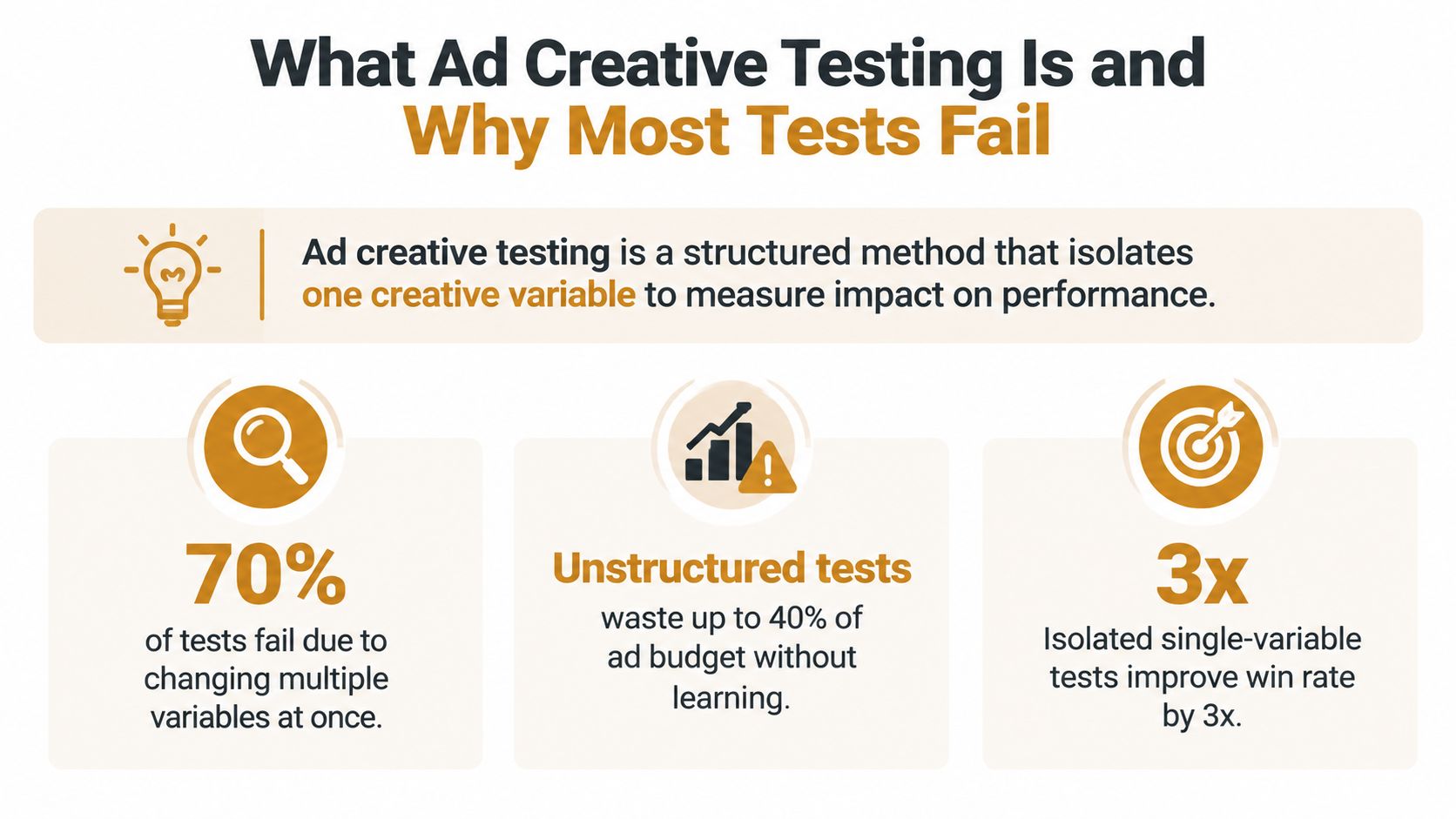
What Ad Creative Testing Is and Why Most Tests Fail
Ad creative testing is a structured method that isolates one creative variable to measure its effect on performance. The variable might be the hook, offer framing, opening visual, proof element, format, or call to action. The measurement should match the buying objective, such as CTR for attention, conversion rate for landing-page response, CPA for acquisition efficiency, or ROAS for commercial performance.
The uncomfortable maths comes first. Meta creative research summarised in 2026 reports that only about 5% to 8% of ads become true winners, while roughly 50% to 53% are switched off before 28 days. Only about 6% of total spend concentrates in winning creatives, although winning ads can capture about 55% of spend once the platform finds them. See the 2026 Meta creative testing benchmark for the underlying figures.
That gap explains why attractive creative doesn’t equal useful creative. A polished ad can win a subjective review and still lose the auction, the click, or the sale. A rough-looking concept can expose a message that scales because the audience understands it immediately.
Throughput beats attachment
Median advertisers ship 6 to 7 creatives per week, while top-spend accounts produce 12 to 19 or more weekly, according to the same Meta creative throughput research. That isn’t a creative vanity metric. It reflects the operating requirement created by low hit rates and rapid fatigue.
Teams that protect a favourite concept for too long usually confuse effort with evidence. Testing exists to find the rare winner quickly, not to prove that the founder’s preferred headline deserved the budget.
A workable account therefore needs three queues:
- New concepts: different customer problems, promises, demonstrations, or proof.
- Iterations: controlled changes to a promising concept, such as a new opening or shorter explanation.
- Retirements: ads removed because they failed the agreed bar or deteriorated after scaling.
Before debating creative quality, run a self-audit of your ad account. It often reveals that the problem isn’t a shortage of ideas. It’s that weak ads remain live long after the data has stopped justifying them.
How to Design a Test That Isolates Learning
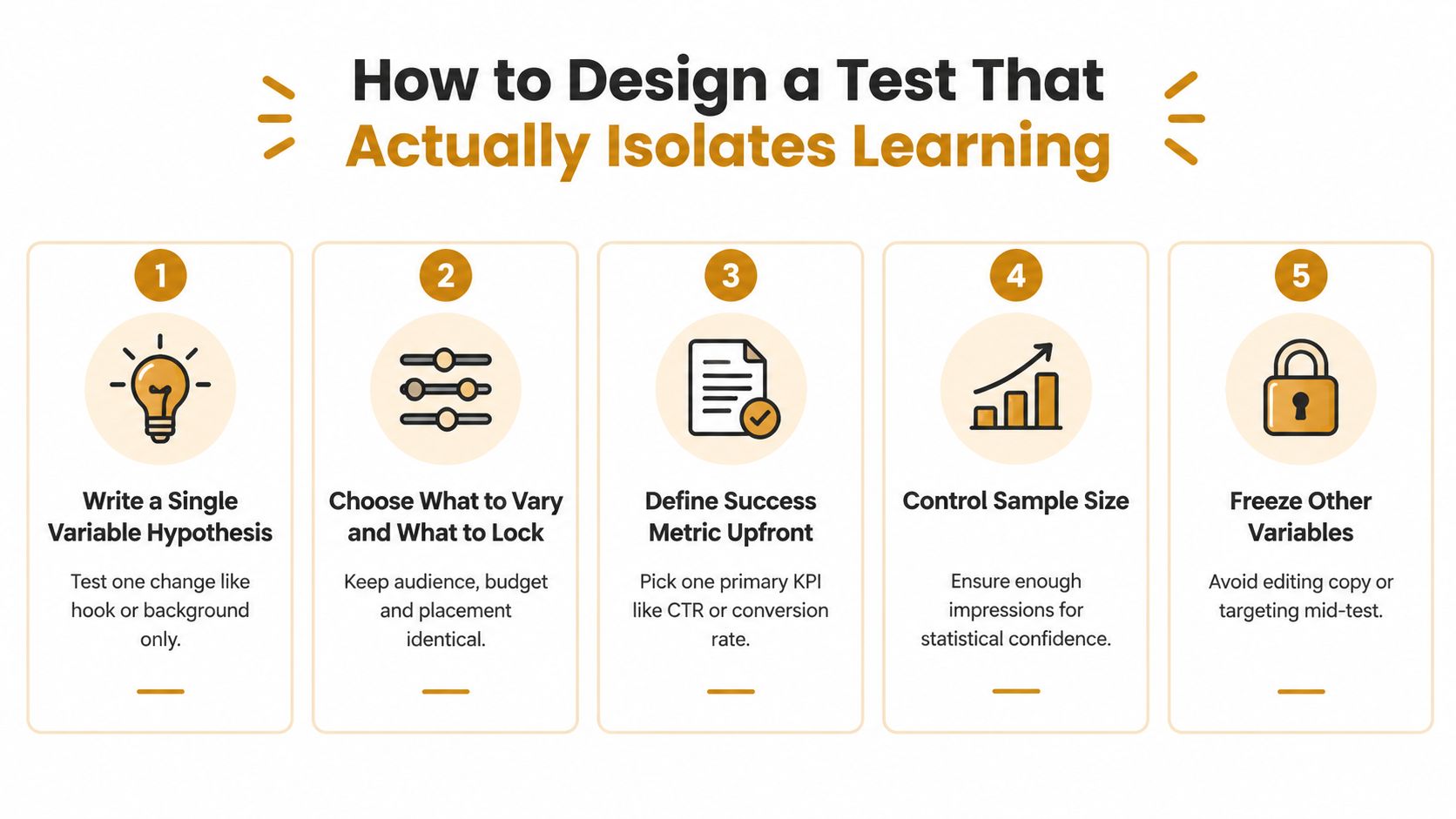
A test starts with one sentence: “Changing X should improve Y because Z.” If it names several creative changes, it is not a hypothesis. It is a bundle of guesses with no clear cause.
“Replacing the product montage with a customer demonstration should improve conversion rate because the demonstration makes the mechanism easier to understand” is testable. “Make the ad more engaging” is not.
Build the brief before the assets
Use 3 to 5 creative variants under identical conditions. The ad creative testing workflow recommends a single-variable hypothesis, a controlled variant set, and a defined measurement window. Baseline conversion rate and minimum detectable effect should determine the sample required, rather than an arbitrary testing period.
Write the brief in five fields:
- Hypothesis: one change and one reason.
- Variable: hook, visual, offer, proof, format, or copy.
- Controls: audience, budget, placement, landing page, bid approach, and attribution settings.
- Primary KPI: one metric that decides the test.
- Decision rule: the evidence required to keep, iterate, or kill.
Set the kill threshold before launch. A variant that fails to reach the required sample within the planned runtime should not receive more budget by default. A clear bar turns testing into a throughput system: ship, measure, kill, and replace. Keep winners live only while they hold the target KPI, then schedule a replacement before fatigue becomes the explanation for falling performance.
Hold the audience and offer constant when testing a hook. Hold the hook constant when testing a product demonstration. A new visual, promise, landing page, and audience in one round produce a result, not a usable creative insight.
Separate concepts from executions
A concept test asks whether the underlying angle works. An execution test asks whether a particular delivery improves an existing angle. They answer different questions.
If a “problem-aware” concept loses, changing its background colour will not rescue the learning. If the concept wins, test the opening frame, presenter, pacing, or proof format. Each result should determine the next production brief.
[[C11-OPTIN]]
Use the single-variable brief to keep creative changes traceable.
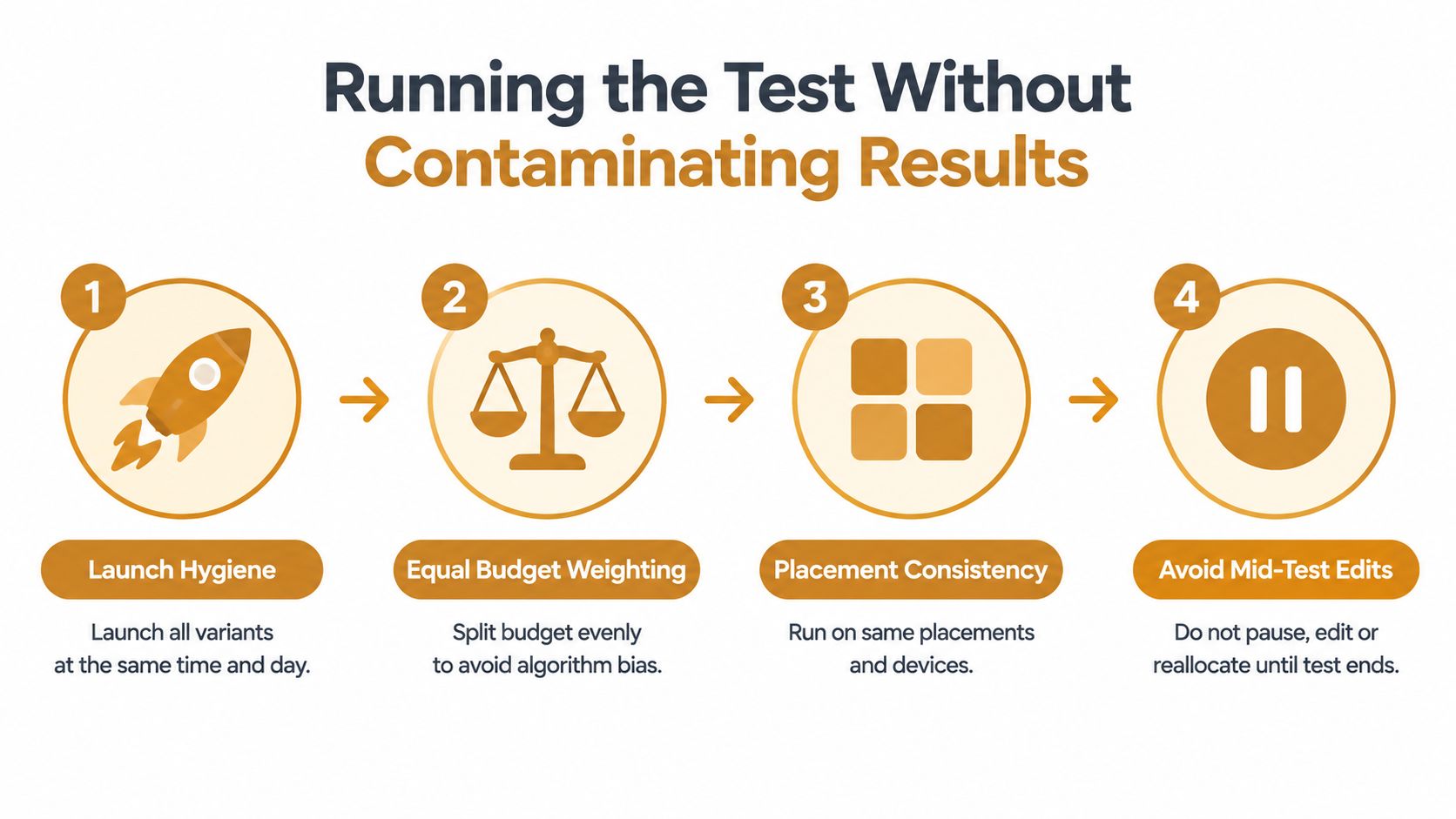
Running the Test Without Contaminating Results
Clean launches matter more than clever post-launch commentary. Launch all variants at the same time, give them comparable budget access, keep placements consistent, and freeze edits until the agreed test window ends.
Lock the launch conditions
Use the same audience definition, conversion event, landing page, placement set, device environment, and optimisation objective wherever the platform permits. Unequal delivery can create an apparent creative winner before the test has collected comparable evidence.
Google’s official responsive search ads guidance makes the same structural point from another angle. Assets may appear in any order, so each headline and description must make sense independently and in combination. Google also permits up to 2 unused RSA headlines to serve as link-based assets pointing to the same final URL domain, as described in its responsive search asset guidance.
Don’t edit copy halfway through. Don’t pause a weak variant because it looks embarrassing after a morning. Don’t move budget towards the early leader because the dashboard feels persuasive. Those actions contaminate the comparison and turn an experiment into platform-driven allocation.
Set a data bar before launch
Many practical frameworks recommend 95% confidence, 80% power, a 7 to 14 day minimum runtime, and roughly 50 to 100 conversions per variant before declaring a winner, as documented in this ad creative testing methodology. These are operating thresholds, not decoration.
Sample size depends on the baseline conversion rate and the minimum detectable effect. A small expected improvement demands substantially more traffic. One framework estimates that detecting a 20% improvement in a low-conversion environment can require around 5,000 visitors per variant at 95% confidence, which is why small accounts shouldn’t pretend to measure tiny lifts precisely.
Three common errors produce false winners:
- Premature calls: deciding after a few days or a handful of conversions.
- Variable overload: changing the hook, offer, format, and audience together.
- Underpowered tests: treating noisy directional data as a proven result.
Record the launch date, spend, impressions, clicks, conversions, and edits in one change log. A later result is only useful if you know what happened during the test.
An account review should also check delivery, tracking, and structural contamination, not just the ad thumbnails. The creative and account audit checklist is useful for that diagnostic pass.
How to Evaluate Winners Losers and What to Do Next
Most creatives won’t win. The decision system should therefore make killing easy and scaling selective.
A winner needs enough conversion volume and a meaningful difference, not merely the best-looking column in a short reporting window. Practitioner guidance commonly uses 95% confidence and at least 50 conversions per variant as a practical floor, while smaller effects can require far more signal. Historical testing summaries note that detecting a 20% difference may require about 50 conversions per variant, a 10% difference about 200, and a 5% difference 800 or more per variant. Those figures are discussed in this creative testing sample-size reference.
Keep, kill, or iterate
| Signal | Keep and scale | Iterate concept | Kill and replace |
|---|---|---|---|
| Evidence | Meets the pre-set confidence and conversion bar | Direction is promising but evidence is incomplete | Fails the primary KPI after a fair test |
| Performance | Meaningful improvement in CPA, conversion rate, or ROAS | One useful signal, such as stronger CTR but weak conversion rate | Weak primary KPI with no credible downstream support |
| Action | Increase exposure gradually and protect the concept | Change one execution variable | Remove spend and write a new hypothesis |
Here’s the maths with named inputs. Suppose Variant A spends £1,200 over 14 days and produces 60 conversions. Its CPA is £1,200 ÷ 60 = £20. Variant B spends £1,200 over the same 14 days and produces 48 conversions, giving £25 CPA. The observed difference is £5 per conversion, but you still need the agreed confidence and sample-size bar before treating the gap as a durable winner.
The calculation tells you what happened. It doesn’t tell you why. If A wins on CPA but loses on lead quality or contribution margin, scaling it can make the account less profitable while the platform reports success.
Don’t rescue middling ads forever
Large-scale Meta creative data reports that mid-range creatives can absorb 38% to 46% of output without becoming winners, while losers can still account for about 17% of spend. The 2026 creative benchmark supports a blunt conclusion: pruning matters as much as production.
For a promising concept, iterate the weakest link. Strong CTR with poor conversion rate points towards message-to-page mismatch, weak qualification, or an offer problem. Weak CTR means the audience isn’t stopping, so changing the landing page first is usually theatre.
A repeatable creative testing engine earns its keep. The system should preserve the winning idea, document the evidence, and create the next controlled variation rather than restarting from a blank page.
When to Refresh Creative Before Fatigue Eats ROAS
Creative fatigue is a replacement problem, not a mood. Watch several signals together, then act before a winner becomes an expensive control.
An independent 2026 benchmark covering 368 creatives reported a 5.5% CTR decline within the first 250,000 impressions and a 19.6% CPA increase by the 500,000 to 1 million impression range. The Meta creative fatigue benchmark gives those figures a useful operational scale.

Use compound triggers
A 2026 best-practice framework recommends treating fatigue as a compound signal:
- Frequency above 3.5 in a 7-day window.
- Engagement rate more than 25% below the ad’s first-week baseline.
- Cost per result more than 30% above the same baseline.
When two of the three signals align, the guidance recommends replacement within 72 hours. See the Meta fatigue replacement thresholds for the complete framework.
Don’t kill a profitable ad because one metric wobbled. Don’t keep it live because ROAS still looks acceptable while frequency climbs and engagement collapses. Use the signals together, then launch the next concept before reallocating heavily.
Run a weekly rotation
Monday is for identifying fatigue and confirming the kill queue. Midweek is for shipping new concepts and controlled iterations. The end of the week is for checking whether replacements earned enough delivery to justify more time.
Production should match account spend and fatigue exposure. Median advertisers ship 6 to 7 creatives weekly, while top-spend accounts produce 12 to 19 or more, according to the Meta creative throughput benchmark. The right volume isn’t a universal quota. It’s the amount needed to keep the test queue full without lowering the evidence standard.
Our creative fatigue production maths turns that rotation into a calendar rather than a last-minute scramble.
How to Test AI Generated Creative Without Creating False Winners
AI-assisted production is useful when the bottleneck is variation. It becomes dangerous when teams mistake cheap output for valid learning.
Recent data reports that AI-generated image variations can lift CTR by 11% and conversion rate by 7.6%, while AI text variations can lift CTR by 3%, according to this AI creative testing summary. Those platform-level gains don’t answer whether customers retain, leads qualify, or contribution margin improves.
Separate speed from business value
Use AI to produce controlled variations around a proven concept, such as alternate openings, crops, backgrounds, or concise copy. Keep human judgement on the proposition, proof, compliance, brand context, and audience tension. A machine can generate a visually different ad without generating a better reason to buy.
Run an AI holdout against manually produced variants under the same audience, budget, placement, runtime, and primary KPI. Add downstream checks for retention, lead quality, refund behaviour, sales quality, or contribution margin where the business model requires them.
Practical rule: A higher CTR is a signal to investigate, not permission to scale.
Our AI creative testing notes cover the production implications. Crank11 uses scored creative production to increase variation speed, but the score doesn’t replace live evidence or commercial measurement.
[[C11-OPTIN]]
Get the AI holdout checklist for separating faster asset production from genuine downstream improvement.
Quick answers
What is the best number of creatives for a test?
Start with 3 to 5 variants built around one hypothesis. More variants can dilute delivery and make interpretation harder unless the account has enough traffic and conversion volume.
How long should an ad creative test run?
Use 7 to 14 days minimum as a practical starting point, then wait for the required conversion and confidence threshold. Calendar time alone doesn’t make an underpowered test valid.
Should I test one variable at a time?
Yes, for diagnostic learning. Change one meaningful variable while holding audience, offer, placement, budget, landing page, and optimisation event steady.
When should I kill an ad?
Kill it after a fair test when it fails the pre-set primary KPI and lacks a credible downstream signal. Don’t kill it solely because it loses an early, underpowered comparison.
How should I test AI-generated ads?
Compare AI-assisted and human-produced variants under identical conditions, then judge downstream quality as well as CTR, conversion rate, CPA, and ROAS.
Tomorrow morning, audit the live queue, assign every creative to keep, iterate, or kill, and write one hypothesis for the next batch. Use the Crank11 creative testing playbook to turn that decision into a repeatable production and measurement cycle.