Creative testing services are the operating system for paid social at scale. They find the few ads that win, retire the rest fast, and keep the account from drowning in stale creative. As of 2026, only 4% to 8% of Meta ads became winners in a benchmark covering 578,750 ads and $1.29 billion in spend, so the job is not inspiration, it’s ruthless portfolio management.
The obvious answer is wrong because this is not about “making better ads” in the abstract. It’s about shipping enough variants, measuring them cleanly, and killing losers before they eat the account alive.
Creative testing services are a production and decision system that generates ad hypotheses, builds variants, runs controlled tests, and promotes winners into scaling campaigns. The service earns its keep by replacing guesswork with a repeatable cadence.
What Creative Testing Services Do
Creative testing services are the operating system for paid creative at scale. They set the test plan, produce variants, read the results, and move winning ads into spend while the rest get cut. That is the job. If the team cannot make fast retirement calls, it is just paying for opinions.
As of 2026, the benchmark is ugly. One analysis of 578,750 ads and $1.29 billion in spend found only 4% to 8% of Meta ads became winners, while roughly 50% to 53% were turned off before 28 days (AdLift benchmark, 2026). The same benchmark said median advertisers shipped 6 to 7 creatives per week, while top-spend accounts shipped 12 to 19+ per week. That gap is the math of under-testing. If you ship too little, you run out of fresh shots at finding a winner.
What gets done, in practice
A serious testing service handles the unglamorous work brands usually skip while calling it strategy. It writes the hypothesis, briefs the concept, produces the assets, sets the test cell, watches the numbers, and pushes the winner into the main account.
Practical rule: if the service does not force retirement decisions, it is not testing, it is collecting opinions.
The replacement cadence matters because fatigue hits fast. Practitioner coverage cites fatigue research showing conversion likelihood drops by about 45% at four repeated exposures, mean exposure depth is 4.2, and more than 19% of impressions are shown five or more times to the same user in a 30-day window (Leadenforce, 2025). That is why testing services are really replacement systems. New output goes in, tired output comes out.
| Creative Testing Benchmarks by Account Maturity | Monthly Tests | Hit Rate | Avg Creative Lifespan | ROAS Stability |
|---|---|---|---|---|
| Early testing | Fewer than 20 | Low and inconsistent | Short | Slips as fatigue builds |
| Growth-stage testing | 20 to 40 | Directionally useful | Moderate | More stable, still noisy |
| High-velocity testing | 40+ | Better winner discovery | Short to managed | More resilient under scale |
A weekly testing rhythm is one of the few patterns that compounds learning. Independent guidance recommends launches every Monday and Thursday, with review points at 24, 48 and 72 hours, then a Friday Kill, Scale or Iterate decision (Jeremy Haynes, LinkedIn, 2025). That cadence beats the usual “refresh when performance dips” routine, which is how accounts go stale.
If you want a blunt standard, judge throughput. If a team is not replacing a meaningful share of active creative each week, the account is ageing in place. Crank11’s lab exists for this kind of production and decision workflow.
The Three Testing Methodologies That Work at Scale
Most creative teams do not lose on ideas, they lose on throughput and timing. The workable systems split the job three ways. Batch testing finds usable winners quickly, multivariate testing shows which element carried the result, and phased rotation keeps scaling campaigns from getting stale.
Batch testing
Batch testing is the main production line. You launch 5 to 10 fresh creatives into equal-spend cells, let them compete, then move the top 1 to 2 into scale. It suits teams that need steady weekly output and do not need to pretend every test is a laboratory paper.
The value is speed. Batch testing tells you which concept has real pull without stretching the experiment until early noise gets mistaken for truth. As of 2026, Meta’s experiment framework treats a creative A/B test as statistically actionable at 65% confidence, while lift and holdout tests need 90% (Digital Applied, 2026). That spread matters because batch tests are for decision-making, not courtroom-level proof.
Multivariate testing
Multivariate testing is for diagnosis. You hold one variable steady, hook, CTA, visual style, or format, and see which piece moved the result. It takes discipline, cleaner tagging, and more patience, but the insight travels well.
Use it once the account already has a strong concept and the key question is which part deserves to survive. Change six things at once and you learn very little. That is not strategy. That is confetti.
Test one thing if you want a clear answer. Test six things if you want excuses.
Phased rotation
Phased rotation is the pressure valve. New creatives enter live ad sets with a small budget share, just enough to measure incremental lift without breaking the current scale structure. Mature accounts need this because swapping out proven performers for shiny untested work is how spend gets burned for no gain.
For creative testing services, the method should match the business problem. Fresh winners call for batch testing. Clear diagnosis calls for multivariate work. Scale protection calls for phased rotation. The right operating system is the one that keeps replacement cadence high enough to avoid creative fatigue without flooding the account with weak cells.
A practical rule is to keep a small test budget, then force decisions fast. If a cell is not learning, it is burning. Crank11’s engine is built around that kind of high-frequency test loop.
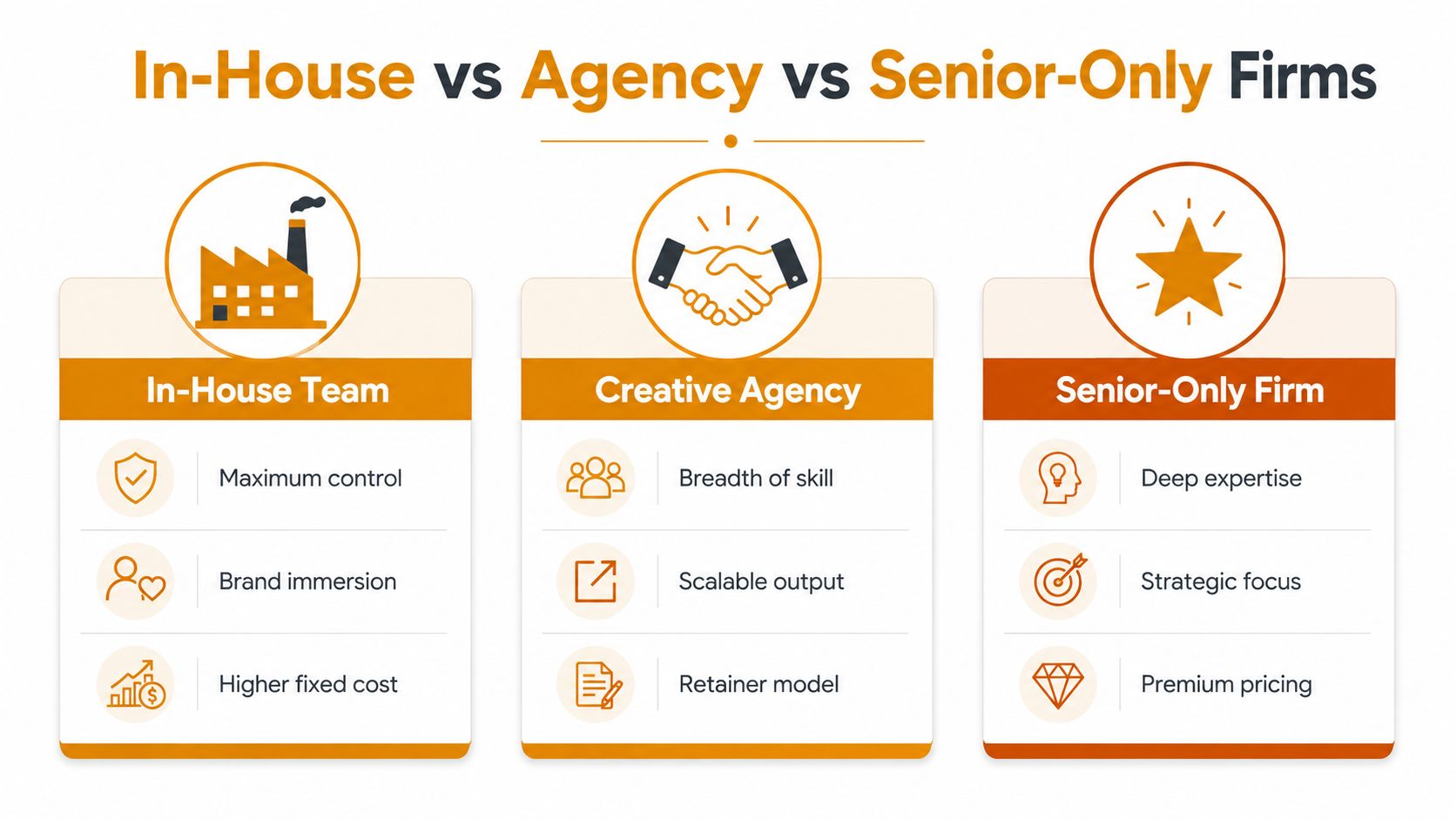
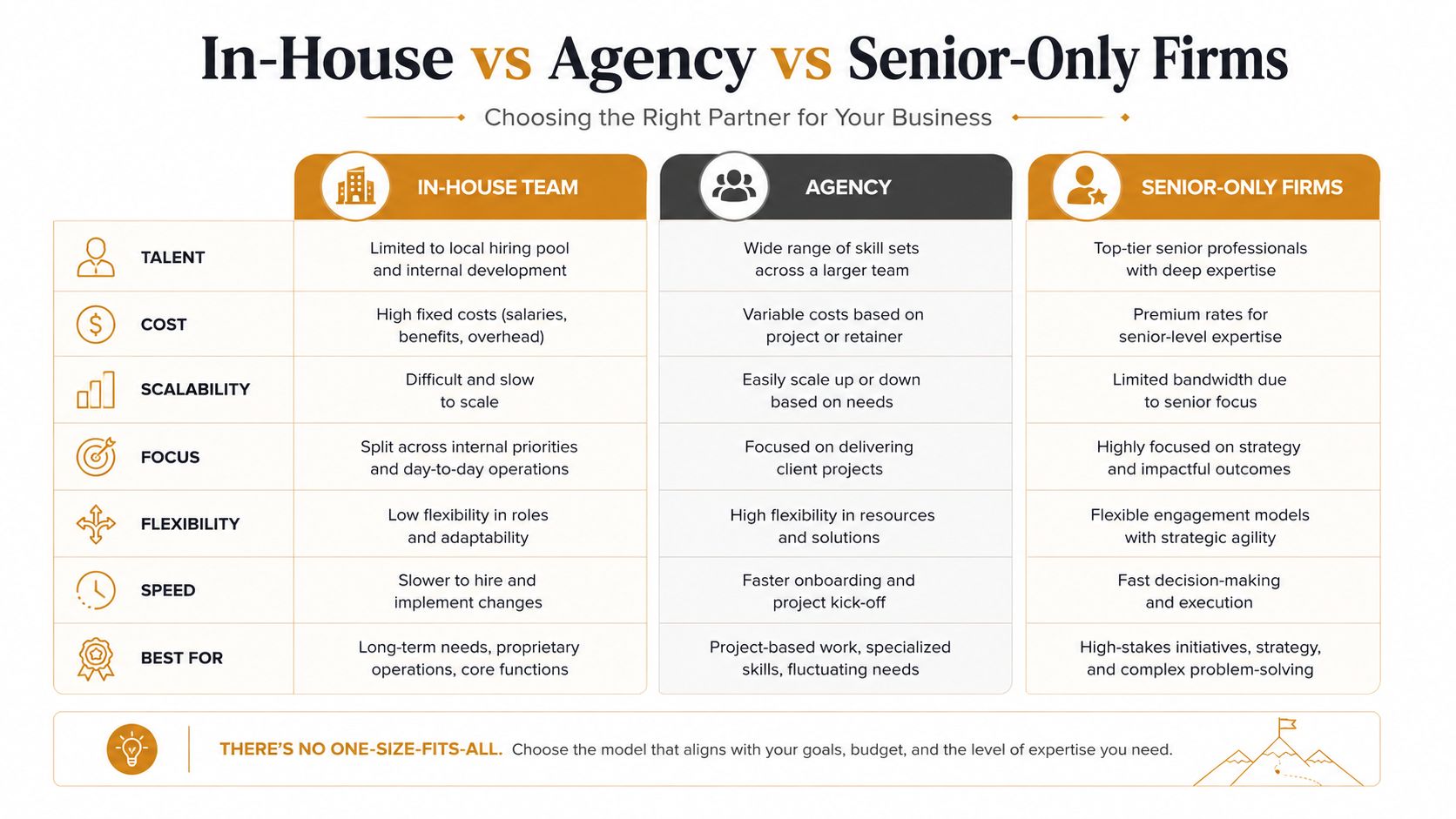
In-House vs Agency vs Senior-Only Firms
The cheapest option on paper usually gets expensive in practice. The issue is not whether a team can make ads. It is whether it can ship enough tests, read them properly, and keep the account from becoming a landfill of half-finished ideas.
In-house teams buy control and brand immersion, but they also carry fixed payroll and internal politics. Traditional agencies can add breadth, yet testing often gets buried under media management and client service. Senior-only firms sit in a narrower lane, but they are built for testing volume and faster decisions.
The actual cost pattern
The maths is straightforward. An in-house setup usually means strategist, designer, media buyer, and analyst on salary, plus management overhead that shows up whether you planned for it or not. Agencies usually bundle testing into broader retainers and take a cut of spend. Senior-only firms charge for decision quality, not headcount fluff.
Practical rule: if the vendor cannot tell you how many new concepts they can ship per week, they are probably not a testing operator.
A useful decision filter starts here.
- Account size. If paid spend is meaningful and creative is the bottleneck, testing needs its own rhythm.
- Production capacity. If the team cannot produce fresh variants weekly, the account will stagnate.
- Internal expertise. If nobody can design a proper test cell, analysis gets muddy.
- Risk tolerance. If the brand cannot afford noisy experiments, it needs tighter governance.
As a working benchmark, independent guidance says to replace 20 to 30 percent of the active creative portfolio each week (Gaasly, 2025). That is a decent reality check for how much motion the system needs.
The agency versus in-house cost maths usually comes down to one question. Who can keep test volume high enough to produce winners without bloating the team? Crank11 runs as a senior-only model, which matters because testing breaks when too many hands touch the thing. The more layers between hypothesis and launch, the more the account turns polite and unprofitable.
KPIs and Measurement That Separate Signal from Noise
CTR is not the prize. It is a symptom. If a testing vendor keeps waving CTR around while revenue tells a different story, the account is being dressed up for a meeting, not run for profit.
A proper measurement stack starts with ROAS lift, then checks whether the result clears the confidence threshold you are using. The main point is simple, creative selection and incrementality are different decisions. If you blur them, you end up calling noise a winner and spending real budget on wishful thinking.
A simple KPI framework
| Creative Testing KPI Framework | Benchmark | What It Tells You | Red Flag |
|---|---|---|---|
| ROAS lift | Directional or causal, depending on test design | Whether the new creative is consistently better | Claiming lift without the right test type |
| Win rate | Healthy around 15% to 20% by operator judgement | Whether the account is generating real winners | Winners are rare or none ever ship |
| Incremental spend capacity | How much budget a winner can absorb before fatigue | Whether scale is real or fragile | A creative dies the moment spend rises |
| Hook rate | Early engagement quality | Whether the opening earns attention | High CTR with weak downstream conversion |
| Conversion rate | Outcome quality | Whether clicks become cash | Optimising for traffic that does not buy |
A quick worked example makes this less fluffy. If an account spends £50,000 per month and testing lifts ROAS by 12%, that creates an efficiency gain on the whole media base. If the service costs £4,000 per month, the margin to pay for it is obvious very quickly. You do not need spreadsheet theatre to see the point, you need to stop paying for under-tested accounts.
A testing service should also show clean sample logic. A widely used A/B approach calculates per-variant traffic from baseline conversion rate, desired detectable lift, confidence level and statistical power, then rounds duration up to a full week and uses a 14-day floor to avoid underpowered tests (Wameq, 2025). That is why good operators are not obsessed with “winning” on day one. They are obsessed with not lying to themselves.
Do not let vanity metrics run the room. Pretty comments, strong CTR and enthusiastic internal Slack messages do not pay invoices. If you want a hard look at the account itself, audit your own ad account and find where measurement got lazy.
A Weekly Testing Calendar You Can Run Tomorrow
The cleanest creative systems are boring in the best possible way. They repeat the same rhythm every week, so the team spends less time debating process and more time producing ads that either win or get binned.
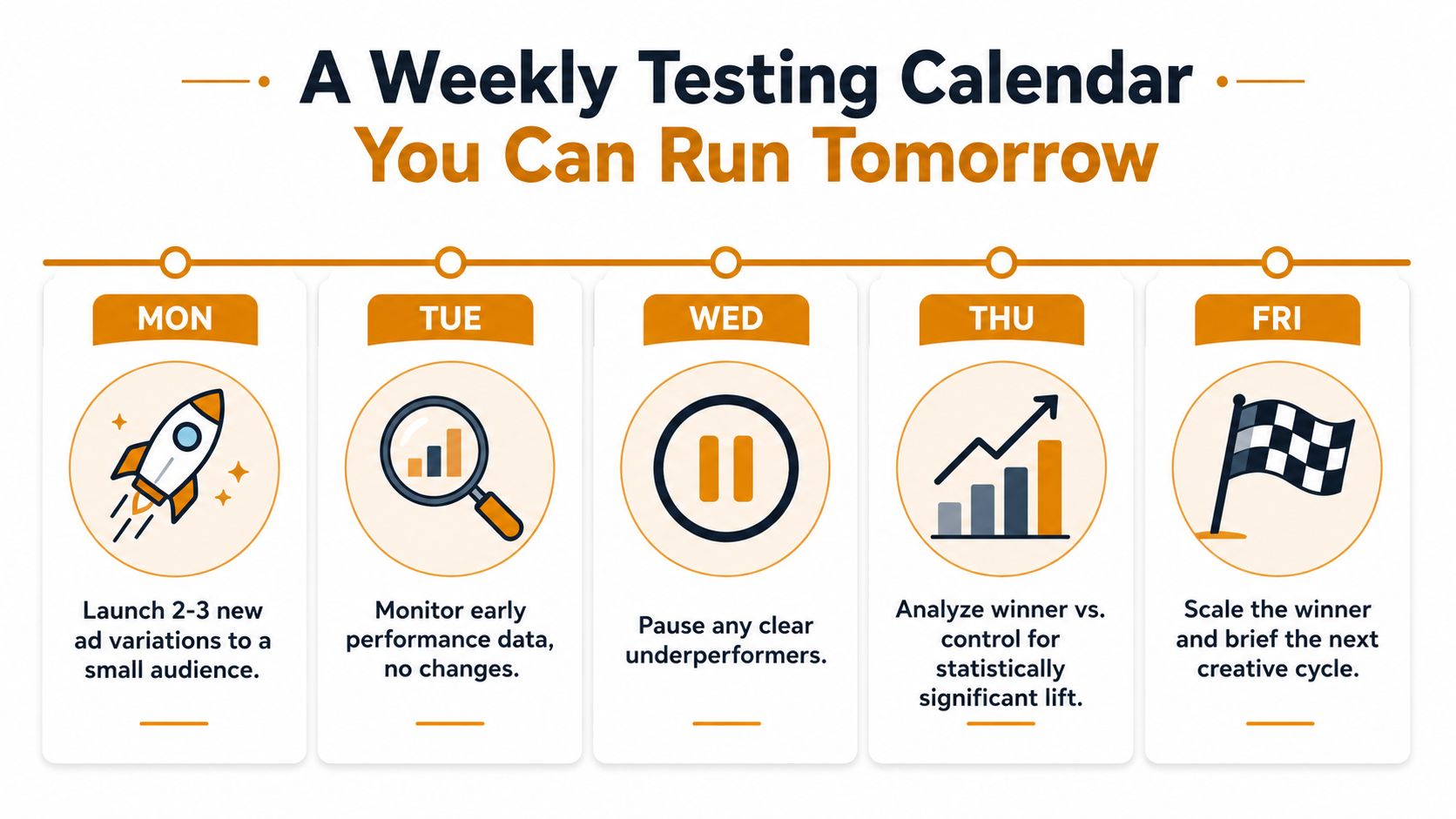
The Monday to Friday loop
Monday is for hypothesis selection. Pick the problem, write the angle, and brief the concept based on last week’s outcomes. Tuesday and Wednesday are for production and QA, with no cleverness and no last-minute brand committee rewrites.
Thursday is launch day. The test batch goes live in a dedicated cell, with budgets capped so the account doesn’t confuse exploratory spend with scale spend. Friday is decision day, where the team classifies each creative as Kill, Scale or Iterate.
Practical rule: if the decision meeting can’t end with a verdict, the test was too vague.
For larger accounts, the minimum viable volume is usually 8 to 12 new creatives per week. That keeps the pipeline fresh enough to find the outliers without turning the team into a burnout machine. It also stops the common disaster where creative becomes a monthly event instead of a weekly system.
Governance matters as much as speed. Someone owns the backlog. Someone signs off the hypothesis. Someone decides what ships. Without that, creative teams tend to pick the safe idea, media buyers tend to protect the current winner, and the account slowly goes stale.
A workable RACI is simple. Creative owns production, media owns test structure, growth owns prioritisation, and one senior operator signs off the final call. If nobody owns retirement, losers linger. That’s how budgets disappear in plain sight.
What Most Brands Get Wrong About Creative Testing
Most brands do not underperform because they lack ideas. They underperform because they confuse occasional experiments with a testing system. The account can feel that difference in the hit rate.
The first excuse is, “we test all the time.” Usually that means landing page tweaks and a few headline swaps. Real creative testing is a repeatable pipeline of fresh concepts, not two safe variants and a hope for the best. The second excuse is, “our creative team already knows what works.” If that were true, stale ads would not keep eating spend and the market-wide hit rate would not stay so low.
The third excuse is, “testing is too expensive.” Under-testing is the expensive move. It leaves winning concepts undiscovered, keeps weak ads live too long, and forces the media team to carry tired inventory longer than it should. As noted earlier, fatigue sets in fast, so every week without fresh replacements is another week of paying for ads that have already stopped pulling their weight.
Our note on creative fatigue and production maths gets into the replacement problem most operators sidestep. If the account does not keep a steady flow of new creative, the rest of the marketing stack starts compensating for a very ordinary failure.
Quick answers
What do creative testing services deliver?
They produce new ad variants, test them in controlled cells, analyse the results, and push winners into scaling campaigns. The point is not more content. The point is better decisions, faster.
How many creatives should a serious account test each week?
As of 2026, benchmarks point to 6 to 7 creatives per week for median advertisers and 12 to 19+ for top-spend accounts (AdLift, 2026). If you’re spending meaningfully on paid social, low volume usually means slow learning.
When should a winner be promoted?
When the test has enough signal to make the creative decision, not when the team is emotionally attached to it. Meta’s creative tests can be actionable at 65% confidence as of 2026, while incrementality claims need stricter proof (Digital Applied, 2026).
What’s the biggest mistake brands make?
They confuse sporadic A/B tests with a continuous testing system. That leads to stale creative, weak learning, and too much spend sitting on ads that should’ve been retired.
How do I know if my testing setup is too weak?
If winners are rare, launches are irregular, or nobody can explain the retirement rule, it’s too weak. If the account isn’t replacing a meaningful share of creative each week, it’s drifting.
[[C11-OPTIN]]
What to do tomorrow morning, brief three fresh concepts, set a weekly launch cadence, and kill anything that can’t justify its spend. If you want the operator playbook that keeps this from turning into guesswork, Crank 11 is built around senior-only creative testing, media and CRO.