The last public update on this site was written in May, when 500k.io was a solo experiment. Four months later it publishes under CRANK 11, sells six services, and most of the work below was done by systems we built rather than by us at a keyboard. This is the list. No client names anywhere: where a number belongs to a client account, it says so, and the account stays anonymous.
May: the content engine finds its rhythm
Thirty articles scheduled in one pass. On 15 May the pipeline drafted thirty articles at once and spread them over sixteen days, every one held to the voice rules in our editorial bible. Thirty hero images were generated the same day. The lesson was not about volume. It was that a queue of finished, dated drafts changes how you think about publishing: the site stops depending on whether anyone had a good morning.
The first Meta Ads playbook. A bonus article on the acquisition funnel we run for paid social, with the MCP tooling behind it. It is the seed of what became the services section in September.
June: the writer and the newsletter get automated
A skill that writes the article. We packaged the whole method (research, plan, write, refine, finalise) into one reusable skill, so a target keyword goes in and a publication-ready draft comes out in the house structure: an experiment-led intro, a unique data angle, a how-to, and a decision at the end.
A five-day newsletter loop. Generate on Monday, email the draft to us, review in the inbox, send. The human step is a reply. Nothing else moved without it, which is still the rule for everything on this list.
July: the pillars and the reporting
Three pillar pages. Long guides on Claude Code, AI SEO, and Claude for business, each wired as a hub above its cluster of shorter articles. Internal linking stopped being something we remembered to do.
Bing wired into every build. Each deploy now submits changed URLs to Bing and IndexNow, which also feeds ChatGPT search and Perplexity. One command produces the weekly snapshot across Google Search Console, Bing and analytics.
Eleven editorial hero images for the pillar cluster, the last set we made in the old light palette.
August: CRANK 11 enters the graph
The founding essay and the entity work. CRANK 11 went into the site’s structured data as its own organisation, with a shared founder node, so an AI search engine asking “what else does Maxime run” gets one consistent answer. The essay on why a solo builder started a second company with a co-founder went up the same night.
Two doors into CRANK 11. A short link to the Blueprint offer and an indexable bridge page for the free playbooks, both with tracked links, so a reader of this site can cross to the other without guessing.
September: the funnels, the rebrand, the engine
The ChatGPT Ads Launch Kit funnel. A complete low-ticket funnel on 500k.io: a readiness quiz that fits one screen, a sales page mirrored section for section on the CRANK 11 Blueprint page, checkout, four upsells and a downsell, a welcome page that recaps what was bought. It runs in a demo mode so the whole path can be walked before payments are switched on. The ChatGPT Ads pixel and the server-side Conversions API were wired and then verified against the live endpoint, which caught two contract errors that would have silently dropped every purchase event. Two ChatGPT Ads campaigns are built and paused, waiting for payments.
The playbook squeeze page. A ChatGPT Ads performance playbook as a PDF, with its own opt-in and email.
Outrank publishes straight into the journal. A webhook receives each article, checks the token, maps it onto our content schema, strips the duplicate table of contents, commits it to the repository, and the deploy pipeline does the rest. Nine articles on ROAS benchmarks, creative testing, CRO audits and acquisition cost arrived through it in the first week. Our own test clicks published a placeholder article three times before the guard learned to recognise them. It was live for under an hour.
500k.io by CRANK 11. On 5 September the site moved to the CRANK 11 identity: near-black, gold, Instrument Serif and Inter Tight, a “by CRANK 11” lockup in the header and footer, the organisation set as the parent in the structured data. The home became a sales page for cold traffic: proof first (the $100,380 Shopify day, unedited), the founder’s night shift, six service lanes, how the engine runs, who is behind it, one free offer. Six service pages, a free audit form that feeds Beehiiv and the CRM, and an About page with both founders and their letters. The target was restated as $500K MRR, and the dashboard now measures against it honestly: 1.9 % on the day the page went live.
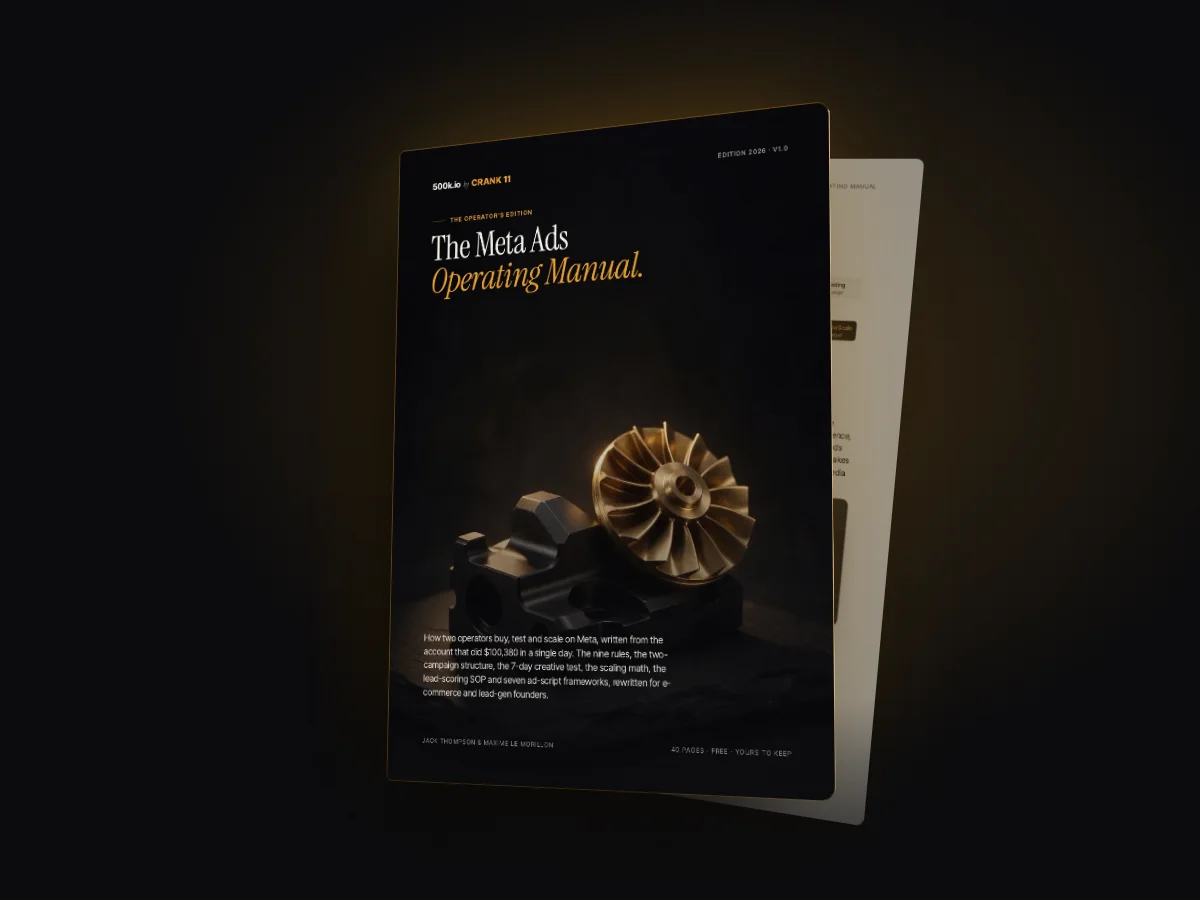
The Meta Ads page and the creative wall. Seventy-two of our own ads, own brands and concept studies, scrolling on the page, and the anonymised lead-generation case: a senior health-insurance account in France taken from $24.03 to $4.95 per lead, 35,807 leads, a sales team boosted from five to fifteen to keep up (real client account, identity withheld under a confidentiality agreement, Meta Ads reporting, billed in EUR and shown in USD at July 2026 rates).
The dream company, measured. A gauge on the home page: 72 % of our own operation runs on systems today, target 100 %, founders’ own estimate. Ads drafted and scored, research and reports written before we read them, follow-ups and quotes queued. The last 28 % is building more tools, reviewing every AI output before it ships, and the judgment calls.
The Skills Bank, rebuilt for business. From 646 to 1,200 active skills, 5,968 candidates screened across GitHub, 92 entries retired because their repository vanished or was archived. Each skill now carries a transparent score (business usefulness, traction, recency, quality, trending), a use-for tag, live star counts, and a one-command install behind a click.
Behind the site. A forty-email nurture sequence built on the books we operate from. Mockups for every lead magnet and a fix for one whose PDF never reached the reader. Six custom fields in Beehiiv so every subscriber carries their lead magnet and audit answers. A first back office for the two of us: the CRM, search rankings per article, audience numbers, waiting on its database keys.
What it taught us
Most of the four months was spent on the parts a visitor never sees: verification against live endpoints, guards against our own test clicks, honest labels on every number. Every time we skipped one of those, it cost a day. Every time we kept one, it caught something.
The public numbers stay on the dashboard, updated as they move. The next note will be shorter, because the engine will have written most of it.
Jack & Max