
Facebook ads rarely fail for one reason. The campaign is usually under-delivering, creative-fatigued, or under-reporting conversions, and each failure needs a different fix. In 2021, Apple’s tracking changes pushed Meta from broader attribution windows towards shorter defaults such as 7-day click, while consent opt-outs removed many deterministic conversion signals.
That’s why “why are my Facebook ads not working” is often the wrong diagnosis. A rising CPA can mean an auction problem, exhausted creative, or a reporting gap. We diagnose those in that order, because changing ads on broken data is just expensive guesswork.
Why Most Diagnoses Miss the Actual Problem
“Facebook ads stopped working” is not a diagnosis. It describes three separate failure modes: delivery, creative exhaustion, and conversion under-reporting. Treating them as one problem leads to the wrong intervention.
Ad performance failure is a measurable break in delivery, persuasion, or signal quality that worsens the reported economics. The correct fix depends on the layer that broke, so audit in that order rather than changing ads first.
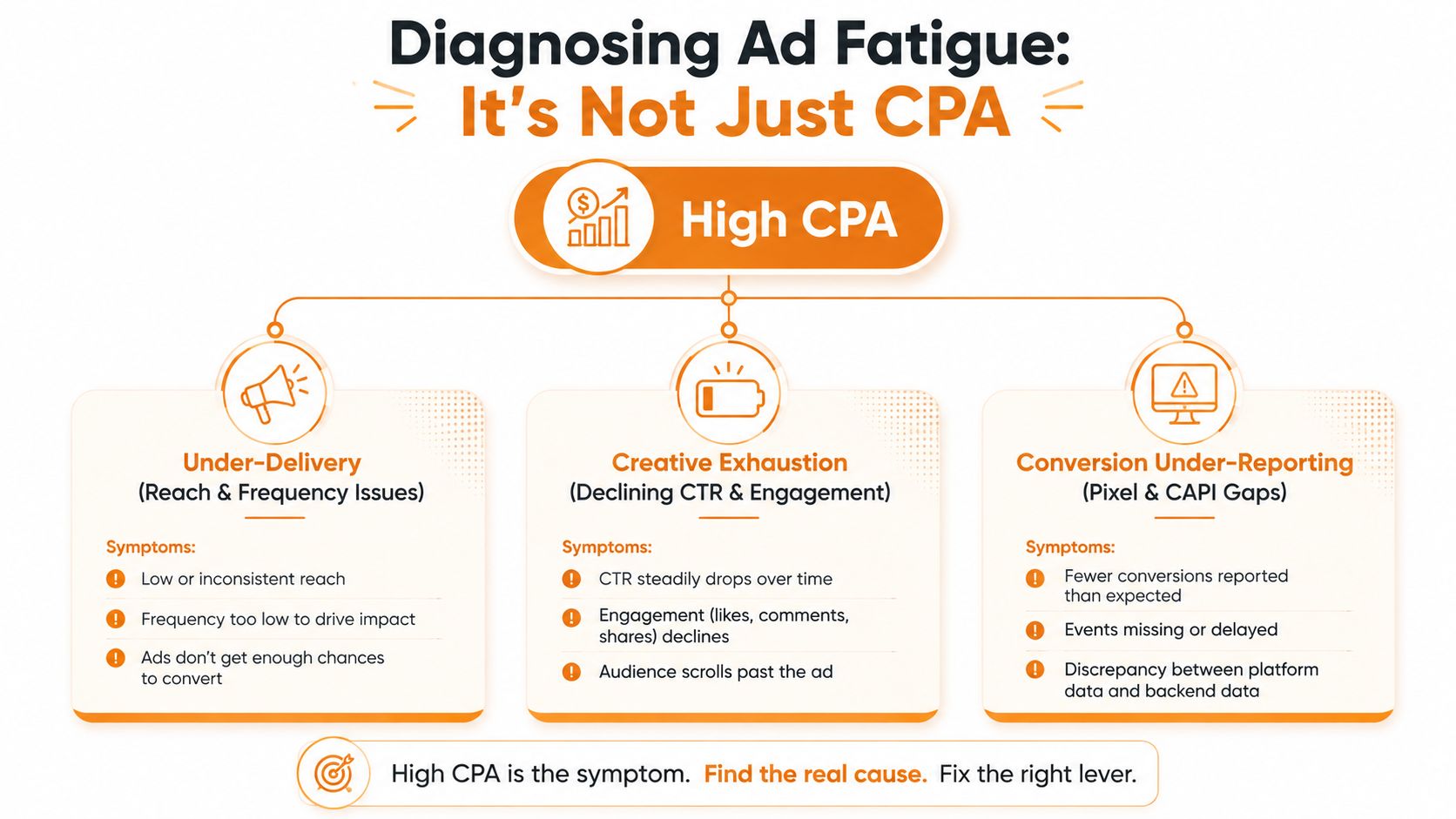
The three failure modes
Delivery failure shows up when spend remains below the cap, reach stops scaling, CPM increases, or the system cannot find enough eligible impressions. Check auction setup, audience breadth, placements, and budget concentration before touching the ads.
Creative failure shows up when frequency rises, CTR declines, and CPA increases while tracking remains accurate. Replace the ad with a different customer angle. Another bid adjustment will not repair weak persuasion.
Measurement failure shows up when Events Manager conversions do not reconcile with CRM or backend records, or when reported CPA looks materially better than the true blended cost. Validate browser and server events, deduplicate conversions, and reconcile attribution before judging account performance.
Apple’s tracking changes made this distinction more important. iOS opt-outs reduced deterministic measurement, while modeled conversions introduced more uncertainty into reported results, as explained in how iOS changes affected mobile attribution.
Our audit rule: repair the measurement layer before judging delivery or creative. Otherwise, you are optimising against a distorted scoreboard.
The same symptom can require opposite actions. A tired ad needs replacement. A thin auction needs broader delivery conditions. Missing server-side events need tracking repair. Pausing a profitable campaign because the dashboard looks weak can also erase useful historical signal.
A sequential audit beats a catalogue of possible causes. Crank11’s position is direct: do not adjust bids until you know whether the account is failing to spend, the ad is failing to persuade, or the account is failing to count. Their account of an agency relationship that failed under pressure also shows how panic decisions can create more damage than the original decline.
Measurement and Tracking Failures That Look Like Performance Problems
Audit tracking before changing campaigns. The Meta Pixel records browser events, while Conversions API sends events from the server. Using both covers different signal-loss points, according to Meta Pixel and Conversions API tracking guidance.
Start in Events Manager. Confirm that browser and server events use the same event ID for one conversion, then review diagnostics for duplicates and missing events. A purchase firing twice inflates reported results. A missing purchase event makes a healthy campaign appear unprofitable.
What to check first
Verify that standard events fire on the correct page and only at the intended stage. A purchase event must represent a completed transaction, not a page refresh, button click, or repeated browser session.
Review Event Match Quality next. Weak matching is a signal problem, not a creative problem. Check that customer information parameters pass correctly, domain verification is complete, and Purchase is prioritised within aggregated measurement.
Then reconcile Meta with the source of truth. Compare reported purchases and values with backend orders and CRM records over the same date range, using the same attribution window. As of 2026, the default window is 7-day click and 1-day view. Meta can credit a conversion after a click within seven days or a view without a click within one day, as described in Meta attribution settings guidance.
| Check | Healthy signal | Broken signal |
|---|---|---|
| Browser and server events | Events arrive through both routes and reconcile | One route is silent or counts diverge |
| Event IDs | Matching IDs allow deduplication | Duplicate purchases or inflated totals |
| Event parameters | Purchase value and currency are present | Missing or inconsistent values |
| Event Match Quality | Strong matching on important events | Weak matching and poor optimisation signals |
| Attribution window | Reporting window matches your buying cycle | Meta and last-click numbers appear incomparable |
Changes to mobile tracking can reduce reported ROAS even when actual sales are less affected. Fewer observable signals slow optimisation, make targeting noisier, and undercount longer purchase paths. Treat the dashboard as incomplete until it agrees with backend revenue and CRM outcomes.
If fewer than 50 optimisation events accumulate inside a rolling seven-day window, flag the ad set as signal-starved. The learning phase generally depends on that event volume, not only on campaign age, according to this learning phase explanation. Consolidate where sensible or optimise for a broader event until the account generates stronger signals.
Run this self-guided ad account audit before changing spend, bids, or creative. Repair the measurement layer first. Otherwise, delivery and creative decisions rely on a distorted scoreboard.
Clean tracking does not guarantee sales. It gives you numbers worth using.
Creative Fatigue and the Three-Day Ad Lifespan
Creative fatigue is performance decay, not a feeling. In a study of 368 creatives, CTR fell 5.5% within the first 250,000 impressions, and CPA rose 19.6% by the 500,000 to 1 million impression range, while CPM didn’t materially rise (creative fatigue benchmark study).
That last point matters. A flat CPM doesn’t clear the ad. The auction can remain stable while the audience becomes less willing to click or buy.
Read the decay signature
Pull a seven-day frequency trend beside CTR and CPA for each prospecting ad. A practical fatigue trigger is frequency around 2.5 or higher, CTR at least 15% to 20% below baseline, or CPA rising 10% to 20% from its normal range (creative refresh thresholds).
Don’t kill an ad because it’s old. Kill it because marginal results are deteriorating.
The median lifespan of Meta ads in independent 2026 analysis of 2.9 million ads was 3 days. 75% were dead within 8 days, and only 5% survived beyond 38 days (2026 creative lifespan analysis). Those figures don’t mean every ad must be replaced on a timer. They do destroy the lazy assumption that a winner should run unchanged for weeks.
| Metric | Warning threshold | Kill threshold | Action |
|---|---|---|---|
| Seven-day prospecting frequency | 2.5+ | Rising with weaker results | Rotate the angle |
| CTR versus baseline | 15% to 20% lower | Persistent decline | Replace the concept |
| CPA versus baseline | 10% to 20% higher | Deteriorating after review | Stop scaling the ad |
| Creative lifespan | Early decay | Material efficiency loss | Move to a fresh test set |
A high-frequency ad isn’t automatically fatigued. It may have spent heavily against one narrow segment. Compare reach, frequency, CTR, and CPA by audience condition before deciding.
Our operating rule is five new creative concepts per week for a serious account, with winners separated from active tests and rotated before the account runs out of variation. That isn’t a universal law. It’s a production requirement created by the speed of decay.
The implication is uncomfortable for founders who keep adjusting campaign structure. If the account lacks fresh hooks, demonstrations, objections, creators, and offers, no bid strategy can manufacture demand.
The cost of stale creative is laid out in this production maths breakdown.
Audience, Learning Phase and Auction Quality
Do not narrow targeting to mask a delivery problem. Check conversion signal and auction competitiveness before changing the audience. Fragmented spend gives the system less information and makes delivery less stable.
Meta’s learning phase is generally associated with about 50 optimisation events in a rolling seven-day window. An ad set below that volume can remain unstable even after running for more than a week. Treat that benchmark as a delivery diagnostic, not a deadline. If events are sparse, avoid frequent edits and unnecessary duplication.
Check signal before audience theory
Start with delivery status and the change history. Creative, audience, and budget edits can disrupt delivery, especially when the ad set already receives few events. Duplication rarely solves the problem. It splits the budget and creates another unit with limited signal.
Then inspect audience saturation. If reach stops expanding while frequency rises and CPA fails to improve, the audience pool is being worked too hard. Broad targeting is not automatically better, and lookalikes are not automatically better either. Choose the structure that gives the optimisation event enough volume without exhausting the available audience.
Compare each ad with the account’s own baseline, the same placement mix, and the same audience condition. Internet CTR benchmarks are poor substitutes for controlled comparisons.
| Metric | Healthy range | Warning sign |
|---|---|---|
| Optimisation events | Around 50 in seven days | Below the learning requirement |
| Audience reach | Expanding with spend | Flat reach and rising frequency |
| Quality ranking | Competitive against the same audience | Bottom-ranked delivery diagnostics |
| Engagement ranking | Competitive for the auction | Weak expected interaction |
| Conversion rate ranking | Competitive for the action | Weak expected conversion |
Meta’s delivery diagnostics include quality ranking, engagement rate ranking, and conversion rate ranking. They compare your ad with competing ads reaching the same audience. A low ranking means the ad is less competitive on user experience or expected action. It does not prove that the platform is malfunctioning. Review the creative promise, post-click experience, and audience fit before rebuilding the campaign (Meta auction quality diagnostics).
Use audience changes only after delivery and signal checks. Keep the account concentrated enough to learn, then broaden when the audience is saturated or the optimisation event is too rare to support consistent delivery.
Budgets, Bidding and the Creative Throughput Bottleneck
Above meaningful spend, creative supply becomes the bottleneck before campaign structure does. Bid changes can redistribute demand. They can’t provide a new reason for a buyer to stop scrolling.
Here’s the maths using a real planning example. If monthly spend is £30,000 and target CPA is £40, then:
£30,000 ÷ £40 = 750 target conversions per month.
That number means the account needs enough fresh creative to generate and maintain 750 conversion opportunities, not that every new ad must win. If fatigue removes viable ads faster than production replaces them, the account loses efficiency while the campaign settings remain perfectly intact.
The supplied production example also frames $30,000 monthly spend at $40 CPA as requiring roughly 25 net new creatives per month to replace fatigued ads and test new angles, with 60 to 80 concepts produced upstream. Keep currencies separate. The formula is what matters, creative demand must be planned against spend and CPA rather than against a vague publishing calendar.
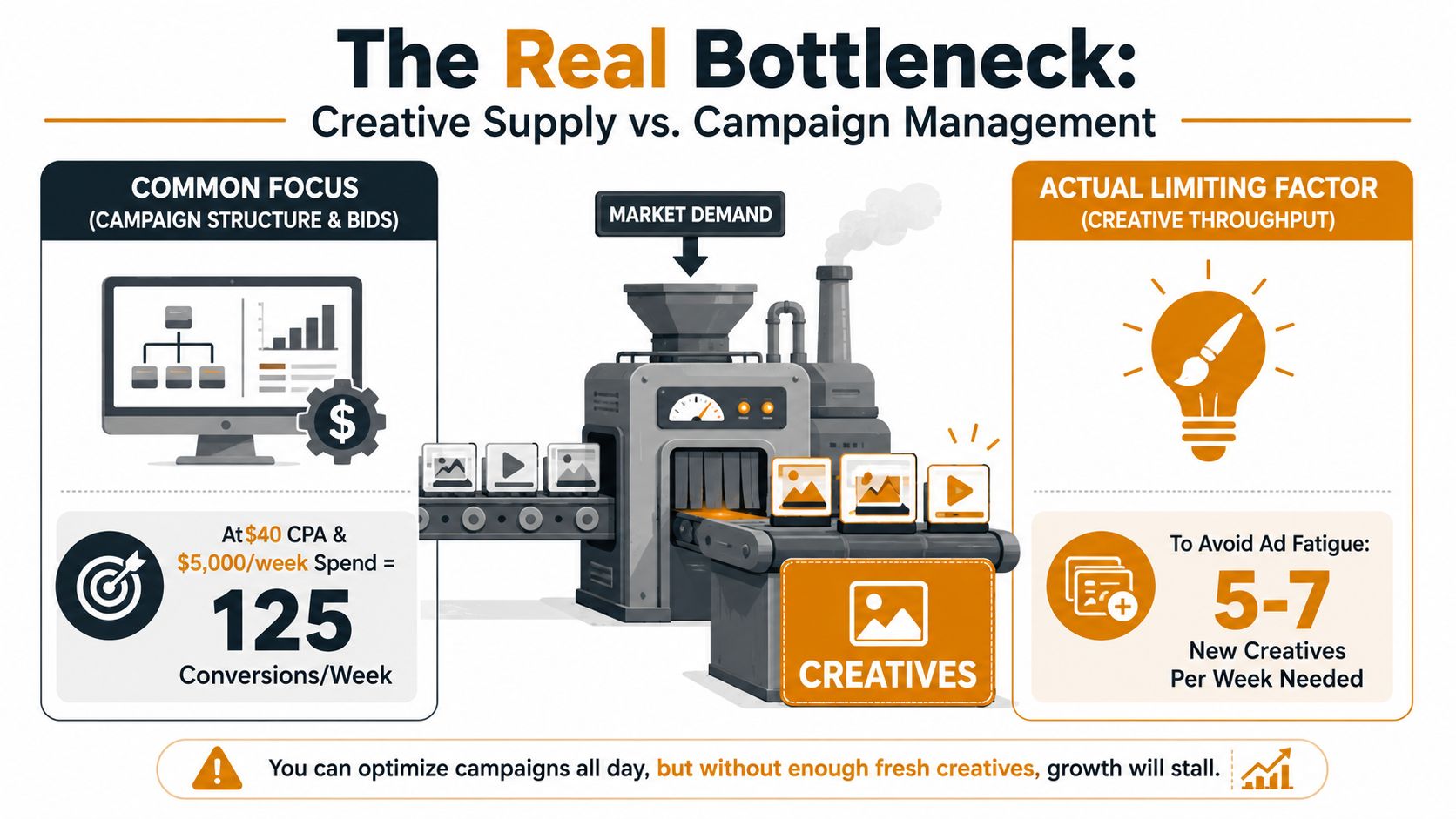
What bid changes can and can’t fix
Campaign budget consolidation can help when too many ad sets compete for too little signal. Ad set budgets can help when you need controlled testing. Lowest-cost bidding can help Meta find available conversions, while bid caps impose a harder constraint that may reduce delivery.
None of those choices repairs exhausted messaging.
Many accounts waste a week here. A buyer duplicates campaigns, changes attribution settings, edits budgets, and calls the resulting volatility “testing”. It isn’t testing. It’s multiple uncontrolled edits that reset learning and destroy causal clarity.
Our position: once spend crosses $1,000 per day, creative output deserves more attention than bid tweaking.
Crank11 operates on the same premise in its creative fatigue production maths. Build a pipeline of distinct hypotheses, not cosmetic variations. Change the promise, proof, objection, format, creator, or demonstration.
The practical ratio is simple. More spend creates more impressions. More impressions consume winning creative faster. If production doesn’t rise with spend, CPA eventually reflects the shortage.
The One-Afternoon Diagnostic Checklist
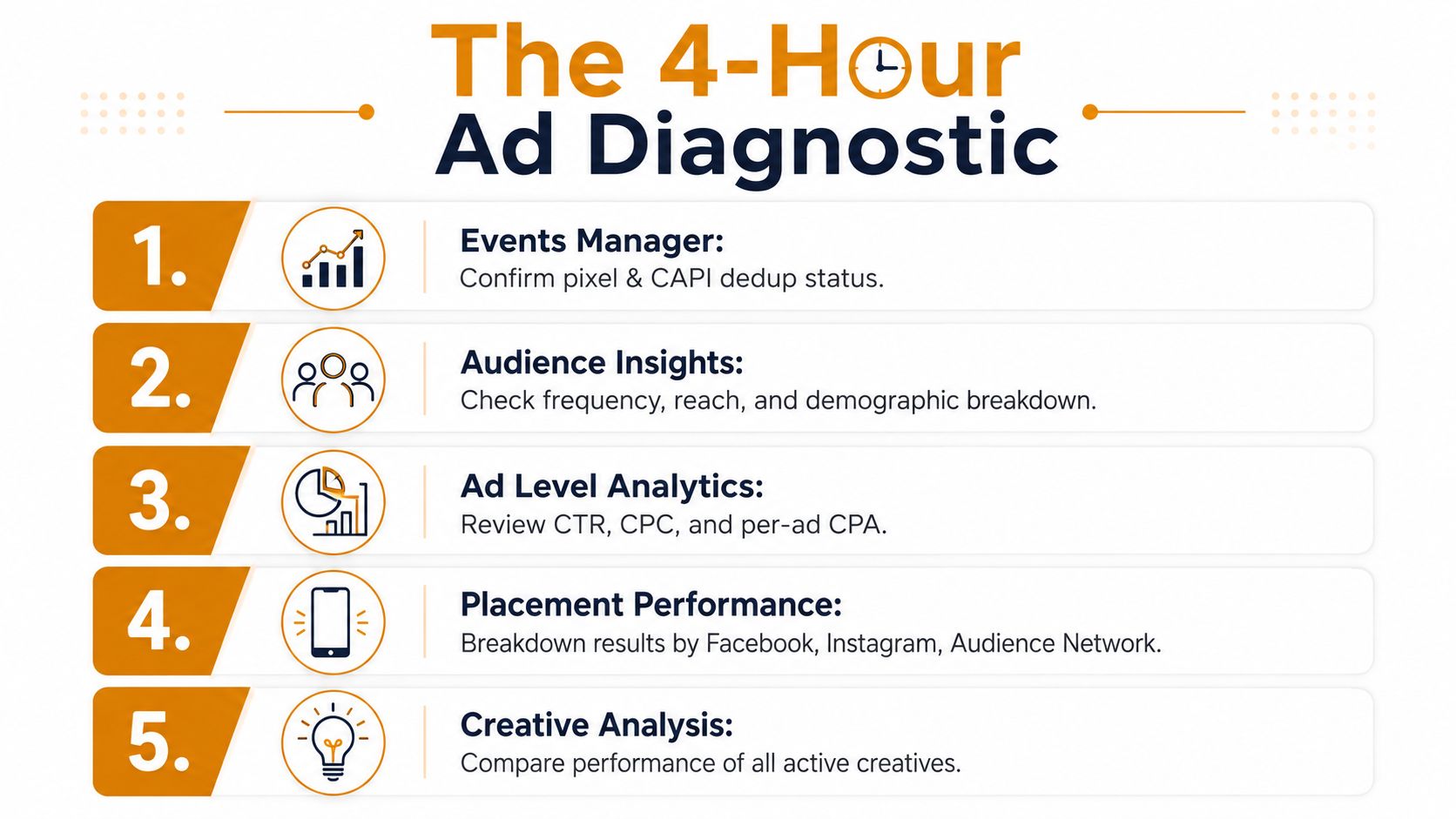
Run the checks in order and write one page of findings. Don’t start with new ads. Start with evidence.
Must fix now
-
Events Manager, 45 minutes. Confirm browser and server events arrive, event IDs deduplicate, purchase values are present, and backend orders reconcile with platform reporting.
-
Delivery diagnostics, 30 minutes. Record spend against budget, delivery status, quality ranking, engagement ranking, and conversion rate ranking. Mark the exact failure bucket, delivery, creative, or measurement.
-
Learning status, 15 minutes. Check whether each important ad set is collecting roughly 50 optimisation events inside the rolling seven-day window. Consolidate fragmented spend where the signal is too thin.
Fix this week
-
Creative trend, 60 minutes. Pull fourteen days of frequency, CTR, and CPA by ad. Flag frequency above 2.5 in prospecting, meaningful CTR deterioration, and rising CPA. Give every replacement a written hypothesis.
-
Audience saturation, 30 minutes. Compare reach expansion with frequency. Review overlap and placement breakdowns, then remove exclusions or fragmentation that prevent Meta from finding eligible buyers.
-
Production review, 30 minutes. Count active test concepts, winners, and replacements in the pipeline. If the pipeline is empty, that’s the constraint.
Monitor
Review the page and offer after the account data is clean. Stable CTR with falling site conversion points away from the ad and towards the landing experience, checkout, pricing, or lead-handling process.
The finished output should fit on one page. This account audit findings framework is useful if you want a structured format, but don’t turn a four-hour diagnosis into a thirty-page report nobody acts on.
[[C11-OPTIN]]
Quick Answers
How do you know whether tracking is broken?
Check active browser events, server events, recent test events, deduplication, purchase values, and backend orders. If Meta undercounts conversions or reports inconsistent values, treat CPA as unreliable until the attribution and event pipeline has been audited.
How quickly should you replace an ad?
Don’t use a universal deadline. Review spend, seven-day frequency, CTR decline, CPA trend, and audience size together. Replace the ad when marginal results deteriorate and the replacement tests a clear new hypothesis.
Does low CTR always mean the audience is bad?
No. Check the creative hook, offer relevance, placement, comments, landing-page promise, and click measurement before narrowing targeting. Low CTR is evidence of weak response, not proof of a bad audience.
Should you duplicate an ad set?
Usually not. Duplication fragments spend and restarts learning, which can create false performance differences. Consolidate first unless you have a clear structural reason to isolate the test.
Can a tiny budget save a campaign?
Sometimes, but sparse conversion volume makes optimisation unstable. Broaden the audience, consolidate duplicate ad sets, and correct measurement before concluding that the offer or channel has failed.
When should you turn an ad off?
Pause for a policy rejection, broken landing page, incorrect URL, persistent tracking loss, or unacceptable unit economics. Don’t pause solely because the ad is young or one reporting period is noisy.
[[C11-OPTIN]]
Tomorrow morning, audit measurement first, then delivery, then creative, and write the failure bucket before changing spend. Crank11’s diagnostic playbook gives you a practical framework for turning that audit into controlled experiments.
Crank11 works with high-spend ecommerce and lead-generation teams on Meta Ads, creative production, tracking, funnels, and CRO, with senior operators signing off the work and no juniors on accounts. Visit Crank 11 to see how the operating model fits a business already buying paid traffic at scale.