
A performance marketing agency is a growth operator that manages measurable acquisition, creative production, conversion optimisation and marketing measurement, not merely ad buying. The performance marketing agency market was valued at $27.4 billion in 2021 and projected to reach $62.3 billion by 2027, with a 14.2% CAGR from 2022 to 2027 (ZipDo, 2024).
Most of what gets sold as “performance” is media buying dressed up. The differentiator is creative throughput, measurement discipline and accountability for incrementality, rather than platform-reported ROAS.
What a Performance Marketing Agency Actually Does
A performance marketing agency is a growth operator that turns paid acquisition into a measured system of media, creative, tracking, funnel testing and commercial accountability.
That definition changes the buying question. A founder spending $40,000 a month does not need campaign screenshots. They need a diagnosis. Is creative decay reducing response? Is tracking misreporting conversions? Is the landing page losing demand? Is media buying failing to reach profitable customers?
The agency’s job is to separate those failure modes before recommending more budget. Most providers sell the same bundle regardless of the answer. That is how companies end up funding creative refreshes for a tracking problem, or changing bids when the funnel is the constraint.
Performance marketing now takes a major share of senior marketers’ budgets. Adobe’s State of Performance Marketing report says it commands more than half of total spend among global senior marketers’ budgets, with 23% increasing allocation over the previous 12 months, 70% keeping it stable and 7% reducing it (WorldMetrics, 2024). Buyers should therefore demand decisions tied to contribution margin, qualified pipeline, CAC and causal evidence, not platform dashboards alone.
Practical rule: Don’t hire a performance marketing agency until it can identify which failure mode is suppressing growth.
Platform ROAS helps with daily bidding. It does not settle whether advertising created business value. A platform records conversions inside its own measurement environment. Incrementality asks whether those conversions would have happened without the advertising. The questions are related, not interchangeable.
A serious operator compares both views. The 2026 open-access study on marketing-mix models, attribution and incrementality recommends combining MMM, multi-touch attribution and incrementality testing. Its framework places attribution in the fast optimisation layer and incrementality in the causal validation layer (BCU, 2026).
Brand agencies build memory. Creative studios build assets. PR firms build reputation. A performance marketing agency connects those outputs to measurable acquisition, records what changed and tests whether the change improved commercial results.
At Crank11, the account is treated as an operating system rather than a media buying retainer. The diagnosis comes before the budget recommendation. Its operating model for paid acquisition is designed for brands already spending heavily, where small measurement errors and stale creative can distort large monthly decisions.
The Four Deliverables a Serious Agency Runs
A serious agency runs four connected systems: media decisions, creative supply, measurement infrastructure and experiments. Remove one, and the account becomes a reporting exercise with invoices.
Paid media buying
The deliverable is a decision trail, not access to an advertising account. Expect channel budgets, campaign architecture, bid logic, audience exclusions, search-term reviews and a change log showing what changed during the week.
Demand a media plan your team can interrogate. Which campaigns acquire customers? Which support retention? What permits budget expansion? What triggers a pause? “The algorithm decides” means nobody owns the decision.
Creative production and iteration
Creative decay can suppress growth while the dashboard blames targeting or bidding. A 2026 benchmark of 368 Meta creatives recorded a 5.5% CTR decline within the first 250,000 impressions and a 19.6% CPA increase by the 500,000 to 1,000,000 impression range (The Interconnections, 2026). Impression exposure therefore gives you a stronger retirement signal than an arbitrary monthly content calendar.
Require a creative log covering hooks, angles, formats, offers, audiences, launch dates and retirement reasons. “We’ll make new ads if performance drops” is a reaction, not a production system.
Measurement and attribution
Tracking failure can look like creative failure. The third deliverable includes an event taxonomy audit, tracking QA, platform reconciliation and a record of known gaps. Browser tracking and server-side event transmission address different failure points. The Pixel runs in the browser, while Conversions API sends event data from the server. They are designed to work together rather than replace one another (Marketer.com, 2026).
The agency should own the diagnosis. You should retain ownership and access to accounts, data and assets. Ask who checks event quality, investigates discrepancies, documents fixes and reverses changes when the evidence turns against them.
Experimentation
A test backlog needs hypotheses, owners, primary metrics, launch dates, decision rules and written learnings. “Variant B won” is not a learning system. It is a coin toss with better stationery.
For CRO, statistical validity matters. A common methodology uses a 95% confidence threshold, corresponding to a p value below 0.05 (Discovered Labs, 2025). Require the agency to explain sample quality, test duration and the decision rule before it declares a winner.
| Deliverable | Weekly artefacts | Monthly artefacts | What to ask for |
|---|---|---|---|
| Paid media | Change log, budget shifts, search-term review | Media plan, channel allocation review | What triggered each material change? |
| Creative | New variants, performance notes, retirement log | Creative matrix, winning angles, production plan | How many assets shipped and why? |
| Measurement | Event QA, discrepancy notes, tracking checks | Attribution reconciliation, tracking audit | Who owns fixes and account access? |
| Experimentation | Test launches, result notes, backlog updates | Experiment readout, prioritised roadmap | Where are learnings stored? |
Large monthly spend exposes weak operations quickly. Media-first agencies often neglect creative. Creative-first agencies often neglect measurement. Before signing, run our ad account audit process, then compare the agency’s proposed outputs with the gaps you can already see. That diagnosis separates creative decay from tracking and funnel failure before a sales call turns either problem into a larger retainer.
Engagement Models and What They Cost
The cheapest agency model can be the most expensive decision. Flat retainers buy capacity, percentage fees reward spend, hybrids reward agreed performance, and projects buy a defined intervention. Choose the structure that matches the operational problem. A salesperson’s preferred pricing model is irrelevant.
Paid media management becomes economically sensible only when spend covers management overhead. A 2026 pricing guide places a practical monthly media threshold at roughly $2,500 to $3,000 for competitive categories. Another cites common annual minimum budgets of $30,000 to $100,000 for media buying services (Progression Agency, 2026). Use those figures as screening points, not permission to ignore your own margins.
A flat retainer works best when deliverables stay fixed. A fee below $5,000 a month can indicate that the account is subsidised by larger clients, especially when the scope includes strategy, creative, tracking and CRO. Ask who is assigned, how many hours are reserved, and what gets removed when the account exceeds its agreed workload.
Percentage-of-spend pricing looks simple. It can also reward budget expansion while efficiency stays flat. A common structure is $1,500 to $2,500 per month plus 10% to 15% of spend above a defined threshold. That incentive is acceptable only when the contract ties increased spend to agreed efficiency and business outcomes.
| Model | Typical fee | Best at spend tier | Where it breaks |
|---|---|---|---|
| Flat retainer | Defined monthly fee | Stable scope and mixed deliverables | Scope expands without fee clarity |
| Percentage of spend | 10% to 15% above threshold | Large, channel-heavy accounts | Agency benefits from higher spend |
| Hybrid | Retainer plus performance kicker | Stable baseline economics | Attribution disputes destroy trust |
| Project or sprint | Fixed project fee | Tracking rebuilds and creative batches | Weak fit for always-on acquisition |
A hybrid model belongs after baseline economics are stable. Write the performance definition precisely: source of truth, comparison period, margin basis and treatment of promotions. “Bonus for growth” is not a definition.
Project pricing fits a tracking rebuild, landing-page sprint or creative production batch. It does not create accountable, always-on media management by itself.
Set these terms before launch:
- Notice period: Avoid being trapped while performance deteriorates.
- Media ownership: The brand should control advertising accounts and billing.
- Data ownership: Keep audiences, event data, dashboards and creative files.
- Reversibility: Require change logs and a process for undoing material edits.
Run the agency versus in-house cost maths before comparing proposals. A lower fee is expensive if your team still supplies strategy, approvals and creative direction. Price the missing labour, then separate creative decay from tracking or funnel failure. That is the ROI calculation to complete before the sales call.
The KPIs That Matter and the Ones That Lie
ROAS is a report, not a diagnosis. Start with whether the agency can connect creative exposure, tracking quality and customer economics to the decision it made. If conversion tracking is broken or the funnel leaks, better media buying will only produce cleaner-looking failure.
Leading indicators show what may happen next. Lagging indicators record what already happened. Platform metrics show delivery and interaction, but they do not prove incremental revenue.
Creative testing velocity deserves close attention. An account with no fresh angles eventually repeats the same message against an audience that has seen it too often. Review exposure curves, frequency at first conversion and the rate at which new concepts replace tired ones. Rising CPM can reflect creative fatigue, audience saturation or a measurement problem. The practical diagnostic is why ads fatigue, not a reflexive budget increase.
Creative age alone is a weak test. Account size, audience depth, offer strength and buying friction change the curve. Treat frequency and CTR movement as signals to investigate, not universal failure thresholds.
The useful stack
A sensible report should show:
- Creative velocity: Assets launched, tested and retired, with the reason attached.
- Thumbstop rate and hook rate: Early evidence that the message earns attention.
- Frequency at first conversion: A clue about audience saturation and buying friction.
- CAC payback period: Whether acquisition fits cash-flow constraints.
- MER: The blended relationship between total revenue and total marketing spend.
- Contribution margin: The figure that decides whether scaling creates cash or consumes it.
- LTV: A useful input for acquisition tolerance, provided it is based on observed cohorts.
| Metric | Category | Why it matters, or doesn’t |
|---|---|---|
| Creative testing velocity | Leading | Shows whether the agency can supply new hypotheses |
| Frequency at first conversion | Leading | Helps separate saturation from creative weakness |
| CAC payback period | Leading and commercial | Connects acquisition to cash timing |
| ROAS | Lagging | Useful only with margin and attribution context |
| MER | Lagging | Shows blended efficiency across the business |
| Platform-attributed ROAS | Platform metric | Useful for in-channel optimisation, not causal proof |
| Reach and impressions | Platform metric | Delivery volume without commercial meaning |
| View-through conversions | Platform metric | Often difficult to validate independently |
| Optimised CPM | Platform metric | Low cost does not mean valuable demand |
| Engagement rate | Platform metric | Interaction can be unrelated to purchase intent |
Separate three failure modes before changing budget: creative decay, tracking failure and funnel failure. Creative decay shows up in weaker attention or conversion after exposure rises. Tracking failure appears as broken event counts, inconsistent attribution or a gap between orders and reported conversions. Funnel failure appears after the click, through weak landing-page conversion, checkout friction or poor lead quality.
Reporting cadence exposes the operator. Weekly reporting should show decisions, tests, creative movement and risks. Monthly reporting should reconcile platform data with finance, CRM or store revenue. A monthly screenshot dump is not reporting. It is evidence that someone remembered the meeting.
The useful KPI is the one that changes a decision and survives a finance check. Everything else is decoration.
Working Out the Real ROI
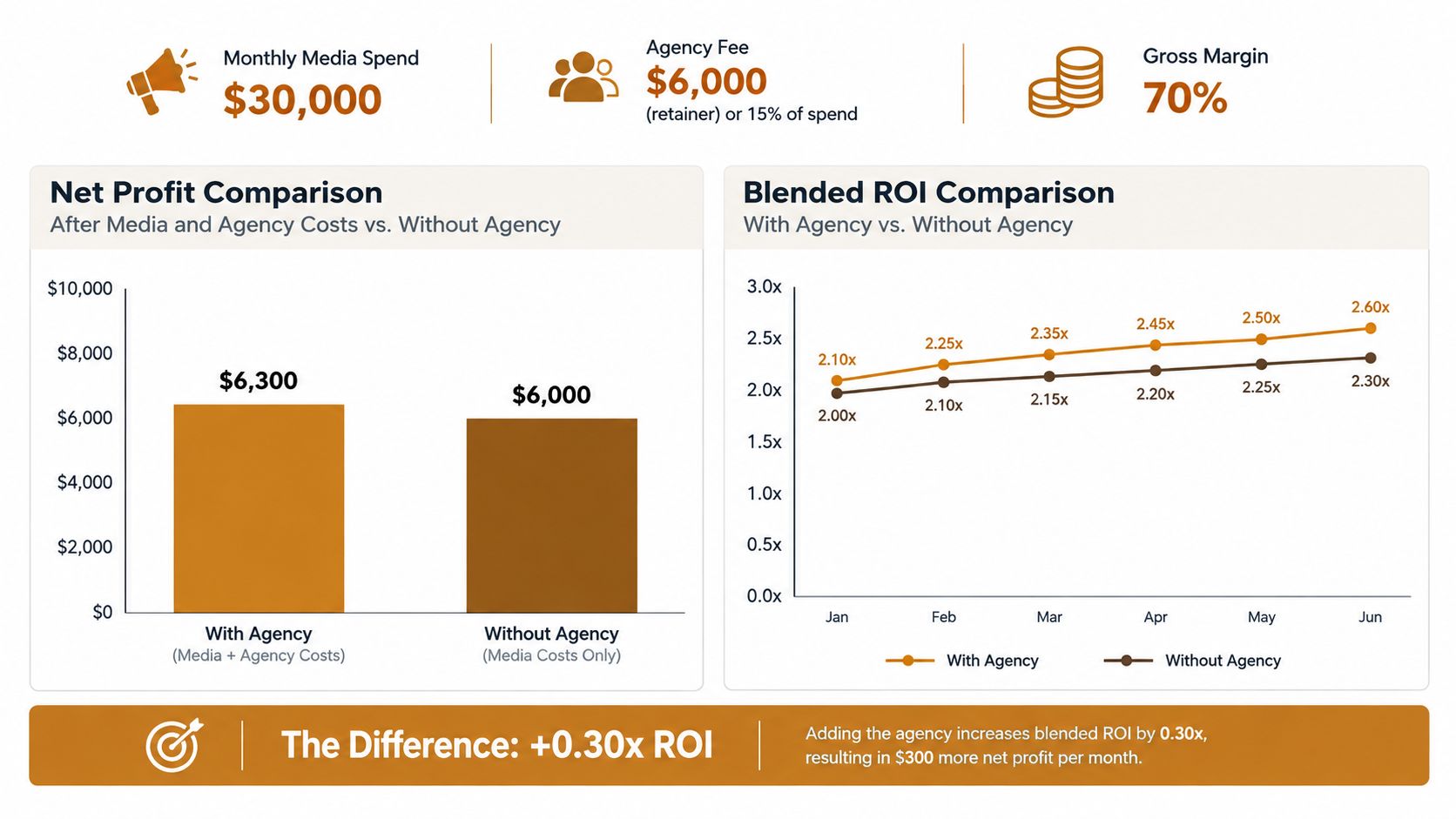
A performance marketing agency earns its fee only when its incremental contribution exceeds that fee. Calculate the economics before reviewing the pitch. That order prevents attractive attribution from doing the selling.
Use these inputs for a monthly model:
- Media spend: $30,000
- Agency retainer: $6,000
- Gross margin: 70%
- Platform-attributed ROAS: 3.5x
- Incrementality adjustment: 15% to 25%
- Payback window: 90 days
At 3.5x platform ROAS, reported revenue equals:
$30,000 × 3.5 = $105,000
Gross profit before agency fees equals:
$105,000 × 70% = $73,500
Subtract media and the $6,000 retainer:
$73,500 minus $30,000 minus $6,000 = $37,500
That figure is reported gross profit after acquisition costs. It does not prove the agency created all $105,000 of revenue.
Apply the stated 15% to 25% incrementality adjustment for a triangulated view. The indicative ROAS range becomes 2.975x to 2.625x. At the lower end:
$30,000 × 2.625 = $78,750
Gross profit after media and agency fees becomes:
$78,750 × 70% minus $30,000 minus $6,000 = $19,125
That gap does not justify abandoning paid acquisition. It shows why platform attribution cannot serve as the company’s accounting system. Use it for rapid channel optimisation, then validate major budget changes with controlled tests, as noted earlier.
Stress-test the pitch
| Stress case | What changes | What to inspect |
|---|---|---|
| Creative decay | CTR falls after heavy exposure | New asset volume and retirement rules |
| Audience saturation | Frequency rises before conversion | Prospecting depth and exclusion logic |
| CPM inflation | Media buys fewer impressions | Contribution margin and conversion rate |
| Tracking loss | Reported conversions fall | Browser and server event reconciliation |
| Funnel friction | Clicks hold, CVR weakens | Landing-page and checkout evidence |
The break-even formula is simple:
Required incremental gross profit = media spend + agency fee + operating costs
For this model, the acquisition programme must produce more than $36,000 in gross profit before it creates value beyond media and the retainer. A business with healthy margins can rationally accept 1.8x blended ROAS when contribution economics support it. A thin-margin business can lose money at 4x platform ROAS when attribution overstates demand and fulfilment costs consume the remainder.
Diagnose the failure before changing budget. Creative decay needs new production. Tracking failure needs event and revenue reconciliation. Funnel failure needs work after the click. The analysis of $40,000 of stale creative shows why production capacity belongs inside the ROI model, not in a separate brand budget.
Six Questions That Reveal More Than a Pitch Deck
Three competing proposals usually measure sales skill. They don’t reliably measure operating skill. Spend 60 minutes asking for working artefacts instead of spending a week admiring polished decks.
1. How many creative assets ship per channel each month?
Demand the creative log, naming conventions and retirement rules. Ask how variants differ, by hook, offer, proof, format or audience. If the answer is “we test continuously” without an asset count or log, there’s no production system.
2. How do you measure incrementality?
Ask for a real MMM, geo-experiment, holdout or conversion-lift write-up. The agency should explain what was tested, which period was used and how the result changed budget allocation. Platform-reported conversions alone don’t answer the causal question.
3. Who owns the tracking stack?
Request the tracking audit and the post-iOS data-loss plan. You should know who checks browser events, server events, deduplication, CRM stages and revenue reconciliation. Ownership must remain with the brand, not an agency account that disappears after termination.
4. What does the fee look like at $50,000 and $200,000 spend?
Ask for a tiered fee schedule in writing. A percentage model that looks reasonable at one spend level can become punitive at another, while a cheap retainer can hide reduced senior attention.
5. What did your last client fire you for?
A candid answer reveals operational maturity. Demand a reference who can discuss missed targets, communication, reporting and the exit process. A claim of perfect retention is less useful than a clear explanation of a failed engagement.
6. What arrives weekly, and where do the learnings live?
Request a sample dashboard, weekly meeting agenda, change log and experiment backlog. The system should show decisions and owners, not just results. If learnings live in one strategist’s head, the account resets every quarter.
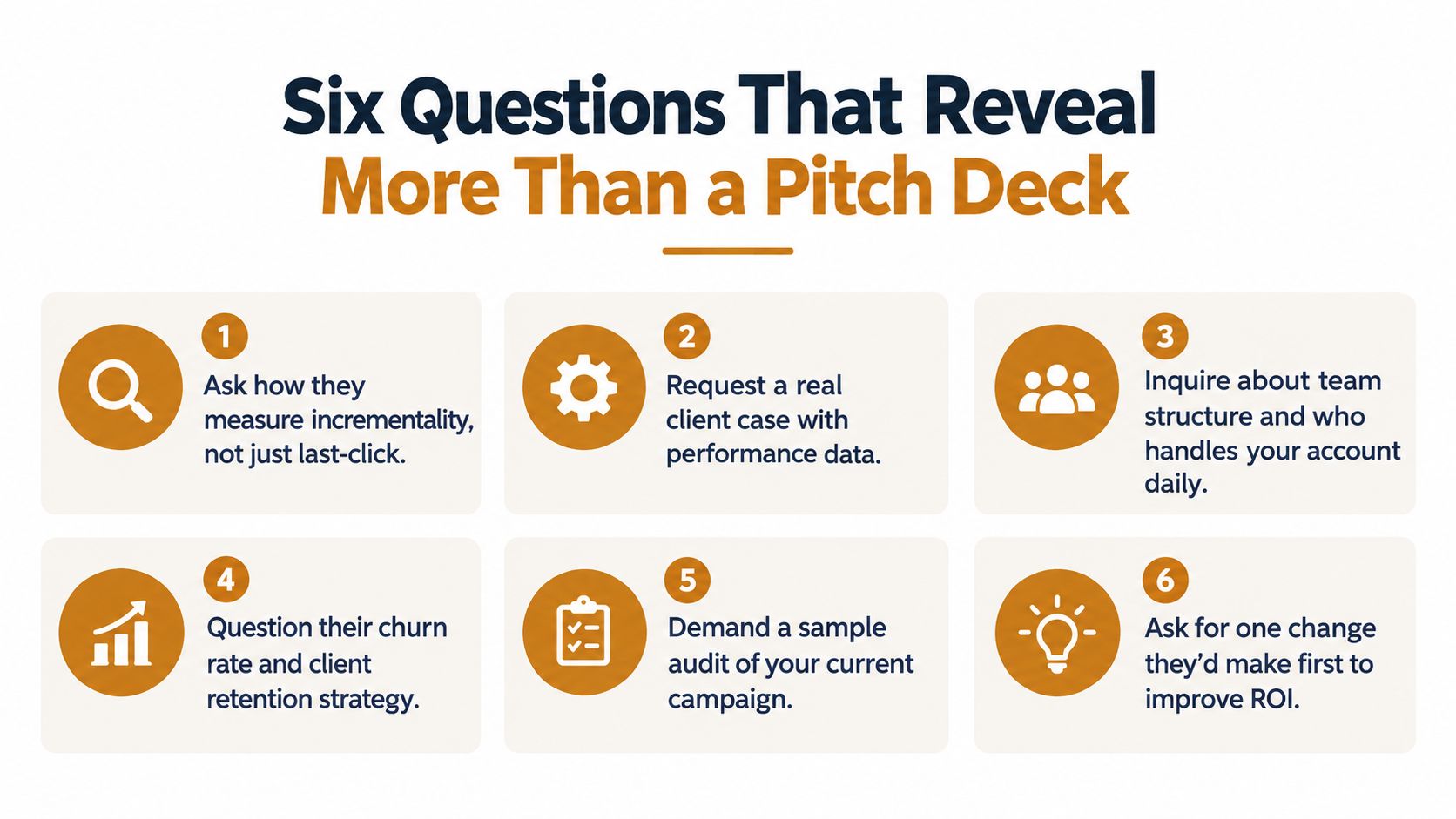
Red flags are predictable: guaranteed ROAS, no incrementality method, no creative log, unclear account ownership, reporting based on screenshots and a contract that makes exit painful. Walk away from all six.
A practical due-diligence sequence is:
- Compare the agency’s deliverables with your current account gaps.
- Reconcile platform revenue with finance or store revenue.
- Inspect creative exposure and fatigue signals.
- Ask for the first three decisions they’d make and the evidence behind each.
- Put fee, ownership and reporting terms in the contract.
A free ad account audit can turn that checklist into a prioritised diagnosis before you sign anything.
[[C11-OPTIN]]
Quick Answers
What is a performance marketing agency? It runs measurable acquisition across media, creative, tracking, funnel optimisation and testing. Media buying is only one part of the job. Diagnose the failure first: creative decay, broken tracking or a leaky funnel require different fixes.
What retainer should a brand spending $30,000 monthly expect? A common guide puts it at $1,500 to $2,500 monthly plus 10% to 15% of spend above a threshold. Scope and senior involvement matter more than the headline fee. Taskip, 2026
What’s the most common engagement model? Flat fee, percentage of spend or a hybrid. Write the fee and $50,000 and $200,000 monthly spend thresholds into the agreement before approval.
Which KPI should you watch first? Contribution margin after media and agency fees. Platform ROAS helps with bidding, but it cannot prove incremental revenue. Calculate the break-even point before the sales call.
What’s the biggest pitch-deck red flag? Guaranteed ROAS without a holdout, geo-lift or conversion-lift method.
What’s the cheapest due-diligence step? Request a sample audit, creative log, change log and dashboard, then match them against your account gaps.
[[C11-OPTIN]]
Tomorrow morning, reconcile attributed revenue with blended contribution margin and inspect creative exposure before changing budgets. For the operating playbook and a free ad account audit, visit Crank 11.