At $30k+ per month on Meta, a Meta ads management agency usually charges 12 to 20 percent of spend with a floor, or a fixed monthly fee around $4k to $12k. The cheaper the headline fee, the more likely you’re buying less creative output, less tracking QA, and fewer senior hours.
Most advice on hiring a Meta ads management agency is wrong because it overweights logos, decks and cherry-picked wins. At this level, the deciding factors are uglier and more useful: creative throughput, kill rules, tracking QA, retainer mechanics, and whether the audit shows they can spot waste before they touch budget.
A Meta ads management agency is an operating layer that turns spend into test velocity, cleaner signals, and faster decisions. If it’s just buying media, you’re paying for the smallest part of the job.
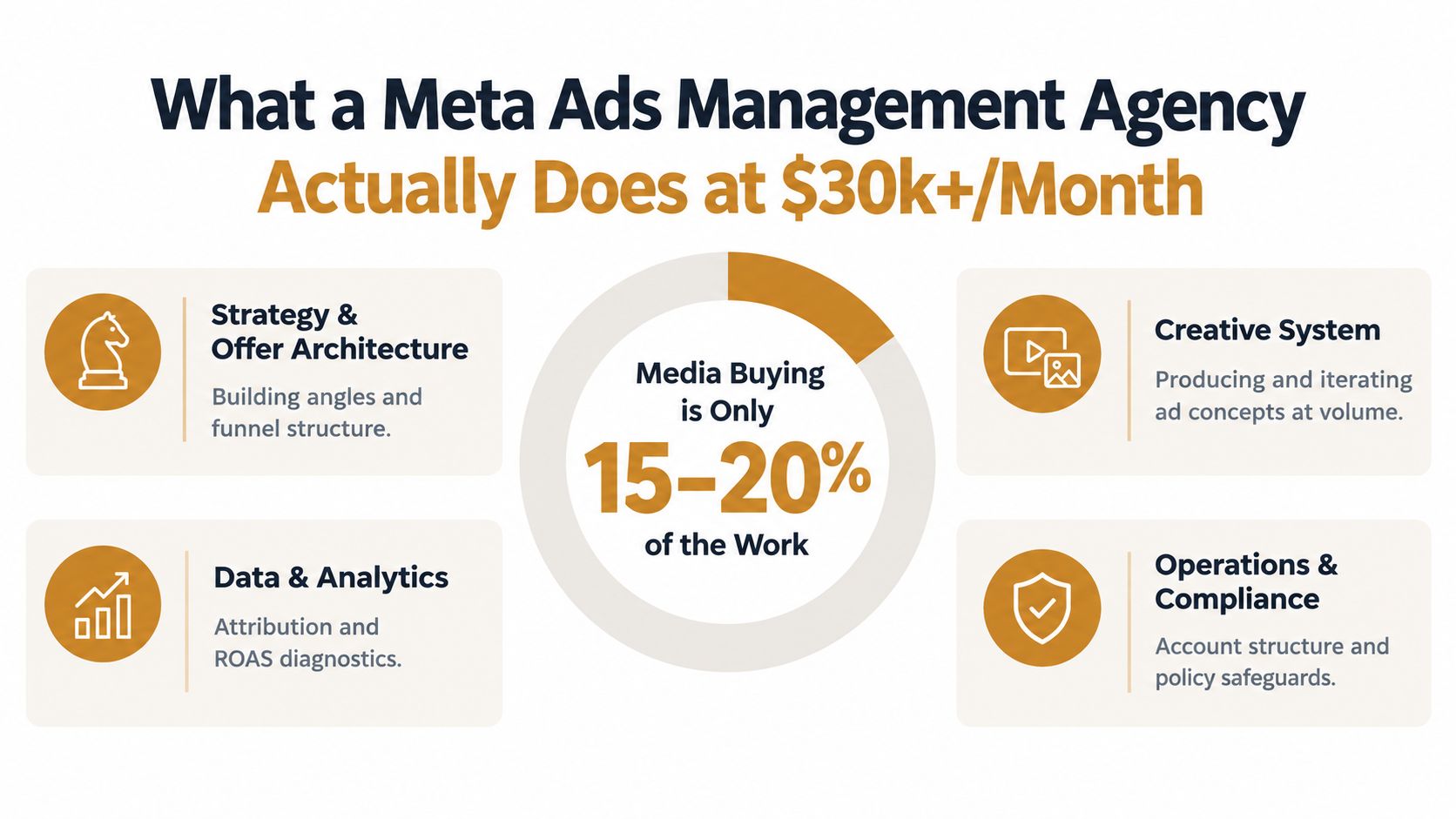
What a Meta Ads Management Agency Actually Does at $30k Plus per Month
At scale, media buying is a minority task. The account lives or dies on creative production, event quality, offer testing, and whether anyone can read the signal without lying to themselves.
Meta’s ad machine is too big to treat casually. Meta reported $196.175 billion in advertising revenue for fiscal 2025, up 22% from $160.633 billion in 2024, and ads made up about 97.6% of total revenue of $200.966 billion according to Meta’s 2025 results, published in 2026. That matters because the platform isn’t a side channel. It’s a giant optimisation system that rewards good inputs and punishes weak ones fast.
What the work actually looks like
For accounts spending real money, we’d expect the work to split roughly like this.
- Creative direction and sourcing. Usually the biggest block. Someone has to write hooks, brief UGC, cut variants, and rotate assets before they rot.
- Tracking and feed integrity. Pixel events, CAPI validation, deduplication, landing page event checks, product feed sanity.
- Structural testing. Testing account structure, exclusions, offer angles, landing page paths, and where to isolate learning.
- Reporting and decisions. Not dashboard screenshots. Actual next-step calls tied to named tests and kill rules.
- Bid and budget moves. Necessary, but rarely the main event.
A buyer-heavy shop looks busy in Ads Manager and quiet everywhere else.
That’s the first screen. If they have no editor, no creative strategist, no owner for Pixel and CAPI, and no creative-level reporting, you’re not hiring a growth operator. You’re hiring someone to nudge budgets.
What to look for in practice
Ask to see the artefacts, not the pitch. A serious shop should be able to show redacted examples of briefs, test logs, event validation steps, creative scorecards, and a weekly readout that changes the next sprint.
If you want a second framework for vetting that kind of shop, this paid social agency evaluation guide is the right starting point.
The Deliverables Checklist That Separates Operators from Slide Decks
A decent answer is specific. A bad one is “we optimise continuously”.
Use the checklist below and grade every prospective shop against it. If they can’t produce examples from the last 30 days, assume the deliverable doesn’t exist.
Meta Ads agency deliverables checklist
| Deliverable Group | What It Includes | Metric It Moves | Pass Threshold |
|---|---|---|---|
| Creative | New concepts, variants, hooks doc, UGC briefs, naming convention | CTR, CPA, hold rate, fatigue resistance | Weekly creative batch exists and kill rules are documented |
| Tracking | Pixel event map, CAPI setup, domain checks, dedup review, purchase path QA | Attribution quality, event reliability, bid stability | Browser and server events are validated before launch |
| Structure | Test plan, exclusions, naming taxonomy, campaign logic, audience separation | CPA stability, overlap control, spend distribution | Account logic is documented in writing |
| Reporting | Weekly scorecard, dashboard access, creative-level readout, monthly decision memo | Faster decisions, less wasted spend | Reporting shows performance by creative, not just by campaign |
| Governance | Named owners, response SLA, approval flow, QBR actions, IP ownership | Execution speed, accountability | Named operator and analyst are assigned |
The non-negotiable tracking rows
Meta’s own developer documentation says standard conversion events are recorded by calling the Pixel’s fbq('track') function with the event name and optional parameters, according to Meta Pixel conversion tracking documentation. That’s not theory. If the event map is vague, the implementation is probably vague too.
A proper QA process also includes pre-launch validation. Meta’s Conversions API setup process includes a Test Events tool in Events Manager and a test_event_code in the test payload, as documented in this CAPI setup reference. If the shop can’t explain how they validate before go-live, they’re guessing with your attribution.
Deduplication is another blunt filter. The practical mechanism is sending the same event_id in both the browser Pixel and server-side CAPI payloads, as shown in this Meta Pixel and CAPI implementation guide. No shared event ID, no clean deduplication.
This checklist becomes more useful if you turn it into a live brief and make the shop fill it in. Our intake brief format is close to the level of detail a founder should demand before signing anything.
This checklist turns vague promises into observable work, with the pass and fail lines already drawn.
[[C11-OPTIN]]
How Meta Ads Agency Pricing Actually Works
Pricing tells you what the shop will protect when margin gets tight. It also tells you what they’ll stop doing.
At this spend level, there are only three pricing models worth taking seriously.
Percent of spend
This is the standard model. Usually 12 to 20 percent of spend, often with a floor. It aligns the shop to scale spend, which is fine until spend plateaus and the work doesn’t. Then creative output and QA hours are the first places they cut.
Worked example.
Inputs: monthly media spend $50,000, fee rate 15%, time period one month.
Calculation: $50,000 × 0.15 = $7,500.
What that means: you’re paying $7,500 per month for management before any extra creative production, landing page work, or tracking rebuilds.
Flat retainer
Usually $4k to $12k per month for accounts in this bracket. This protects operator hours better because the fee isn’t tied to spend volatility. The downside is incentive drift. If performance improves, the shop doesn’t automatically share upside unless the contract says so.
Hybrid
This is often the most honest structure. Smaller base fee, smaller media percentage, and a separate creative line item. Cleaner incentives. Easier to audit. Harder to hide margin.
Meta Ads agency pricing models compared
| Pricing Model | Structure | Cost at $50k/mo | When It Works | Watch Out For |
|---|---|---|---|---|
| Percent of spend | 12 to 20 percent of media, often with a floor | $7,500 at 15% | Scaling budgets where output rises with spend | Fee balloons while deliverables stay flat |
| Flat retainer | Fixed monthly fee | Usually $4k to $12k | Stable workload, strong creative and QA scope | Weak upside incentive |
| Hybrid | Base fee plus lower media fee plus creative budget | Varies by scope | Accounts needing high creative volume | Hidden add-ons if scope is fuzzy |
Practical rule: Ask what happens to deliverables if spend stays flat for 90 days. The answer is usually more revealing than the price.
Three negotiation points matter more than haggling over the last few hundred quid.
- Ask for the rate card in writing. Not just the proposal total. You want the fee logic.
- Ask for the team roster. Names and roles, not just the company brand.
- Cap the media percentage at a spend ceiling. If spend doubles but the work doesn’t, the fee shouldn’t float forever.
If you’re comparing structures side by side, this pricing page should help you pressure-test what’s included and what’s being buried.
The Scoring Rubric We Use to Grade a Paid Media Agency
Most founder scorecards are too soft. They reward confidence, not operating quality.
Use a weighted rubric and score the shop in front of them. If they can defend the score with evidence, good. If they can’t, you’ve just saved a quarter.
Paid media agency scoring rubric
| Criterion | Weight | What to Ask For | Pass Threshold |
|---|---|---|---|
| Creative output rate | 25 | Last quarter’s creative volume by format and concept | Fails the sheet if weak |
| Tracking QA process | 20 | Event map, CAPI validation, naming convention, dedup method | Fails the sheet if weak |
| Kill rules and decision thresholds | 15 | Actual rules used to pause, iterate, or scale | Named thresholds in writing |
| Reporting cadence | 10 | Weekly readout and dashboard example | Decision-ready, not vanity-only |
| Retainer mechanics | 10 | Exit terms, ownership, markups, scope change rules | Clear and plain |
| Strategic context | 10 | Margin, LTV, offer map, funnel assumptions | Commercial understanding is obvious |
| References | 10 | Peer conversations and recent examples | Verifiable and current |
How to score it
The pass line is 70 out of 100. But there’s a catch that matters more than the total. Any score under 10 in creative output rate or tracking QA process fails the whole sheet.
That sounds harsh. It should. Weak creative throughput starves the account. Weak tracking poisons the feedback loop. Everything else becomes theatre.
What strong answers look like
A serious shop should show:
- Creative evidence. Real output logs, not moodboards.
- Tracking evidence. How browser and server events are validated and deduplicated.
- Decision evidence. Examples of why they paused one ad and scaled another.
- Commercial evidence. They understand margin pressure, not just platform metrics.
One more uncomfortable point. As of 2026, industry commentary around Meta keeps pushing in the same direction: automated optimisation and creative-led growth. Coverage also points to growing importance of faster asset production and rotation over manual bid tinkering, as discussed in Meta ads updates in 2026. So if a shop still sells itself mainly as “great media buyers”, they’re pitching the old bottleneck.
Crank11 fits this senior-operator model. We run Meta, Google, creative production and CRO with no junior staffing, but the rubric still applies to us. It should. Any shop worth considering should survive the same inspection.
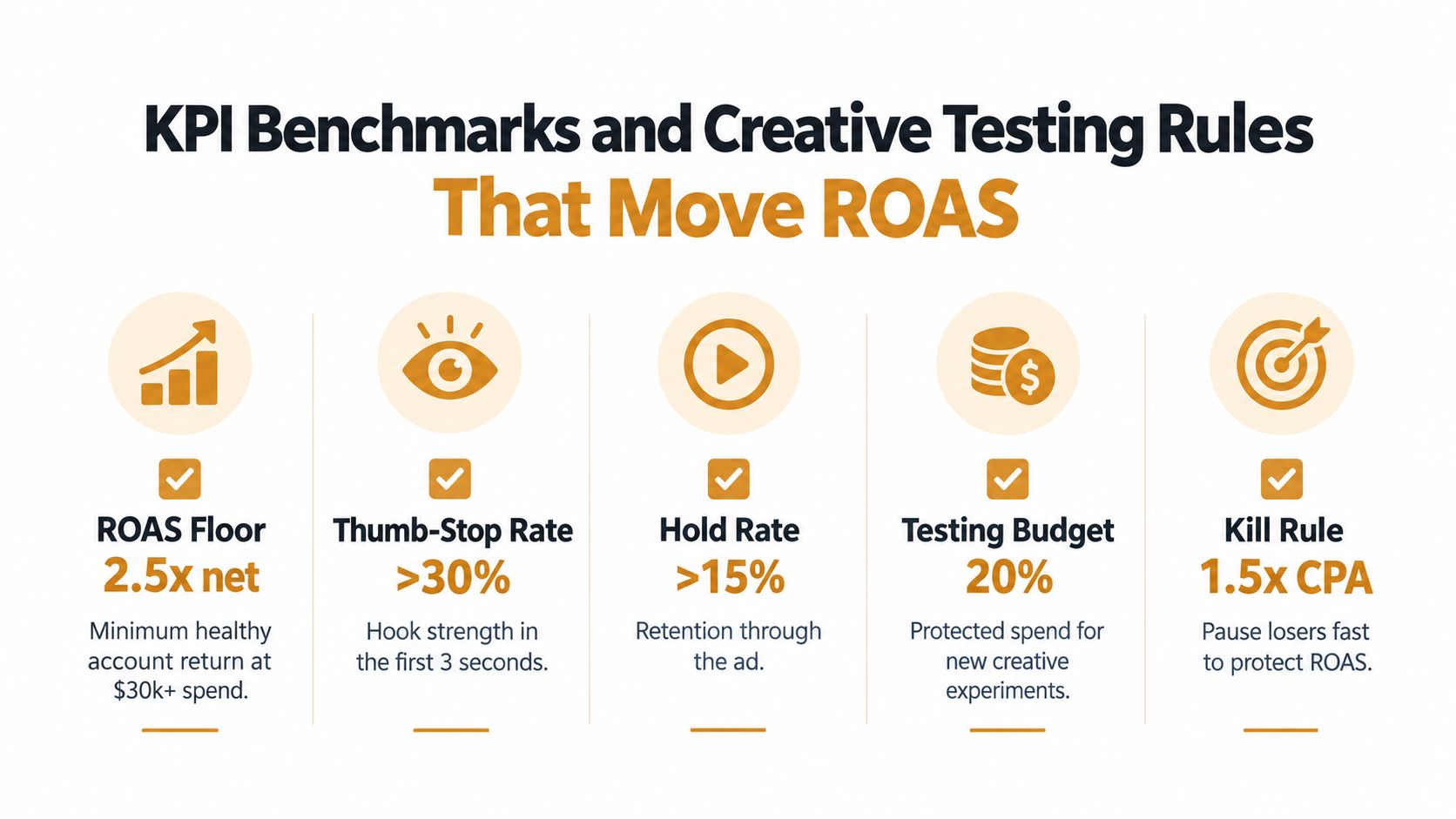
KPI Benchmarks and Creative Testing Rules That Move ROAS
Most ROAS problems aren’t solved by “better optimisation”. They’re solved by cleaner testing and faster creative replacement.
The hard bit is discipline. Teams still kill or crown ads too early, then wonder why scaled performance falls apart.
The testing rules that matter
A solid Meta creative test uses one variable at a time, runs for at least 7 days, and waits for signal before declaring a winner, according to this 2026 Meta creative testing framework. Useful thresholds in that framework include 400 to 500 impressions for CTR checks, 15+ lead events for CPL checks, 25+ conversion events for CPA checks, with some operators preferring 50 conversion events per variant before a final call.
That’s the boring answer. It’s also the one that saves money.
Why most testing programmes underperform
The biggest mistakes are predictable.
- Too many variables. Hook, visual, offer and CTA all changed at once. You learned nothing.
- Stopping early. Calling a winner after 24 to 48 hours is how teams scale noise.
- Judging vanity metrics. CTR can improve while CPA gets worse.
- No kill rules. If nobody defines failure, losing ads linger.
That same framework suggests predefined kill rules such as pausing creatives landing at 2x above target cost per conversion, or falling below reference points like 0.8% CTR and 1.0% conversion rate. Those are useful because they force action before wasted spend becomes habit.
If the shop can’t tell you exactly when an ad dies, they don’t have a testing system. They have opinions.
Why volume matters
Large-scale Meta creative datasets are brutal on this point. Industry coverage of a 550,000-ad analysis says roughly 5% of creatives became genuine winners, while around 50% got almost no spend at all. Another benchmark source in the same coverage reports only about 2% of tested creatives scale, with winning accounts testing 2 to 4 new variants per week at $50k to $100k monthly spend and more than 10 variants per week once spend exceeds $100k, according to this review of Meta creative testing benchmarks.
That’s why we prefer a portfolio view. Protect 10 to 20% of spend for testing. Ship fresh concepts weekly. Rotate losers quickly. This breakdown of creative fatigue and production maths is useful if your bottleneck is output, not ideas.
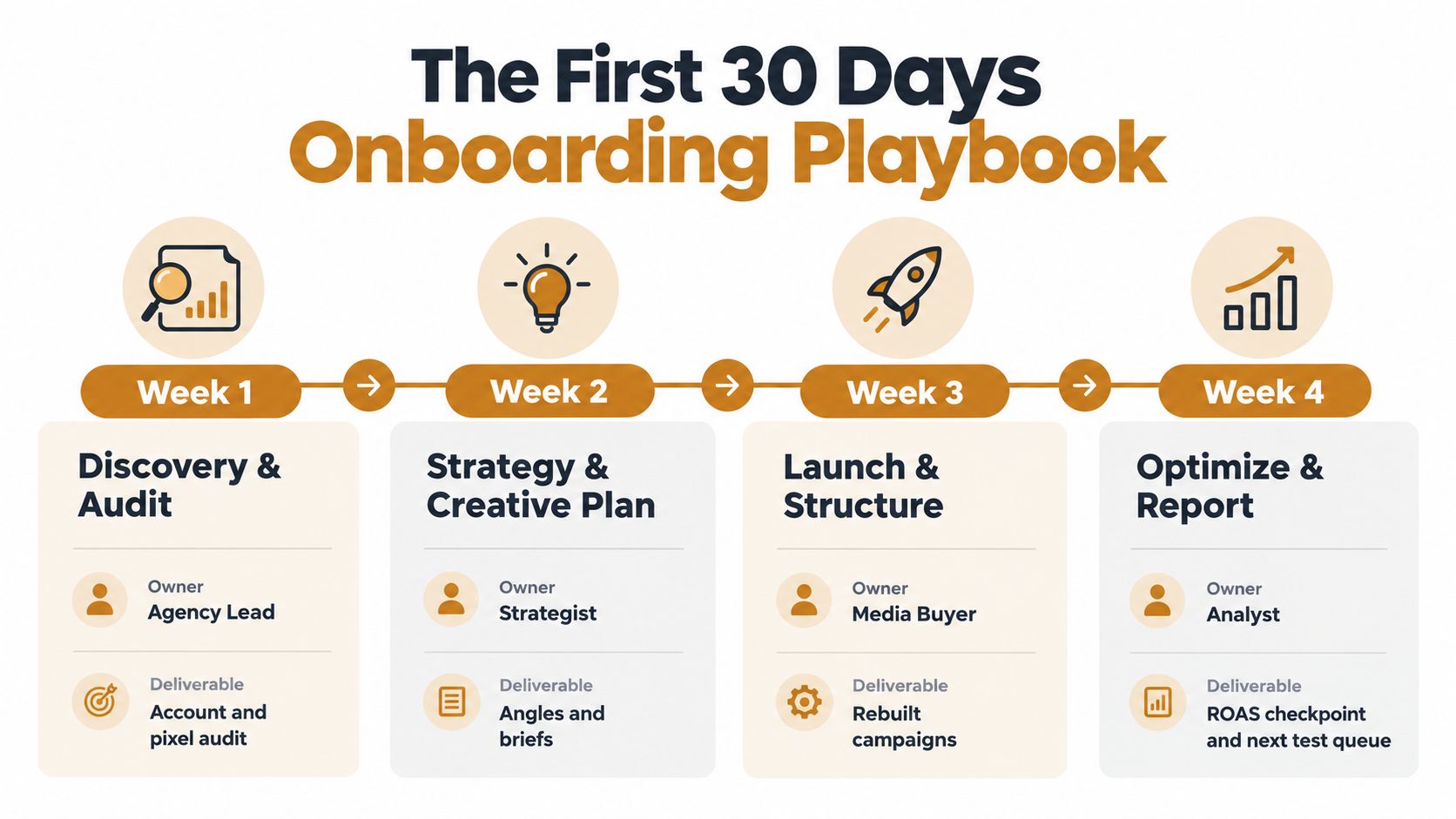
The First Thirty Days Onboarding Playbook
A competent onboarding doesn’t promise miracles in week one. It builds signal, structure and a test queue you can trust.
Anything else is sales copy with a login.
Week one
Tracking audit first. Event map, Pixel sanity check, CAPI validation, domain verification, naming clean-up, baseline export.
No one serious starts by launching fresh campaigns before confirming the account can count.
Week two
Creative inventory. Existing winners, stale assets, weak hooks, missing formats, landing page mismatch. Then a hook library, UGC brief, and production kickoff.
As of 2026, this matters even more because creative fatigue remains the most common failure mode in mature Meta accounts. Practitioner coverage reports refresh windows ranging from 2 to 4 weeks for cold prospecting to as little as 5 to 7 days for high-performing creatives, and one 2026 benchmark noted ads beyond 3 to 4 weeks can see up to 29% higher CPMs and 35% lower CTR, according to this analysis of creative fatigue on Meta.
Week three
Audience and exclusion rebuild. Prospecting separated from retargeting properly. Test plan written down. Kill rules attached to each test. Learning agenda agreed before spend goes out.
That avoids the usual mess where half the account is fighting itself and nobody knows what the campaign is meant to prove.
Week four
First serious readout. Not victory laps. A review of what the first fourteen days said, where tracking is stable or noisy, which creative angles deserve another pass, and what gets paused next.
Don’t trust any shop that promises performance before day 14. First they need clean data. Then they need enough of it.
What a Real Meta Ads Account Audit Finds and How to Read It
A real audit is diagnostic, not flattering. It should show where money is leaking, what’s cosmetic, and what needs fixing in order.
If all you get is “campaigns need optimisation”, bin it.
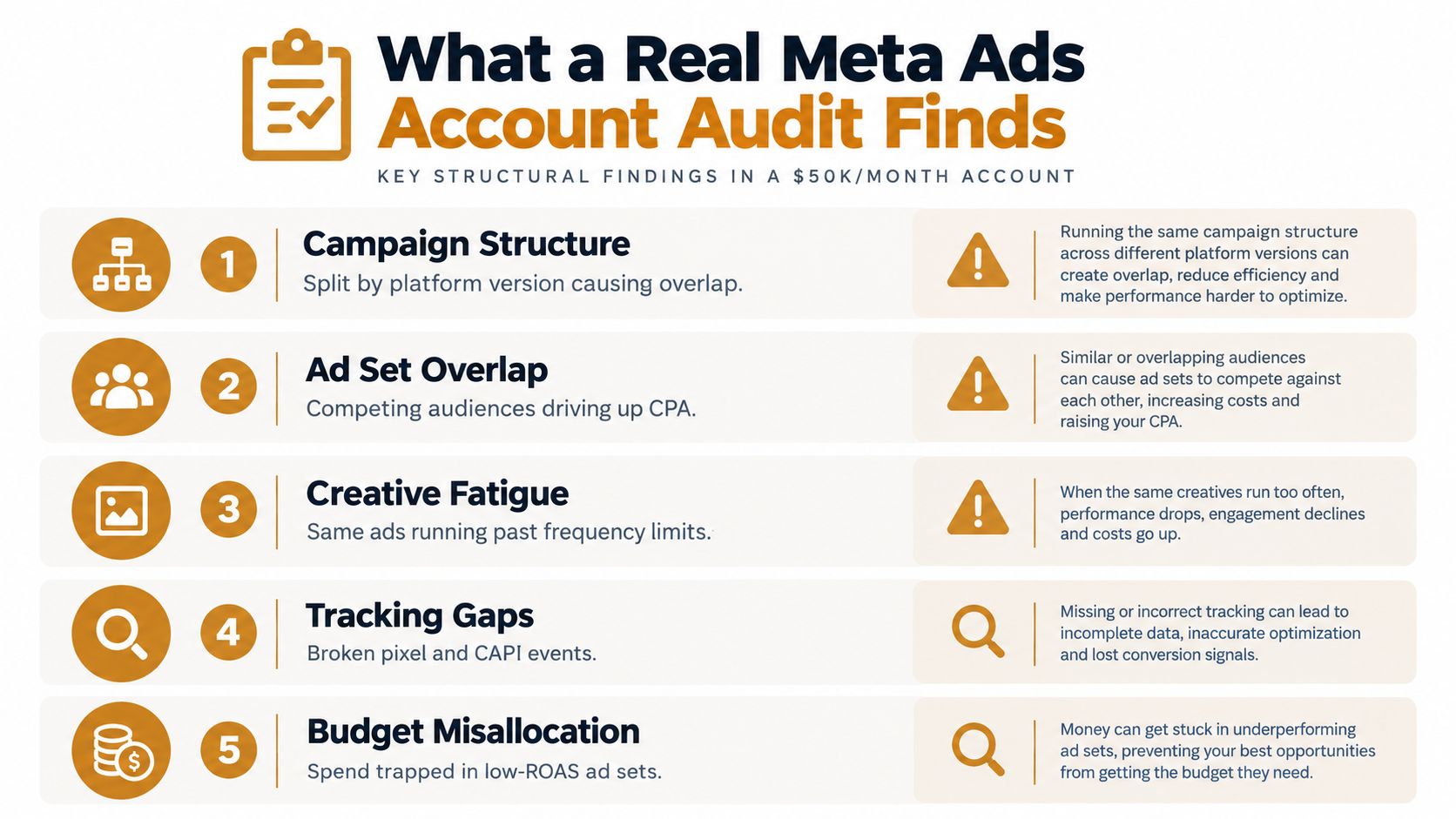
What usually turns up first
Structural mess. Duplicate audiences competing across ad sets. Prospecting and retargeting without proper exclusions. Naming that hides intent. Campaign splits built around old habits rather than current buying logic.
Then the tracking layer. Browser and server events firing unevenly. Purchase paths missing parameters. Event naming inconsistent between funnel steps. Attribution looks clean in the dashboard right until finance tries to reconcile it.
What the creative section should tell you
Not “the creatives are tired”. That’s lazy. The audit should identify which concepts are exhausted, which format still has room, where CTR is misleading, and whether the problem starts in the first seconds or later in the click path.
Meta’s own December 2025 data, as reported in a neutral industry analysis, found that AI-generated creative diversification lifted Advantage+ ROAS by 22% for first-time users, while AI image variations drove an 11% lift in click-through rate and a 7.6% higher conversion rate, according to this 2026 review of creative testing evidence. The useful takeaway isn’t “AI fixes ads”. It’s that structured creative variation moves performance enough to deserve system-level attention.
The questions that separate good audits from theatre
Send these back to the auditor.
- Which fixes compound first. Meaning what improves signal for every later decision.
- Which issues need creative support. Structure alone won’t rescue stale hooks.
- Which problems belong to the landing page. Paid media can’t fix a broken conversion path by force.
- What should be paused now. Not “monitored”. Paused.
If you want to sense-check your own account before speaking to anyone, this self-audit walkthrough is a better filter than another generic checklist.
[[C11-OPTIN]]
Quick answers
How much should a Meta ads management agency cost at $50k per month spend
Usually 12 to 20 percent of spend or a fixed $4k to $12k retainer. At $50k spend, 15% means $7,500 monthly. The useful question isn’t just cost. It’s what creative, tracking and reporting work that fee buys.
What’s the biggest red flag in a Meta ads agency pitch
A pitch that centres on media buying while glossing over creative output and tracking QA. At scale, those two areas decide whether account data is usable and whether fresh ads keep replacing fatigued ones.
How many new creatives should an agency test
Enough to behave like a portfolio, not a lottery ticket. The benchmark coverage cited earlier shows strong accounts testing 2 to 4 new variants per week at $50k to $100k spend, and more than 10 per week above $100k.
How long should they run a creative test before calling it
At least 7 days in a clean single-variable setup. Early checks can use 400 to 500 impressions for CTR or 25+ conversion events for CPA, but final calls need more patience than is typically given.
Should tracking QA be in scope or billed separately
Basic QA should be in scope. Rebuilds, migrations and major attribution repair may be separate. If the proposal excludes tracking ownership entirely, that’s a problem, not a preference.
What should I ask for before signing
Ask for redacted samples from the last 30 days. Briefs, creative scorecards, weekly readouts, event validation notes, and the test log. Real work leaves artefacts.
Crank 11 works with founders and in-house teams spending serious money on paid traffic who need cleaner tracking, faster creative turnover, and reporting that leads to an actual next move. If that’s the job, visit Crank 11 and start with the free ad account audit.
Tomorrow morning, ask your current shop for the last 30 days of creative briefs, test logs, and tracking QA notes. If that request gets awkward, use the free audit at Crank 11’s audit page.