
A media buying agency plans, purchases and optimises paid ad inventory for advertisers. The U.S. industry is estimated at $14.4 billion in 2026, with 606 businesses, but most buyers still optimise the wrong layer of the stack.
They chase cheaper CPMs, negotiate inventory and admire platform dashboards while creative fatigue, broken measurement and slow experimentation consume the budget. For a founder spending $30k a month, procurement is rarely the main failure. Delivery is.
What a Media Buying Agency Actually Does
A media buying agency is a business that plans, purchases and optimises paid ad inventory across publishers, exchanges and walled gardens for advertisers seeking reach, efficiency and usable signal.
That definition is accurate, but incomplete. It describes the transaction, not the value.
Most agencies position buying as a procurement problem. They talk about rates, reach, audience segments and platform access. Those things matter, but they aren’t where serious accounts usually lose money. A campaign can buy inexpensive impressions and still fail because the creative is tired, the conversion event is unreliable, or the team takes too long to act on evidence.
The U.S. category remains mature rather than explosive. IBISWorld estimates the U.S. media buying agencies industry at $14.4 billion in 2026, with revenue growing at a 1.7% CAGR between 2021 and 2026. That scale creates plenty of vendors, but scale alone doesn’t prove operational quality.
A media buying agency should convert budget into validated demand, not merely convert budget into impressions.
The work that matters is delivery. Can the agency produce enough creative variation to keep testing alive? Can it preserve clean event data across channels? Can it make reversible changes quickly, document them, and connect platform results to revenue?
A founder should judge the engagement against four outputs: creative velocity, signal integrity, experiment cadence and allocation decisions. Cheap inventory is useful only when those four systems are working.
Start by examining the account rather than accepting a polished pitch. Our guide to auditing your own ad account gives you a practical way to find waste, tracking gaps and structural problems before an agency explains them away.
The distinction matters because a vendor can perform media tasks while avoiding commercial accountability. A delivery partner owns the quality of the inputs, the pace of learning and the clarity of the decisions that follow.
The Four Job Layers Inside a Media Buying Engagement
A serious engagement has four layers, and each layer produces an artefact you can inspect. If an agency can’t show the artefact, it probably isn’t doing the work.
Planning turns commercial intent into a buying plan
Planning starts with the brief, audience hypothesis, budget curve and channel mix decision. The output should be a media plan that states allocation, expected CAC, pacing rules and the conditions for moving spend.
This isn’t a decorative slide deck. It should explain why a channel belongs in the mix, which funnel job it performs and what evidence would cause the agency to reduce or expand it.
Procurement secures inventory with visible terms
Procurement takes the plan and audience signals into direct publisher relationships, programmatic deals and social platforms. The output is committed inventory, documented terms and a clear record of who controls the buying relationship.
The global market illustrates why governance matters. Mordor Intelligence valued global media buying services at $105.8 billion in 2025 and projects $174.1 billion by 2031. Its report says large enterprises represented 78.73% of market share in 2025, while North America represented 41.48%, so larger advertisers and major markets shape much of the operating model.
Execution turns assets and signals into live experiments
Execution starts with creative assets, tracking pixels and defined conversion events. The output should include live campaigns, structured tests and a change log showing what changed, why it changed and what happened afterwards.
Ask for the log. Not a vague promise of optimisation. A real log.
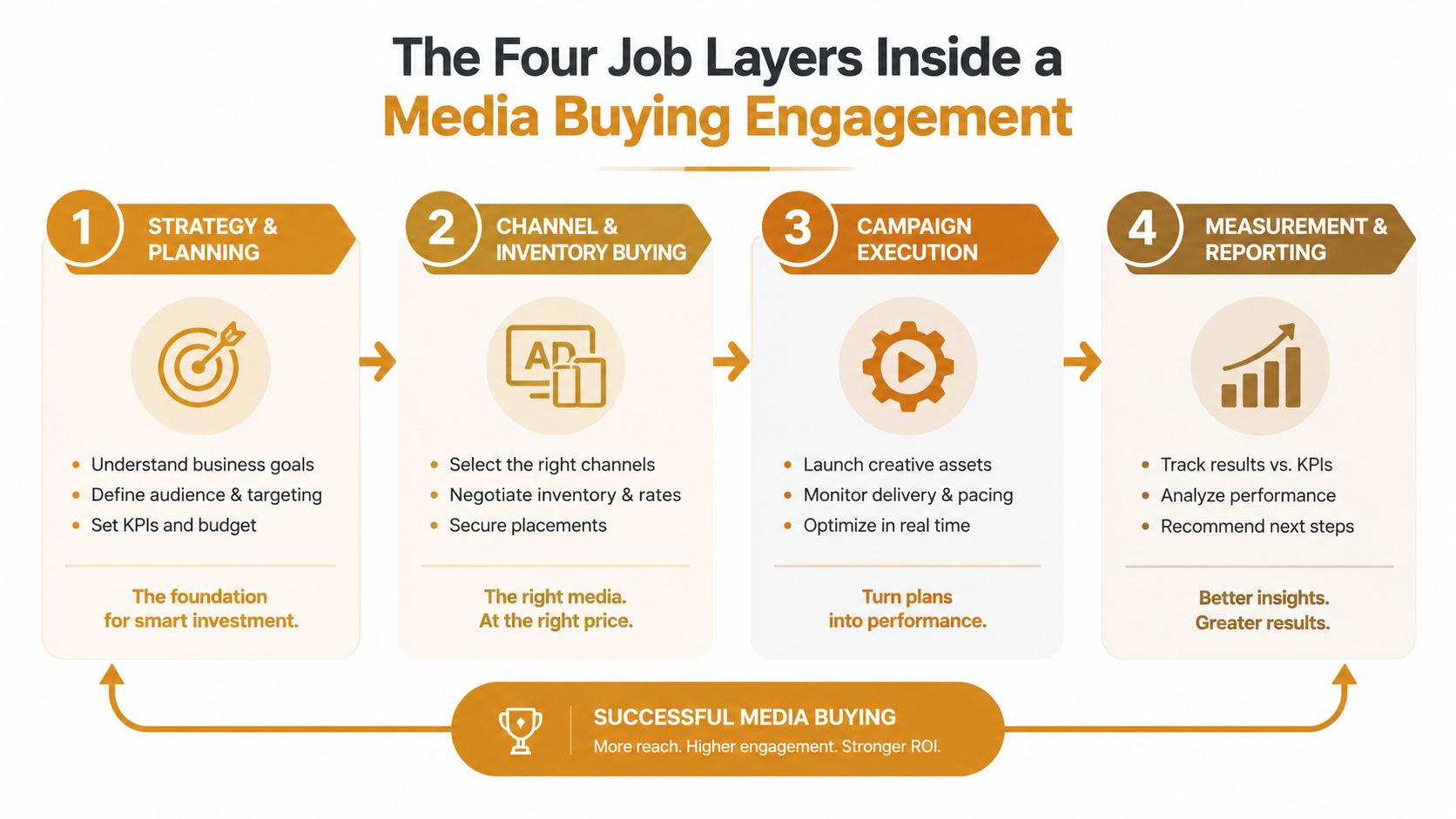
Measurement converts platform data into commercial decisions
Measurement combines platform data, incrementality tests and CRM events. The output should be a weekly read, a monthly memo and a quarterly reallocation decision tied to business outcomes.
The ANA’s programmatic supply chain guidance recommends direct contracts with primary supply-chain partners, including DSPs, SSPs and ad verification vendors, and calls for a chief media officer to own internal governance. The reason is straightforward. Fragmented control weakens accountability.
An agency that delivers only campaign screenshots is selling access and labour. An agency that produces evidence across all four layers is operating a system.
[[C11-OPTIN]]
Programmatic vs Direct Buying and When Each Wins
Programmatic buying wins on reach and operational efficiency. Direct buying wins when placement quality, context and signal control matter more than the lowest impression cost.
The decision isn’t ideological. It depends on funnel position, creative format and how much uncertainty your measurement stack can tolerate.
Programmatic buying uses automated bidding across many available placements. It works well for broad reach, retargeting and audience-led buying where scale matters more than a named environment. The trade-off is less visibility into the path between budget and placement, with greater exposure to low-quality inventory and platform-side decisions you can’t fully inspect.
Direct buying secures a defined publisher, placement, audience or context. It generally costs more per impression, but you know what you’re buying. That matters for upper-funnel video, specialist audiences, connected television and audio, where the environment affects attention and brand safety.
Decision matrix
| Dimension | Programmatic | Direct |
|---|---|---|
| Primary advantage | Broad reach and automated buying | Placement and context control |
| Cost profile | Usually more efficient for fragmented reach | Usually higher per impression |
| Visibility | Variable, often dependent on platform reporting | Clearer publisher and placement terms |
| Best use | Retargeting, lookalike-led display and broad prospecting | Premium video, CTV, audio and endemic publishers |
| Main risk | Arbitrage inventory, bot exposure and signal loss | Higher commitment and less flexible scale |
| Operational threshold | Under $20,000 per month on one channel, overhead is rarely justified | Above that level, assess placement quality and measurement needs |
The $20,000 monthly threshold is an operating rule, not a universal law. Below it, building direct relationships can consume attention without improving the buying decision. Above it, the trade-off deserves a proper review because waste in the environment can outweigh a cheaper CPM.
The question is not, “Which buying method is better?” Ask, “Where does this impression need to appear, and what evidence must return?”
For broad retargeting, programmatic usually earns its place. For a high-consideration product where context shapes trust, direct buying has a stronger case. For CTV or audio, insist on transparent placement and delivery data rather than accepting a blended reach number.
How Media Buying Agencies Price Their Work
Most agency pricing falls into three structures: percentage of spend, a flat retainer, or a performance fee. The cheapest-looking proposal often isn’t the cheapest working-media arrangement.
Percentage pricing is easy to understand. A fixed proportion of media spend becomes the agency fee, so the fee rises as the account scales. Flat retainers create a predictable operating cost, while performance pricing ties part of the fee to an agreed result and can create disputes over attribution, margin and controllable inputs.
The standard retainer model is a fixed monthly fee for a defined scope. Stackmatix describes a monthly retainer as recurring payment for ongoing strategy and execution, with deliverables agreed in advance.
The $50,000 monthly calculation
Use named inputs, not an attractive headline fee.
- Media spend: $50,000 per month
- Percentage fee assumption: 15% of spend
- Flat retainer assumption: $10,000 per month
- Performance fee assumption: 8% of tracked revenue, with a $3,000 base
Percentage model: $50,000 × 15% = $7,500. The monthly outlay is $57,500, before creative add-ons, reporting charges or other pass-through costs.
Flat model: $50,000 + $10,000 = $60,000. The higher visible fee buys a cleaner P&L if the scope includes the required creative, testing and reporting work.
Performance model depends on revenue. If tracked revenue is $100,000, the fee is $3,000 + ($100,000 × 8%) = $11,000, making total outlay $61,000. The agency shares upside, but you may surrender margin as scale improves.
| Pricing model | How it’s calculated | Fee on $50k spend | Hidden costs | Break-even note |
|---|---|---|---|---|
| Percentage of spend | 15% × $50,000 | $7,500 | Account mark-ups, creative extras and planning fees | Examine carefully as spend rises |
| Flat retainer | Fixed monthly scope | $10,000 | Production exclusions, tools and overages | Easier to forecast |
| Performance fee | $3,000 base plus 8% of tracked revenue | $11,000 at $100k revenue | Attribution disputes and margin leakage | Requires agreed data and definitions |
The hidden costs deserve more attention than the headline model. Look for platform fee mark-ups, white-label reporting charges, separate creative production, quarterly planning retainers and fees for landing-page changes.
Above $200,000 per month, percentage fees deserve a hard challenge because the agency’s workload won’t necessarily rise in proportion to spend. Flat retainers should also be renegotiated when scope, channel count or creative production changes materially.
Ask one question in every proposal: What is my fully loaded cost per dollar of working media?
Our agency versus in-house cost maths helps separate management fees from the operating costs that proposals often bury.
How to Choose a Media Buying Agency Without Getting Sold To
Choose an agency by testing its operating constraints, not by admiring its results deck. A thirty-minute call should expose weak ownership, thin creative output and dashboard theatre.
Use this checklist.
-
Spend minimum. Ask whether the agency takes accounts below $30,000 per month. If it does, ask who operates those accounts and how senior review works. Budget fit doesn’t prove quality, but a mismatch often creates a junior service model.
-
Account ownership. Your business should own the portfolio, ad accounts, pixels or datasets, domains, analytics, feeds and billing profile from day one. Independent ownership guidance for media buying clients says the contract should cover portability, historical data, audiences, pixels, billing control and termination.
-
Creative output. Ask for net-new concepts shipped per channel per cycle. Fewer than four creative tests per channel per cycle is a warning sign for an account spending at this level. The answer must distinguish new concepts from minor copy edits.
-
Measurement ownership. Ask who owns the post-purchase signal loop and which attribution model governs decisions. A last-click-only or platform-native-only answer disqualifies the agency. The media buyer needs commercial data, not a convenient platform score.
-
Day-to-day seniority. Ask for the name and role of the operator making daily decisions. Don’t accept the salesperson’s experience as evidence of the delivery operator’s experience.
-
Reporting cadence. Require weekly written commentary. It should explain spend movement, test results, losses, next actions and decisions that were rejected. A dashboard without judgement is decoration.
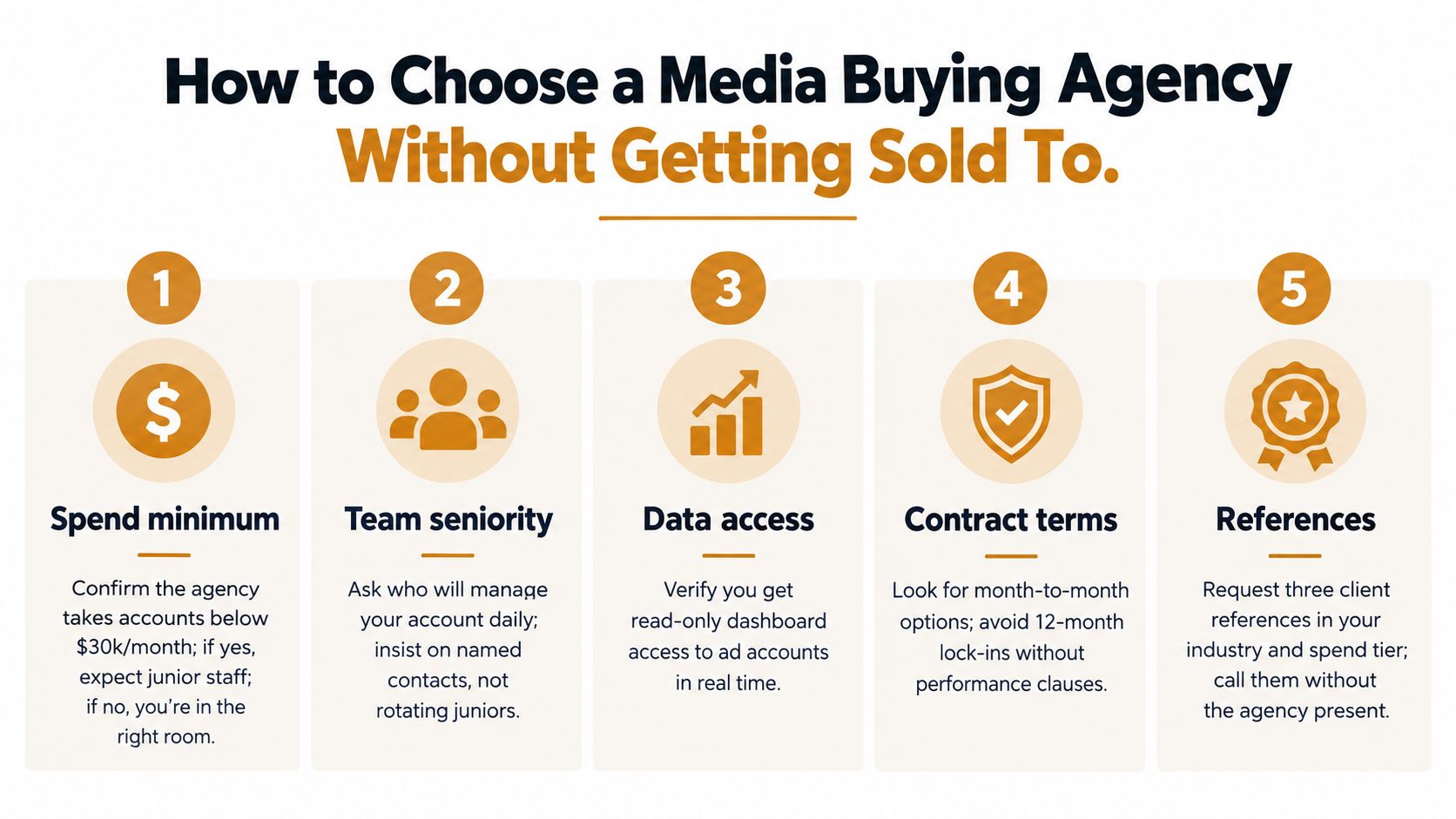
Contract rule: You should be able to leave with your accounts, data, audiences, creative assets and historical performance intact.
Ask whether the engagement is month to month, what happens after termination and who can change account ownership. Google Ads ownership analysis explains that a client account can have one owner, ownership travels up the manager hierarchy, and creating a new account from a manager account automatically creates ownership there. Linking an existing account doesn’t transfer ownership automatically.
Use this paid social agency selection framework before signing. It forces the conversation away from personality and towards controls.
What a Media Buying Agency Should Deliver When Budgets Are Tight
When spend contracts, bid management alone becomes a cost line. A serious agency should shift from expansion theatre to controlled delivery, clearer evidence and reversible decisions.
The first output is a kill list. It should name underperforming placements, audiences and campaigns, with CPA or CPL thresholds attached. “We reduced waste” isn’t a deliverable. A table showing what was stopped, the threshold breached and the budget released is.
The second is a creative velocity plan. The agency should identify the strongest concepts, protect their delivery and keep new variations entering the system. Our creative fatigue production maths is useful here because a shrinking budget makes every test more expensive to misread.
Four weekly outputs
- Waste report: placements and audiences stopped, with the decision rule.
- Creative report: new variations shipped, winners retained and fatigue signals observed.
- Measurement report: discrepancies between platform data, analytics and CRM outcomes.
- Budget roadmap: the expected pipeline effect of each proposed cut or reallocation.
Creative testing needs discipline. Independent guidance recommends reserving 10% to 20% of total spend as a distinct test pool, with decision thresholds often set at 2,000 to 8,000 impressions per variant or more than 50 conversions for meaningful lift detection. Creative testing guidance explains the test-pool and threshold approach.
Don’t let an agency call every cut a strategy. A budget reduction should connect to a forecasted pipeline consequence, a measurement limitation or a specific test result.
The right partner doesn’t vanish when fees are under pressure. It makes the operating system tighter.
[[C11-OPTIN]]
Quick Answers for Founders Hiring a Media Buying Agency
What engagement terms are realistic?
A monthly retainer with defined deliverables is the cleanest structure for most accounts. Month-to-month terms are preferable when the scope is still being proven. Add ownership, reporting, creative output and termination language to the contract.
How long should onboarding take?
Onboarding should begin with access, measurement checks, historical review and a written action plan. Don’t judge optimisation before the agency has verified the conversion definitions and account structure. Ask for dated onboarding outputs rather than a vague promise of a fast launch.
What reporting cadence signals professional work?
A weekly written read signals active management. It should explain what changed, what was learned and what happens next. A dashboard dump with no commentary is not reporting, it’s data transfer.
Should the agency own the ad account?
No. The brand should own its ad accounts, pixels, datasets, audiences, domains, analytics and billing profile. The agency should receive access and document its work. Ownership created inside a manager hierarchy can become difficult to unwind.
Which clause protects the client if performance deteriorates?
Use a clear termination and portability clause. It should guarantee access to historical data, audiences, pixels, creative assets and billing control after termination. Our account ownership position is also discussed in why we fired our agency.
Tomorrow morning, audit the account against creative velocity, signal integrity, experiment cadence and ownership before comparing agency fees. Crank11 applies that delivery model across Meta, Google, creative production and CRO, with senior operators and transparent reporting, so visit Crank 11 to review the playbook.