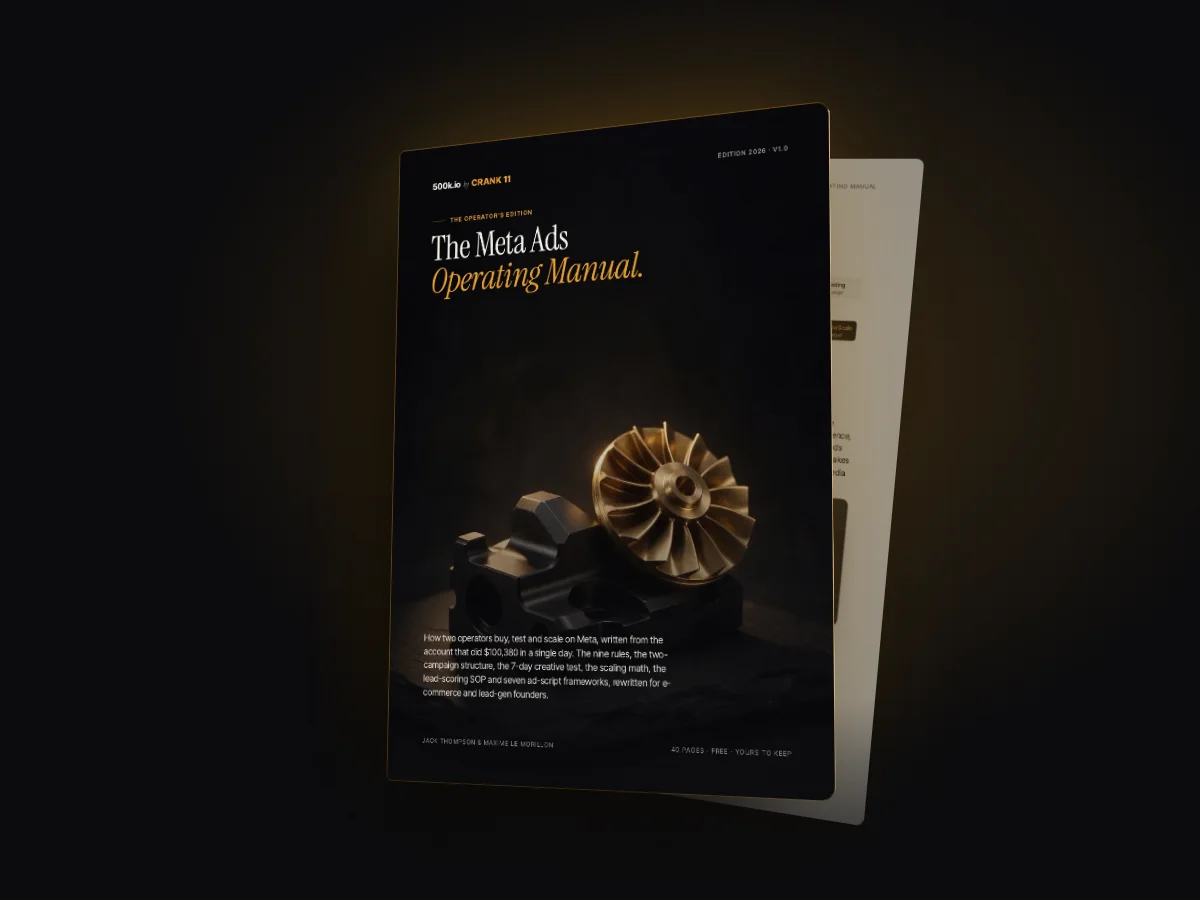
Last Tuesday I opened a Meta dashboard and saw a 60% CPL spike across three campaigns inside 48 hours. By Friday we’d diagnosed it, refreshed creative, and had CPLs back inside target. That loop — diagnose, refresh, deploy — used to take 5-7 days with 2-3 people. With the AI workflow we shipped in March, it now takes 12-18 hours with one person. That single shift is the whole thesis of this article.
This is a longer essay than I usually write. It’s the brand-defining piece for 500k.io because the bet I’m making is what determines whether the path to $500K solo is realistic for me — and for anyone reading this who’s running ads, building agencies, or thinking about either. If you’ve read the honest math: $500K solo SaaS in 18 months, this is the agency-side companion.
Quick context for new readers: I’m Maxime. I run The Kreators AI with my co-founder Jack. Combined we manage ~$45M of revenue across US lead-gen and FR mutuelle senior verticals. I personally manage roughly $10M of Meta Ads spend. 500k.io is the live journal of me building a solo $500K business on top of the agency — currently at $9,500 MRR, 22.8% to target, on a 13-tool $565/mo stack. The receipts are public on the dashboard.
Why I’m writing this
Most “I run $X of Meta Ads” essays are pitches. Here’s what I learned, here’s the course. I’m not selling a course. I’m publishing this because three things are happening simultaneously in 2026 that I haven’t seen anyone else map clearly:
- Manual ad creative iteration is collapsing in time-cost. The 5-7 day diagnose-iterate-deploy loop is becoming a 12-18 hour loop. That changes agency unit economics.
- Agency margins are compressing from in-house AI ops. Mid-market clients are bringing AI-assisted media buying in-house faster than expected. Agencies that don’t differentiate via AI workflows lose those clients within 24 months.
- Solo operators with vertical expertise + AI workflows can compete on turnaround time and margin. This is the 500k.io thesis — the path I’m taking personally.
These three trends compound. They’re the bet. Below is the math.
What $10M of Meta spend actually taught me
You learn different things at $0-100K spend, $100K-$1M, and $1M-$10M. The lessons don’t transfer cleanly across scales.
What I learned at $0-100K spend (years 1-2)
Optimization is largely irrelevant at this scale. The best campaign at $50K spend mostly looks like the worst campaign at $50K spend after you back out random variance. What actually matters at this scale: pick the right vertical, get a clean enough creative shipped, don’t blow up your account on compliance violations.
Most “media buying expertise” sold to founders at this stage is theater. The decision space is small enough that getting basics right wins.
What I learned at $100K-$1M spend (year 3)
Creative iteration speed becomes the bottleneck. The math says you should test 20-50 angle variations to find the 2-3 that scale. At manual production speeds (3-5 ads per week per buyer), that takes 3-6 months. By the time you find the winners, the audience has fatigued and you start over.
This is where most agencies get stuck. They have systems for media buying optimization (placement, audience, bidding) but no system for creative production at scale. Margins compress because the same campaign gets re-optimized for 6 months instead of refreshed every 4-8 weeks.
What I learned at $1M-$10M spend (year 4 and ongoing)
Creative angle is everything. I have specific data here. On UpgradeMatch (US bathroom remodeling) in Q1 2026:
- Best angle (Safety): €4.37 CPL on 6 leads (small sample but consistent)
- Best volume angle (Statistics): €16.56 CPL on 22 leads
- Mid angle (Product features): €23.46 CPL on 19 leads
- Worst angle (Reviews): €65.89 CPL on a small sample — killed before scaling
15x cost gap between best and worst angle. Same product (walk-in shower lead gen). Same audience (US bathroom remodeling intent). Same landing page. Same ad account. Same compliance gates (Modernize, TCPA).
The single decision — which angle to lead with — drove a 15x cost outcome. Bidding optimization, audience refinement, placement tweaks, day-parting — all of those combined moved CPL by maybe 1.5-2x at best. Angle moved it 15x.
This is the lesson nobody trains junior media buyers on. Most “Meta Ads optimization” content is about the 2x levers because they’re easier to teach. The 15x lever is angle, and angle is creative work, and creative work has been the slowest part of the loop.
The bet — three layers
If creative iteration speed is the bottleneck, and AI is collapsing creative iteration time from days to hours, then the bottleneck moves. That’s the foundation of the bet.
Layer 1 — Manual creative iteration loop becomes AI-driven by 2027
Right now (May 2026), most agencies still have humans doing the bulk of ad creative production:
- Brief written by strategist (1-2 hrs)
- Copy written by copywriter (2-4 hrs per variant)
- Design / image generation (2-6 hrs per variant)
- Compliance review (1-2 hrs per variant)
- Upload + setup (30 min - 1 hr per variant)
Total per variant: 6-15 hours human time. At agency rates, $400-$1,500 fully-loaded cost per variant.
In an AI-augmented workflow:
- Brief written by strategist or AI from existing brief library (15-30 min)
- Copy written by Mercury-style AI agent referencing voice bible + performance data (5-10 min)
- Image generation via gpt-image-1 or Midjourney (5-15 min)
- Compliance review via skill referencing compliance bible (10 min)
- Upload + setup (10 min, partially automated)
Total per variant: 45-80 minutes human time. Cost: $50-200 fully-loaded.
That’s a 10-15x cost compression on creative production. Same quality after iteration cycles. The agencies that ship this workflow in 2026 will produce 10x the variants at the same cost. The ones that don’t will lose campaigns to the ones that do.
Layer 2 — Agency middleman compresses 40-60% on margin
Mid-market clients ($1M-$10M ad spend) are bringing AI ops in-house faster than I expected. Two of our agency clients in 2025 left to build internal teams in 2026 — both citing AI tooling making in-house ops viable at lower headcount.
The math from the client side:
- Pre-AI in-house team: 4-6 FTEs at $80K-$150K each = $400K-$900K/yr
- AI-augmented in-house team: 1-2 FTEs at $100K-$180K each + $20K-$50K/yr in tools = $150K-$430K/yr
Agency replacement cost was previously 5-10x the agency fee for mid-market clients. Now it’s 1.5-3x. The “build vs buy” calculus has flipped for clients in the $1M-$10M spend bucket.
Agencies that don’t differentiate via AI workflows will see margins compress 40-60% over the next 24 months. Either through clients leaving for in-house, or through pricing pressure to keep them.
The agencies that survive: the ones that compound AI leverage faster than clients can replicate it. Higher-velocity creative, deeper vertical expertise, broader compliance coverage. The agency stops being a labor arbitrage business and becomes a leverage arbitrage business.
Layer 3 — Solo operators with vertical expertise + AI workflows compete with mid-market agencies
This is the 500k.io thesis. If creative iteration is 10-15x faster with AI, and the bottleneck moves to vertical expertise + judgment, then a solo operator with deep vertical knowledge + AI workflows can produce mid-market agency output at solo unit economics.
What this looks like in practice:
| Metric | Mid-market agency | Solo with AI workflows |
|---|---|---|
| Headcount | 4-12 FTE | 1 + AI agents |
| Monthly fixed cost | $80K-$300K | $5K-$15K |
| Creative variants / month | 100-300 | 100-300 |
| Turnaround time (brief to live) | 5-10 days | 24-72 hours |
| Margin to founder/owner | 15-30% | 60-85% |
Same output, drastically different unit economics. The trade-off: solo can’t easily scale beyond 5-10 large clients because vertical expertise doesn’t replicate. But for the right 5 clients, the math is brutally good.
500k.io is my personal version of this bet. $9,500 MRR / 1 client at $9,500/mo retainer = 22.8% to $500K target. If I can scale to 5 similar retainers at the same margin, I clear $500K. If the workflows compound enough that I can run those 5 with 35-40 hours/week, the bet pencils.
What I’m actually betting on (where my own money goes)
This isn’t theoretical. Here’s where I’m putting time and capital.
Bet 1 — In-house AI workflows at The Kreators AI
We’re investing 15-20% of agency operating budget in 2026 on AI workflow development. Specific projects:
- Mercury-style AI copywriter trained on the agency’s compliance + voice bibles
- Apollo-style AI media buyer for diagnostic + reporting automation
- Vertical-specific skills for TCPA, GDPR, FR mutuelle compliance
- Daily creative refresh pipeline for top campaigns
If these workflows save 20-30% of creative production time across our $45M book, that’s $400K-$1M of margin recovery against compressing agency rates.
Bet 2 — 500k.io as the solo proof point
I’m building 500k.io publicly to test whether the solo + AI workflow model actually works for someone with my background. If it does, the playbook becomes valuable in itself (see Claude Skills marketplace as the next App Store). If it doesn’t, I write the post-mortem and pivot.
Investment: roughly 6 hrs/week of my own time + $565/mo on the stack. Cheap, time-bound, and the downside is tutorial content.
Bet 3 — Vertical expertise as productized skills
Packaging the highest-leverage agency knowledge as paid Claude Skills:
- TCPA compliance audit framework
- Meta Ads campaign architecture for bathroom remodeling
- Mutuelle senior creative angle library
- Compliance copy patterns for restricted verticals
Pricing $499-2,499 each. Distribution via 500k.io and Synapse Circle. Target $5K-25K MRR by Q4 2026.
Bet 4 — Distribution before everything
The single highest-leverage move I’m making in 2026: building distribution. The 500k.io newsletter, the LinkedIn cadence, the podcast appearances, the Synapse Circle community. Distribution is the asset that compounds even if the agency model shifts under us.
If the bet is right, we have multiple revenue paths. If the bet is wrong, we have an audience that lets us pivot fast.
What I’d bet against
The contrarian half of the bet — what I think doesn’t work in 2026-2028.
Against agencies that haven’t shipped AI workflows by mid-2026
If your agency in May 2026 doesn’t have an active AI workflow project, you’re probably 18-24 months from being structurally uncompetitive on creative volume and turnaround time. The window to invest closes by Q4 2026.
Against “AI-first” founders who’ve never run a real campaign
The number of “AI marketing experts” on Twitter who have never managed a $100K Meta budget is staggering. Theory beats practice exactly never in performance marketing. If your AI workflow has never survived a real campaign with real money on the line, it doesn’t survive a real campaign.
Against solo founders who build SaaS without distribution
Half the founders I track who attempted solo SaaS in 2024-2026 built before they had distribution. 11 of 14 failed. Distribution is the moat. Product is the deliverable. Backwards is expensive.
Against any model that depends on cheap human labor as a moat
If your business runs on offshoring creative production at $5-15/hr, AI workflows at $50-200 per variant fully-loaded match your output at higher quality and faster turnaround. The labor arbitrage moat closes faster than most owners expect.
“The agencies that survive 2026-2028 are the ones that compound AI leverage faster than their clients can replicate it. Higher-velocity creative, deeper vertical expertise, broader compliance coverage. The agency stops being a labor arbitrage business and becomes a leverage arbitrage business.” — Maxime Le Morillon, building 500k.io in public
What I could be wrong about
Steel-manning the case against my own bet. Three things that would invalidate part or all of the thesis.
1. AI creative production hits a quality ceiling that takes years to crack
If AI-generated ad creative plateaus at 60-70% of human-creative quality and stays there for 3+ years, the time-compression gains don’t translate to performance gains. Agencies that ship slower-but-better creative continue to win, and the “10-50x more variants” thesis becomes “10-50x more variants of mediocre creative.”
I think this is unlikely (current trajectory suggests we’ll cross 90% quality parity by mid-2027) but it’s the strongest counter-bet.
2. Meta platform shifts in ways that punish AI-generated creative
If Meta detects and downranks AI-generated creative (which they’ve toyed with for organic content), the workflow advantage flips. Agencies that ship human-edited creative win. AI-only workflows underperform.
I’d put this at 20-30% probability over 24 months. Mitigated by hybrid workflows (AI generation + human editing) which we’re already running.
3. Mid-market clients keep outsourcing despite AI viability
Cultural inertia is real. Some mid-market clients will keep paying agencies even when in-house is cheaper because changing vendors is painful. The agency margin compression takes 4-5 years instead of 2.
This delays the bet but doesn’t invalidate it. Solo operators still win on turnaround and margin even if agency margin compression is slow.
Why I’m publishing this on 500k.io and not LinkedIn
This essay would get more engagement on LinkedIn. I’m publishing it on 500k.io because the long-form essay is the content most likely to compound — for AI citations, for SEO, for the specific founder audience that reads 4,000-word pieces. LinkedIn rewards 200-word hot takes. 500k.io rewards depth.
Also: I want this on a domain I own. Not a platform that can change algorithms or terms tomorrow.
If you read this far, you’re the audience. The 500K Brief newsletter is at /newsletter. Synapse Circle community is at /community. Both are free at this stage. Both are where I’ll publish updates on whether the bet is working as we go.
FAQ
How much Meta Ads spend do you actually manage?
$10M personally over the past 4 years across US bathroom remodeling, FR mutuelle senior, US personal injury. Combined with my co-founder Jack at The Kreators AI: roughly $45M of combined revenue. 500k.io is the personal-brand journal of going from $0 to $500K solo on top of that.
What’s the AI bet you’re making?
Three layers: manual ad creative iteration becomes AI-driven by 2027 (10-50x more variants), agency middleman compresses 40-60% on margin (in-house ops gets viable at lower headcount), solo operators with vertical expertise + AI workflows compete with mid-market agencies on turnaround and margin.
Are you closing The Kreators AI agency?
No. The agency runs in parallel with 500k.io. The bet is that the agency model evolves, not that it dies. We’re investing in AI workflows internally — the agency that survives compounds AI leverage faster than competitors.
What’s the single biggest lesson from $10M of Meta spend?
Creative angle beats every other variable by 5-10x. Same product, same audience, same landing page, same ad account: best angle €4.37 CPL, worst €65.89 CPL. 15x cost gap from one decision.
Why publish this as 500k.io content if it’s about the agency?
Because the bet determines whether 500k.io’s path to $500K solo is realistic. If AI rewrites the agency playbook, it also rewrites the solo playbook. The audiences overlap.
What would you bet against?
Against agencies that haven’t shipped AI workflows by mid-2026. Against “AI-first” founders who’ve never run a real campaign with real money on the line. Against any model that depends on cheap human labor as a moat.
Going further
- The honest math: $500K solo SaaS in 18 months
- Why Claude Skills Are the Next App Store
- The AI Agent Monetization Playbook
- Claude Code Pricing in 2026, Actually Explained
- The 500K dashboard
- The 500K stack
- The 500K Brief newsletter
FAQ
How much Meta Ads spend do you actually manage?
$10M personally over the past 4 years across multiple verticals (US bathroom remodeling, FR mutuelle senior, US personal injury). Combined with my co-founder Jack at The Kreators AI, we manage roughly $45M of combined revenue. That's the agency context — 500k.io is the personal-brand journal of going from $0 to $500K solo on top of that.
What's the AI bet you're making?
Three layers: (1) Most of the manual ad creative iteration loop becomes AI-driven by 2027 — creators ship 10-50x more variants. (2) The agency middleman compresses — agencies that don't build AI workflows lose 40-60% of their margin to in-house AI ops within 24 months. (3) Solo operators with vertical expertise + AI workflows can compete with mid-market agencies on pure margin and turnaround time.
Are you closing The Kreators AI agency?
No. The Kreators AI is the agency. 500k.io is the personal journal of building solo on top. Both run in parallel. The bet I'm making is that the agency model evolves, not that it dies. We're investing in AI workflows internally — the agency that survives 2026-2028 is the one that compounds AI leverage faster than competitors.
What's the single biggest lesson from $10M of Meta spend?
Creative angle beats every other variable by 5-10x. I have data on this — same product, same audience, same landing page, same ad account: best angle gets €4.37 CPL, worst angle gets €65.89 CPL. 15x cost gap from one decision. Most agencies are still optimizing the wrong things.
Why publish this as 500k.io content if it's about the agency?
Because the bet is what determines whether 500k.io's path to $500K solo is realistic. If AI rewrites the agency playbook, it also rewrites the solo playbook. The audiences overlap — leveraged solopreneurs care about the same shifts agencies face.
What would you bet against?
Against agencies that don't ship AI workflows internally by mid-2026. Against solo founders who build SaaS without distribution. Against 'AI-first' founders who haven't run a real campaign with real money on the line. Against any model that depends on cheap human labor as a moat.