
A Google Ads management agency owns strategy, campaign build, bidding, creative, feeds, tracking and reporting, then accepts accountability for efficient growth at scale. For founders spending $30,000 or more each month, the right partner protects measurement quality and budget decisions, rather than merely adjusting keywords.
A google ads management agency is a specialist team that connects paid-search strategy to commercial outcomes. Hiring one for keyword lists alone is the popular answer, and it’s incomplete in 2026. Automation now changes bids, search coverage, assets and landing-page destinations, so human governance matters more than busywork.
We built Crank11 around that problem. We’ve built our own brands past $35M, managed more than $10M in personal paid spend, and learned that efficient acquisition depends on what gets measured, approved and reversed, not just what gets launched. Founders spending $30k+/month need an operator who can diagnose waste before scaling it.
What a Google Ads Management Agency Actually Does
A serious agency turns Google Ads into a governed growth system. It decides where budget belongs, which signals deserve trust, what automation can change, and how each decision affects CAC, qualified pipeline, contribution margin, or revenue.
“Keyword research, ad copy and bids” describes campaign setup. Account management carries a wider responsibility. Automated systems can influence matching, bidding, assets, and URLs, while consent gaps can corrupt the data used for optimisation.
The job is accountability, not activity
An agency should own the operating rhythm around paid search:
- Commercial strategy: Translate margin, LTV, sales capacity, and inventory into campaign priorities.
- Account architecture: Separate brand, non-brand, products, services, and geographies so different objectives remain visible.
- Measurement governance: Validate purchases, qualified leads, offline outcomes, and consent signals before using them for optimisation.
- Automation oversight: Review recommendations, set boundaries, document edits, and reverse changes that weaken efficiency.
- Post-click performance: Treat landing pages, forms, and checkout paths as part of the acquisition system.
The account also needs a reversible-edits audit. Every material change should record the date, owner, hypothesis, affected campaigns, expected outcome, and rollback method. Review the result against CAC, lead quality, margin, or revenue, then reverse the change when the evidence fails. This audit protects the account from silent automation drift and leaves you with an intelligible record when agency ownership changes.
Google Ads remains the largest paid-search ecosystem. A 2026 industry summary estimates an 80.2% global PPC market share, while benchmark data across more than 13,000 US campaigns reports average Search performance of 6.64% CTR, $5.42 CPC, 8.18% conversion rate and $66.69 cost per lead. These figures come from Whatagraph’s 2026 PPC benchmark summary, and they show why small efficiency changes matter at meaningful spend.
At $30k/month, a one-dollar CPC increase buys fewer visits from the same budget. If clicks fall while conversion rate and lead quality stay constant, qualified opportunities fall with them. The agency must quantify that trade-off against your margin threshold, not celebrate a cheaper click in isolation.
Our position: If an agency cannot explain what it changed, why it changed it, and how to undo it, it is managing a platform, not your growth risk.
Inspect the operating model before admiring the presentation. A polished report can coexist with weak tracking, uncontrolled automation, and ownership clauses that make departure painful. The warning signs are laid out in why we fired our agency. Your account should remain intelligible without the agency standing beside it.
How Google Ads Management Has Changed Since AdWords
Google Ads management moved from manual keyword buying to continuous control of an automated advertising system. The platform’s history explains why a modern brief must include bidding, creative, feeds, landing pages and measurement together.
Google launched AdWords in 2000. In 2002, it moved from CPM to CPC pricing. Quality Score and the AdWords API arrived in 2005, Smart Bidding launched in 2016, Responsive Search Ads in 2018, and Performance Max in 2020. These milestones are documented in the Google Ads benchmark timeline from Owlclaw.
Manual controls became inputs
Early search management rewarded close attention to keyword bids and ad groups. That work still matters, but it no longer represents the full control surface. A manager now supplies conversion goals, values, exclusions, creative assets, feed information, URL controls and first-party signals, then evaluates what the system does with them.
Responsive Search Ads changed the creative workflow. Performance Max widened the inventory and asset problem. Smart Bidding made conversion quality a commercial concern, because the system can optimise efficiently towards the wrong event if the account records weak signals.
By 2024, Google had added AI asset testing and Video Enhancement features to Performance Max, while its ads reporting retention policy changed in November 2024. Those changes reinforce a point many retainers miss. Platform competence now means adapting to product changes without allowing the account to drift.
Why keyword-only management fails
Keyword lists can’t govern an automated system by themselves. If tracking records every low-value form completion as a success, bidding learns the wrong lesson. If consent gaps remove conversion signals, the model sees an incomplete customer journey. If final-URL expansion sends traffic to pages that don’t match intent, a strong click signal can still produce poor commercial outcomes.
This is why we treat Google Ads as an operating loop:
- Define the business signal.
- Check whether the signal is captured.
- Give automation controlled room to act.
- Review the result against profit and incrementality.
- Keep, modify or reverse the change.
A provider that still sells “weekly bid adjustments” as the central deliverable is selling yesterday’s job description. The valuable work sits above the interface.
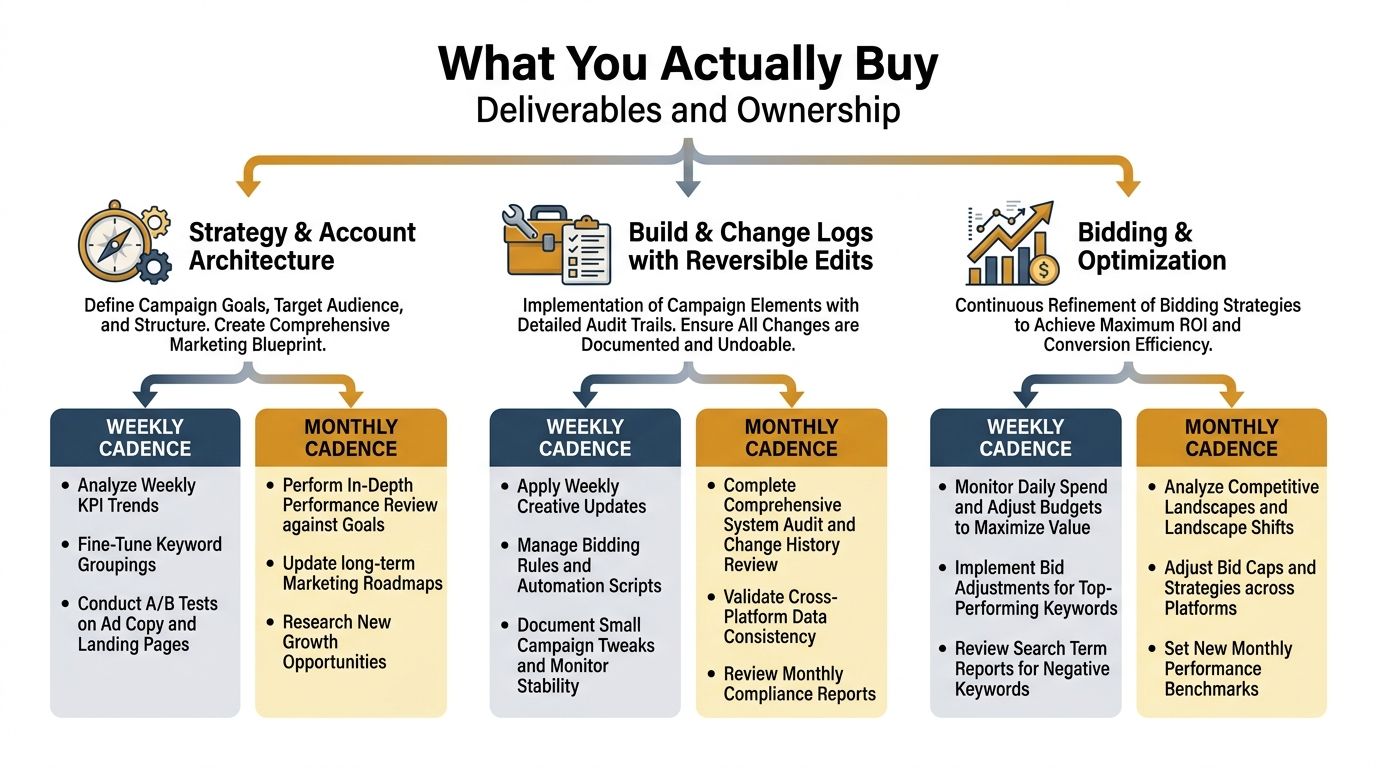
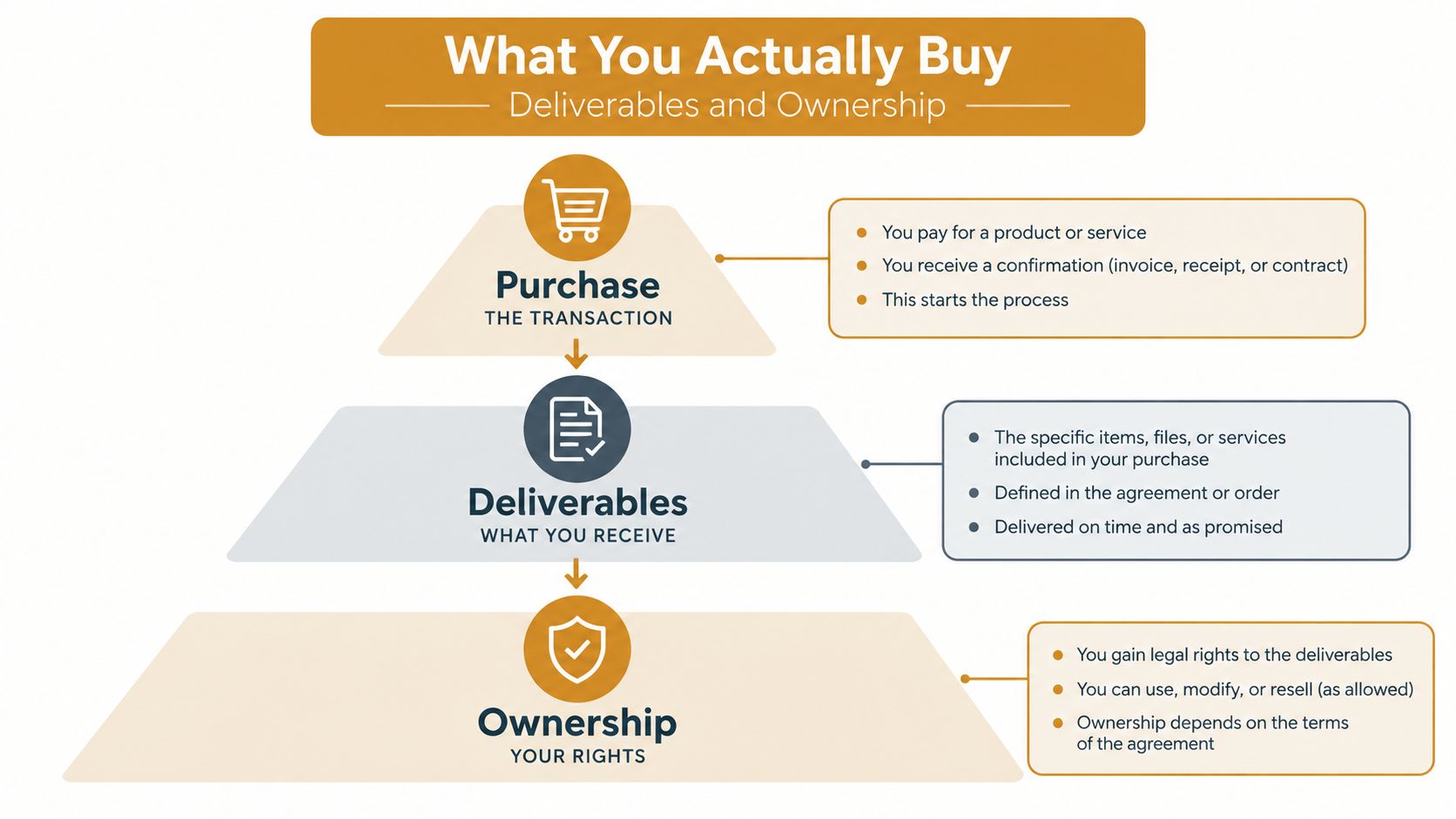
What You Actually Buy Deliverables and Ownership
You’re buying a repeatable operating system, not access to someone who logs in occasionally. The scope should specify the cadence, owner, approval rights and evidence for every material decision.
Weekly ownership
A useful weekly cadence begins with account health and ends with approved action.
- Search and query review: An operator checks intent, irrelevant demand, brand overlap and emerging opportunities.
- Budget allocation: Spend moves between campaigns only after checking marginal efficiency and business constraints.
- Creative review: Assets are assessed against message, offer, policy and conversion quality, not just impressions.
- Change log: Every edit records date, operator, reason, expected effect and rollback method.
- Lead or revenue validation: Reported conversions are checked against CRM stages, orders or qualified outcomes where available.
The client should sign off strategic changes that alter risk, such as new geographies, materially broader targeting or a different optimisation event. The agency can handle routine reversible edits within agreed boundaries.
Monthly ownership
Monthly work should answer a harder question than “did ROAS rise?” It should explain whether the account is acquiring valuable customers efficiently and what constraint is limiting the next increment of spend.
That includes account architecture, search coverage, feed quality, landing-page performance, creative testing and budget scenarios. It also includes a written record of what was tested, what failed, what earned expansion and what remains uncertain.
Tracking deserves its own line item. Google’s documentation says Consent Mode changes how Google tags behave according to consent state, and conversion modelling can address missing journeys when consent signals aren’t available. Google also reported a 7% conversion increase in one Consent Mode example, as described in its Consent Mode product documentation.
Google states that the ad_user_data consent type is required for measurement use cases including enhanced conversions and tag-based conversion tracking in its consent requirements reference. This isn’t a legal footnote. It determines whether advanced measurement can function.
Ownership must be contractual
You should own the ad account, billing relationship, conversion properties, audiences, feeds, landing pages and creative source files. Google confirms that if a manager account creates a new Ads account, the manager automatically becomes its owner, which makes account creation and access control a concrete governance issue. The mechanics are set out in Google’s manager account ownership guidance.
Ask for access on day one. Ask for exports before termination. Ask whether an agency can make changes without approval and where the rollback record lives.
A missing change log predicts confusion. A missing ownership clause predicts friction. Both are scope failures, not minor administrative gaps.
How Much a Google Ads Management Agency Costs and How Pricing Works
Pricing should reflect operating complexity and accountability, not reward an agency for spending more. For a founder spending $30k+/month, percentage-of-spend pricing needs guardrails, while a flat retainer needs a clearly defined workload.
| Pricing Model | How It Charges | Best For | Watch Out |
|---|---|---|---|
| Percentage of spend | A set share of monthly media spend, often with a minimum | Accounts where workload rises sharply with spend | The agency earns more when spend rises, even if efficiency weakens |
| Flat retainer | Fixed monthly fee for defined deliverables | Predictable budgets and stable operating scope | Cheap scopes often omit tracking, CRO or creative governance |
| Flat plus performance | Base fee plus an agreed performance component | Mature measurement with trusted revenue or lead data | Attribution disputes can distort incentives |
| Project audit | Fixed fee for a defined diagnostic | Accounts needing an independent health check | An audit without implementation may leave the main problem untouched |
The maths exposes the incentive
Take named inputs: $50,000 monthly media spend, a 15% management fee, and a one-month period. The fee calculation is:
$50,000 × 0.15 = $7,500 per month.
That means the business pays $7,500 for management in addition to $50,000 in media, before creative, landing-page or data work that sits outside the scope. The model can be sensible if the agency’s workload and accountability rise with the account. It becomes awkward if the agency recommends more spend without proving that marginal traffic improves contribution.
A flat retainer avoids that direct spend incentive, but it can create a different failure. If the scope covers only campaign maintenance, nobody owns the measurement layer or post-click bottleneck. The lowest invoice can then become the most expensive option through ignored waste.
Set breakpoints before signing
Percentage fees need a ceiling, minimum deliverables and a review point when spend changes materially. Flat retainers need a workload limit, response expectation and an explicit list of what ships each week. Performance fees need a definition of conversion value, an attribution window and rules for refunds, sales-cycle lag and offline qualification.
Our Google Ads pricing framework is useful only as a reference point. Your decision should rest on the economics of the account, the risk of bad measurement and the amount of senior attention required.
Don’t accept a fee discussion detached from decision rights. If the provider controls spend, targets and reporting, the commercial model must make those powers visible.
How to Tell If Management Is Working Benchmarks and Measurement Health
ROAS can look healthy while the account measures the wrong customer action. Judge management in this order: measurement health, traffic quality, then landing-page efficiency. Treat platform results as outputs that require business validation, not as proof of value.
The 2026 benchmark dataset covers more than 13,000 campaigns across 23 industries, with average Search CTR of 6.64%, conversion rate of 8.18% and cost per lead of $66.69, according to TheeDigital’s 2026 Google Ads benchmarks. Use these figures as directional baselines. They are not universal targets.
Read the mismatch
A CTR near 6.64% with conversion rate materially below 8.18% directs attention after the click. Review message-to-page continuity, form friction, offer clarity, mobile experience and whether the conversion event represents a commercial outcome.
Low CTR with healthy conversion rate indicates a different problem. Inspect query relevance, ad messaging, brand and non-brand separation, match behaviour and the visible offer. Do not rewrite the landing page to fix an ad relevance problem.
CPC also needs context. Consolidated benchmark sets place average Search CPC around $4.22 to $5.26, while a broader benchmark summary reports $5.42. Use those figures as reference points, then account for category, intent and geography before declaring a bid strategy broken. A rise from $4.22 to $5.42 is roughly a 28% increase, so the same budget buys fewer clicks even before conversion performance changes.
Audit signal quality before scaling
Consent Mode, enhanced conversions and final-URL expansion change the inputs available to automated bidding. Documented comparisons report about 7% more conversions or conversion value at similar CPA or ROAS with the full feature suite compared with search-term matching alone.
That result supports a controlled test, not blind expansion. Fix consent and conversion quality first. Then record each change, its expected signal, its risk boundary and the rollback state. Reversible edits make AI-assisted optimisation auditable and protect the account from untraceable drift.
Use our ad account audit guide to inspect the account in the right order. Confirm that reported conversions represent valuable outcomes, consent signals behave correctly, CRM or order data reconciles, and the landing URL serves the intended journey.
Diagnostic rule: A benchmark tells you where to look. It does not tell you what to change.
How to Evaluate a Google Ads Management Agency Without a Beauty Parade
Choose governance over impressive execution. The best presentation in the room can’t compensate for unowned accounts, unreviewed AI recommendations or reporting that stops at platform ROAS.
Run this five-part test before signing.
1. Can humans explain the strategy
Ask the senior operator to explain budget allocation in terms of customer economics, not platform recommendations. They should identify the conversion event, the acceptable acquisition cost, the role of branded demand and the conditions for increasing spend.
If the answer is a list of settings, keep looking. Strategic oversight must remain human-led because the business decides what a valuable customer means.
2. Are AI changes bounded
Require a written automation policy. It should state which recommendations can be applied automatically, which require approval and what evidence triggers a rollback.
A reversible-edits framework needs five fields:
- Change: What changed in the account?
- Reason: Which business or measurement problem justified it?
- Expected signal: What should improve, and over what observation period?
- Risk boundary: What deterioration triggers review?
- Rollback: Which prior setting, asset or budget state gets restored?
This framework preserves speed without turning the account into an untracked experiment.
3. Can you audit the ledger
You should be able to reconcile platform spend, reported conversions, qualified outcomes and revenue. If the agency resists raw access or presents only a blended score, the reporting system is protecting the provider, not the budget.
4. Do thresholds exist before the test
Agree decision thresholds before launch. Examples include a maximum acceptable CAC, a minimum qualified-lead rate, a contribution-margin floor or a rule that new traffic must show incremental value rather than merely receive brand credit.
We disagree with the standard advice to chase ROAS in isolation. A campaign can report strong ROAS by harvesting demand that would have arrived anyway, while a higher-cost acquisition stream creates better LTV and genuine growth. Budget allocation should consider incrementality and LTV, not just the platform’s attributed revenue.
5. Is the account genuinely senior-led
Ask who writes the strategy, who approves changes and who answers during a performance break. A senior-only model, clear reporting and a defined response target matter more than a large account roster.
Our in-house versus agency cost maths is useful here because the comparison isn’t just salary against retainer. It includes founder time, specialist coverage, creative production, tracking maintenance and the cost of slow decisions.
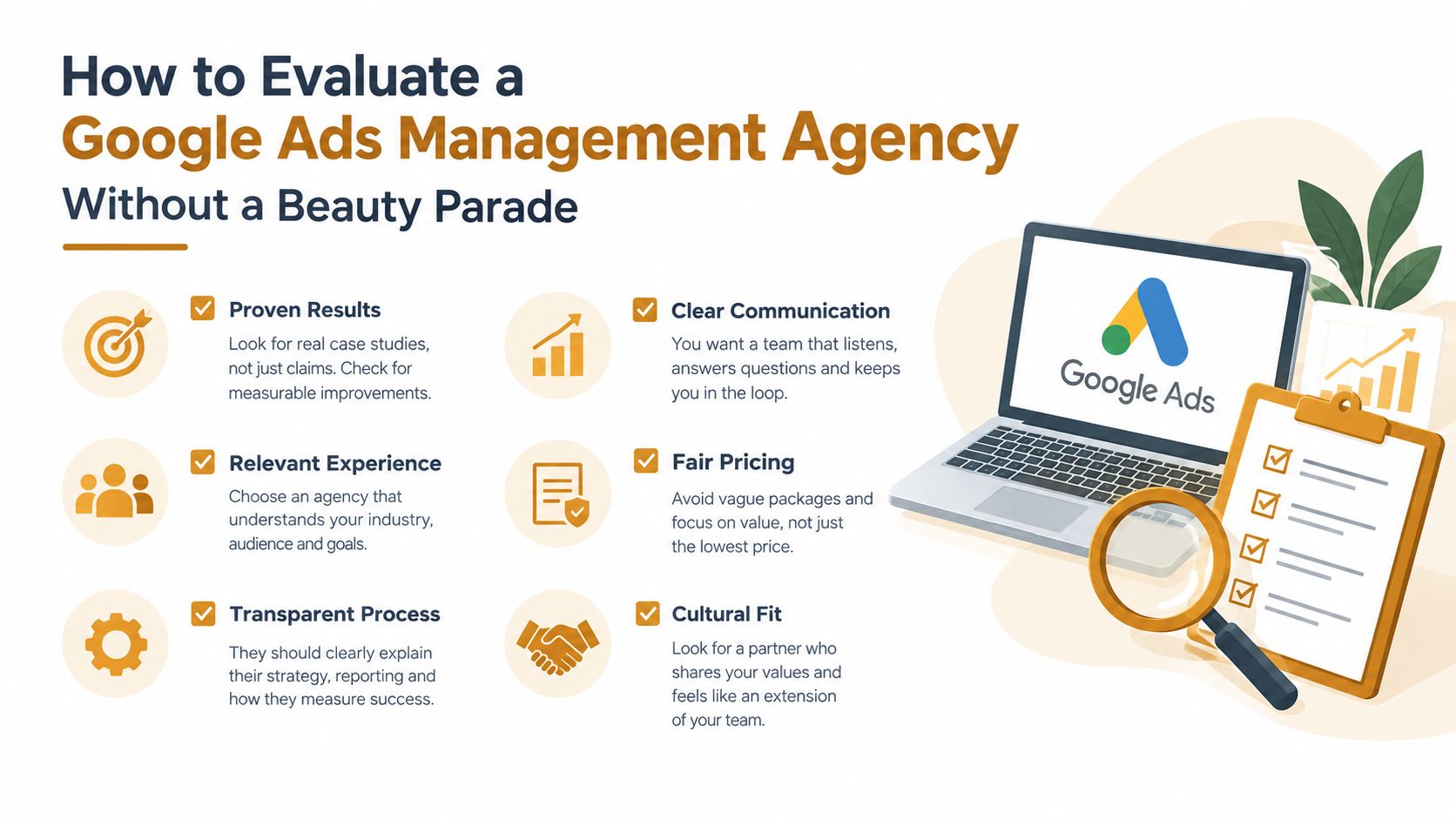
Score each category from zero to two. Any provider scoring zero on ownership or measurement should be rejected, regardless of its promised ROAS.
Quick Answers About Hiring a Google Ads Management Agency
Should we hire an agency or keep Google Ads in-house?
Keep it in-house if you already have senior coverage for strategy, tracking, creative, CRO and platform governance. Hire externally when one operator is carrying all of those jobs, because execution speed and measurement quality will eventually suffer.
What monthly spend justifies an agency?
There’s no universal minimum, but a $30,000 monthly media budget creates enough financial exposure for governance to matter. At lower spend, a focused internal operator may be more efficient. At higher spend, the cost of unmanaged measurement errors rises with every allocation decision.
How long should the contract be?
Prefer month-to-month terms with fixed deliverables. You need enough time to establish clean measurement and observe tests, but a long lock-in is not a substitute for performance, transparency or reversible work.
Who should own the account?
You should own the account, billing relationship, assets, audiences, feeds and landing pages. Give the agency access, not permanent control over the company’s acquisition infrastructure. More practical answers sit in our Google Ads FAQ.
How quickly should we expect useful signal?
Expect immediate visibility into structural and tracking problems, but judge strategic changes over an agreed observation period. A provider should show what it changed, why the change matters and what evidence will determine the next decision.
Tomorrow morning, export the last change history, validate the primary conversion against revenue or qualified outcomes, and mark every unexplained edit for review. Use the free ad account audit to turn that review into a prioritised action list.
[[C11-OPTIN]]
Crank11 provides senior-led Google Ads management, change logs, reversible edits, tracking fixes, creative production and CRO for brands spending $30k+/month. Visit Crank 11 to see how we connect paid acquisition decisions to measurement and commercial accountability.