
A fixed price marketing agency charges a set fee for a defined scope, usually monthly or per project, regardless of ad spend or revenue. The model works when deliverables, revision limits and change orders are explicit. It doesn’t guarantee better ROI. It guarantees a predictable invoice, while the quality of execution still depends on resourcing and control.
The popular advice says fixed pricing is simple. That’s incomplete. The buyer question is whether the fixed scope gives your brand enough senior attention, creative iteration and operational flexibility to justify the fee.
What a fixed price marketing agency actually means
A fixed price marketing agency is a partner that charges a set fee for defined marketing deliverables, regardless of changes in ad spend or revenue. The fee can cover a monthly retainer, a campaign build, an audit or another bounded project.
That structure differs from percentage-of-spend pricing. A percentage model rises as media spend rises, while a fixed fee stays constant within the agreed scope. A hybrid combines a base fee with a variable charge, often for additional work or media management.
For a founder scaling beyond $3 million in revenue, predictable overhead can be useful when paid budgets move quickly. You know the agency invoice before the month starts. You can model the cost against contribution margin, forecast cash requirements and avoid paying more because the media budget increased.
The trade-off sits elsewhere. Fixed pricing transfers more scope risk to the agency, so the agency must define what it will deliver, how often it will deliver it and how many revisions are included. The paid social agency selection framework should therefore examine operating capacity, not just the monthly fee.
Bounded work makes the model viable
An audit, campaign build or launch has a discernible endpoint. Ongoing optimisation doesn’t. A retainer can still use fixed pricing, but it needs a bounded operating envelope, such as named channels, defined reporting, agreed creative production and explicit approval steps.
The fee is not a blank cheque for every new idea that appears during the quarter. If a new funnel, channel or product launch enters the plan, something else must leave, or the parties need a change order.
Practical rule: A fixed fee should describe the work the agency will perform, not merely the result the client hopes to receive.
This is why “unlimited testing” is a warning sign. Testing consumes strategy, production, implementation and analysis capacity. Without limits, the phrase either produces weak execution or creates a dispute later.
How much does a fixed price marketing agency cost in 2026
A fixed fee can look predictable while hiding expensive capacity limits. In 2026, ongoing single-service ecommerce engagements commonly cost $5,000 to $25,000 per month, while full-stack partnerships often range from $20,000 to $75,000 per month, according to Darkroom’s 2026 agency pricing benchmarks. These fees cover agreed work, not a percentage of ad spend or revenue.
A separate 2026 pricing survey reports that 42% of agencies use flat fees, compared with 31% using percentage-of-spend pricing and 27% using hybrid models. Typical flat-fee ad agency retainers range from $2,500 to $15,000+ per month, depending on scope, as outlined by Ryze’s agency pricing comparison.
| Engagement type | Monthly fixed fee | Typical deliverables |
|---|---|---|
| Single-service engagement | $5,000 to $25,000 | Paid media management, creative or retention work within one specialist scope |
| Full-stack ecommerce partnership | $20,000 to $75,000 | Paid media, creative production, funnel work and retention |
| Generalist retainer | $2,500 to $12,000 | Broader marketing support with a narrower delivery envelope |
| Growth retainer | $6,000 to $25,000 | Strategy, testing and execution across a defined growth remit |
The ranges matter less than the capacity behind them. A $5,000 fee may buy specialist paid media management, while a broader package at the same price spreads attention across creative, CRO, email and reporting. At $15,000, verify the senior operator time, production capacity and implementation access included.
Project work follows a different benchmark. A PPC audit commonly clusters around $2,000 to $5,000, while campaign buildouts commonly sit around $3,000 to $8,000, according to The Zulu Method’s marketing agency pricing benchmarks.
A proposal is expensive when it buys vague availability. It can be cheap when it buys a precise operating system.
Read the fee beside the deliverables. Count creative batches, landing page builds, optimisation cycles, reporting depth and revision rounds. Scope expansion and repeated approvals can consume the margin that funds senior review, leaving the client with slower testing and weaker output. Use our pricing structure as a reference point, then apply the same capacity test to any provider.
Why fixed fees create scope creep and revision bottlenecks
Fixed fees create their worst problems when strategy changes faster than the contract. The agency has promised a set amount of work for a set fee, so every new request consumes capacity without automatically creating revenue.
A new product launch illustrates the friction. The original scope covers Meta Ads, a creative batch and weekly optimisation. Mid-quarter, the founder asks for a new channel, a landing page, three new angles and another approval round. None of those requests is unreasonable. Together, they can displace the work that made the original fee viable.
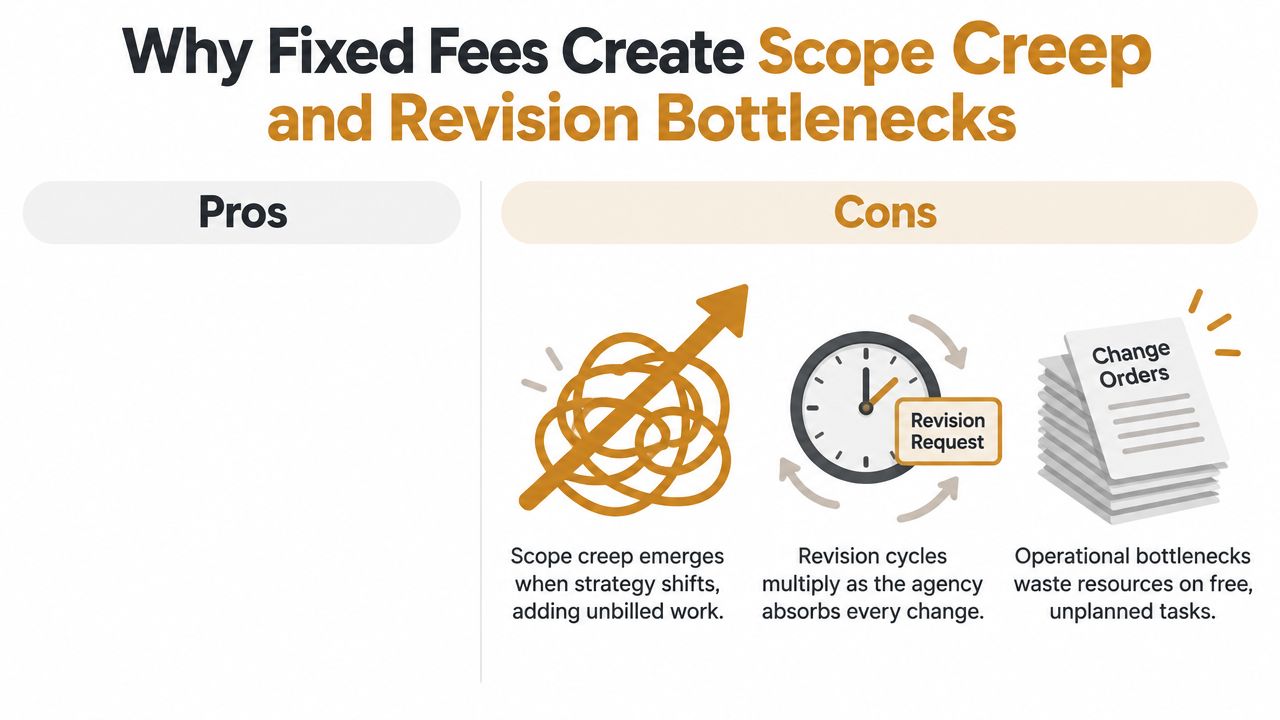
Where the bottleneck appears
The agency usually responds in one of three ways:
- Absorb the work: Margin falls, senior time gets squeezed and delivery quality deteriorates.
- Delay existing work: The new request ships, but planned testing or optimisation slips.
- Reject or reprice it: The agency protects capacity, but the client experiences friction.
A fixed-price contract study found 31% of fixed-price projects experienced budget overruns, with unclear specifications and difficulty implementing new ideas identified as core risks in the published fixed-price project study. The lesson isn’t that fixed pricing is defective. It’s that unclear boundaries are costly.
Revision loops cause similar damage. One “small tweak” to a concept can become several rounds involving copy, design, editing, compliance review and implementation. If the agreement doesn’t state the number of revisions per deliverable, the agency either gives away unplanned work or begins rationing feedback.
The common advice is to demand unlimited iterations. We disagree. A defined revision cap, paired with a fast change-order process, creates more honest collaboration. If priorities change, say which existing deliverable moves out, or price the additional capacity.
That’s also why our experience firing an agency matters as an operational lesson. A low-friction relationship isn’t one where every request is accepted. It’s one where both sides can see the cost, consequence and decision before work starts.
The unit economics of a monthly paid media retainer
A monthly fee only works if the agency can staff the account properly after overhead, delivery cost and margin. Buyers should ask for the capacity model, not just the headline number.
Take a $15,000 monthly retainer for full-stack execution. Use these named inputs:
- Monthly fee: $15,000
- Agency overhead allocation: 25% of the fee
- Target operating margin: 25% of the fee
- Delivery pool: the amount left for account work
- Senior blended delivery rate: $150 per hour
The calculation is:
$15,000 minus $3,750 overhead minus $3,750 margin equals $7,500 delivery budget.
At a $150 hourly delivery rate, that buys:
$7,500 divided by $150 equals 50 senior delivery hours per month.
That figure is not a universal standard. It’s a buyer-side test. If the scope includes paid media, creative direction, asset production, landing page work, CRO, reporting and stakeholder management, 50 senior hours can disappear quickly.
Test the capacity against your account
A brand spending £30,000 per month on paid traffic should map those hours to actual operating requirements. How much time goes to budget pacing, tracking checks, creative analysis, brief writing, approvals, implementation and experiment readouts?
If the proposal promises full-stack execution but the implied capacity is materially lower than the workload requires, the agency faces an unpleasant choice. It can use less experienced staff, reduce iteration or omit work. That is how a seemingly reasonable fee damages output quality.
The agency versus in-house cost maths is useful here because it forces a comparison based on capacity, not labels. Ask for named roles, expected involvement and the percentage of delivery handled by senior operators.
Capacity test: Divide the delivery budget by the blended hourly rate, then compare the resulting hours with every promised deliverable.
Don’t confuse activity with impact. More hours won’t rescue weak judgement, but a strategy cannot be executed without enough capacity. The retainer should make both visible.
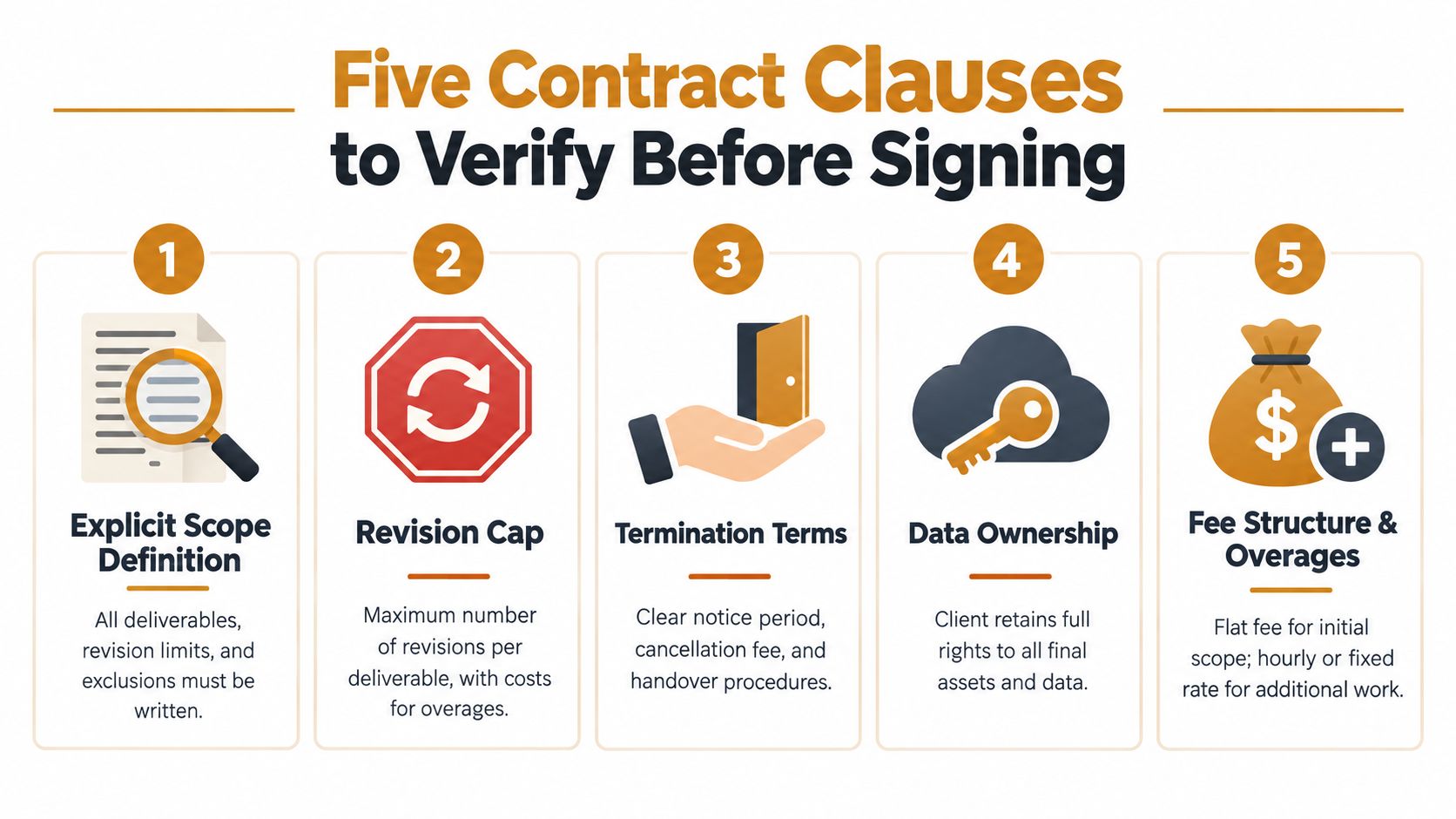
Five contract clauses to verify before signing
A fixed fee protects neither party by itself. The contract must control ownership, scope, revisions and changes before delivery starts. These five clauses expose the operational risks that can consume the retainer and reduce output quality.
-
Asset ownership from day one. The client should own ad accounts, pixels, creative files, website files, analytics, email lists and related data. The agency should have authorised access, not control of the underlying assets. Standard contract templates recommend writing ownership into the agreement rather than relying on informal assurances. Independent marketing contract guidance
-
Month-to-month exit terms. State whether there is a minimum term, cancellation fee or notice period. Month-to-month engagements should also specify access and asset handover after termination. Month-to-month agency contract guidance
-
A post-termination handover. Specify the format, timing and responsible party for transferring access, files, reporting history and documentation. Otherwise, a provider change can create avoidable rebuilding work.
-
Revision limits. Define the maximum revisions per deliverable, what qualifies as a revision and how approval delays affect the schedule. “Reasonable revisions” gives neither side a usable boundary. Repeated review loops consume the same fixed hours as new work, leaving less capacity for testing and quality control.
-
A change-order process. Explain how out-of-scope requests are priced, approved and scheduled. The clearest choice is to remove an existing deliverable or approve additional work at a stated rate.
Separate fixed deliverables from strategic outcomes. No agency controls ROAS, CAC or revenue alone, because auctions, tracking and market conditions affect them. Review the full Crank11 terms and operating conditions beside the proposal. If the provider cannot explain ownership or change control plainly, treat that reluctance as commercial information.
[[C11-OPTIN]]
Use this checklist before signing. It should make scope, ownership, revisions and extra work unambiguous.
Quick answers on fixed price marketing engagements
Does fixed pricing work for low ad spend?
Only when the scope stays narrow. At $500 to $1,000 per month, an account can realistically test one or two Shopping campaigns or retargeting. $1,000 to $3,000 per month is where small stores often begin to see more predictable ROAS. A large fixed fee is disproportionate at that spend level, because the management cost can consume too much of the available budget.
How should creative fatigue be handled under a capped fee?
Define production volume, formats, concepts, revision limits and retirement rules before work begins. If fatigue requires more output than the agreed scope, replace lower-priority deliverables or approve an additional batch. Unlimited creative is not a workable fixed-fee promise.
What happens when ad spend doubles mid-month?
The fee can remain unchanged if the scope and workload stay unchanged. If higher spend requires more monitoring, campaigns, channels or reporting, use the contract’s change-order process. Otherwise, the agency absorbs extra hours, margins fall, and review or testing work is usually the first thing squeezed.
Is project pricing better for an initial audit?
Usually. A project fee fits a bounded audit with defined outputs and acceptance criteria. Published benchmarks place a PPC audit around $2,000 to $5,000, as noted earlier. A retainer makes more sense once the audit identifies recurring work and a realistic monthly capacity.
Does fixed price mean the agency owns the accounts?
No. The client should own accounts, assets and data from day one, while the agency receives authorised access. Put that requirement in the contract and verify permissions directly.
[[C11-OPTIN]]
Use a buyer worksheet to map fees to senior hours, deliverables, revisions and change orders. For a fixed-fee operating model with transparent deliverables, visit Crank 11.