Creative testing solutions are not an ideation exercise, they’re an operating system. The teams that win treat creative as a budgeted loop of production, measurement, and retirement, not a pile of concepts waiting for someone to like them.
That’s the bit often missed. More variants don’t fix a weak system. Better rules do.
What Creative Testing Solutions Actually Do in 2026
Creative testing solutions turn ad assets into budget decisions. They run a controlled system with production input, named KPIs, statistical floors, and retirement rules so spend goes to the ads that earn it, not the ones that look good in a review thread.
Creative production is not creative testing
Production makes the asset. Testing decides whether that asset deserves scale. Teams that blur those jobs usually keep shipping new variants while spend barely moves.
That split matters once volume gets real. Large accounts are no longer checking ads one by one, they are running continuous experiments across active libraries of creative. A recent report from AppsFlyer’s 2025 report shows the scale of that shift without turning it into a theory exercise.
Practical rule: if a process can’t show what gets cut, what gets kept, and what gets budget, it isn’t testing.
The old review model burns time. Creative testing solutions answer one question cleanly: which asset gets more spend next. Moodboards, taste, and brand preferences sit outside that decision loop.
Crank11 treats this as an operating system because that is what paid acquisition requires. Once spend climbs into the $30k+ per month range, production, scoring, and retirement need to be tied together. If they aren’t, the team is making expensive guesses. Our creative experiments lab exists to structure that loop instead of chasing volume for its own sake.
The Three Layers of a Real Creative Testing System
A real system has three layers, and if one goes missing the whole thing gets mushy fast. Those layers are pipeline, scoring, and retirement.
Pipeline keeps the machine fed
The pipeline is the weekly flow of hooks, formats, offers, and CTAs. The job is not to chase endless volume. It is to keep a steady batch moving, because creative testing collapses when the team runs dry or only ships favorites. High-performing accounts keep a constant intake of new variants, and the win rate stays low on purpose. That is normal.
Low win rates are not a bug. They are the signal that most ideas should die quickly so budget can move to the few that deserve scale.
Scoring stops taste from running the account
Scoring is where teams get sloppy. They watch thumb-stop rate, nod, and launch the winner before enough data has landed. A proper floor for CRO-style testing is 95% statistical confidence and 80% power, with enough conversions and enough business cycles before judgment, according to this CRO testing guide.
That floor is not glamorous. It is the difference between a real signal and a lucky spike. If you read too early, you are usually selecting noise and calling it insight.
Retirement saves budget from sentiment
Retirement is the part teams hate because it cuts emotional attachment out of the process. A loser should die after a fixed budget, a fixed cycle count, or a clear miss against the control. A winner gets promoted, but not with a reckless jump.
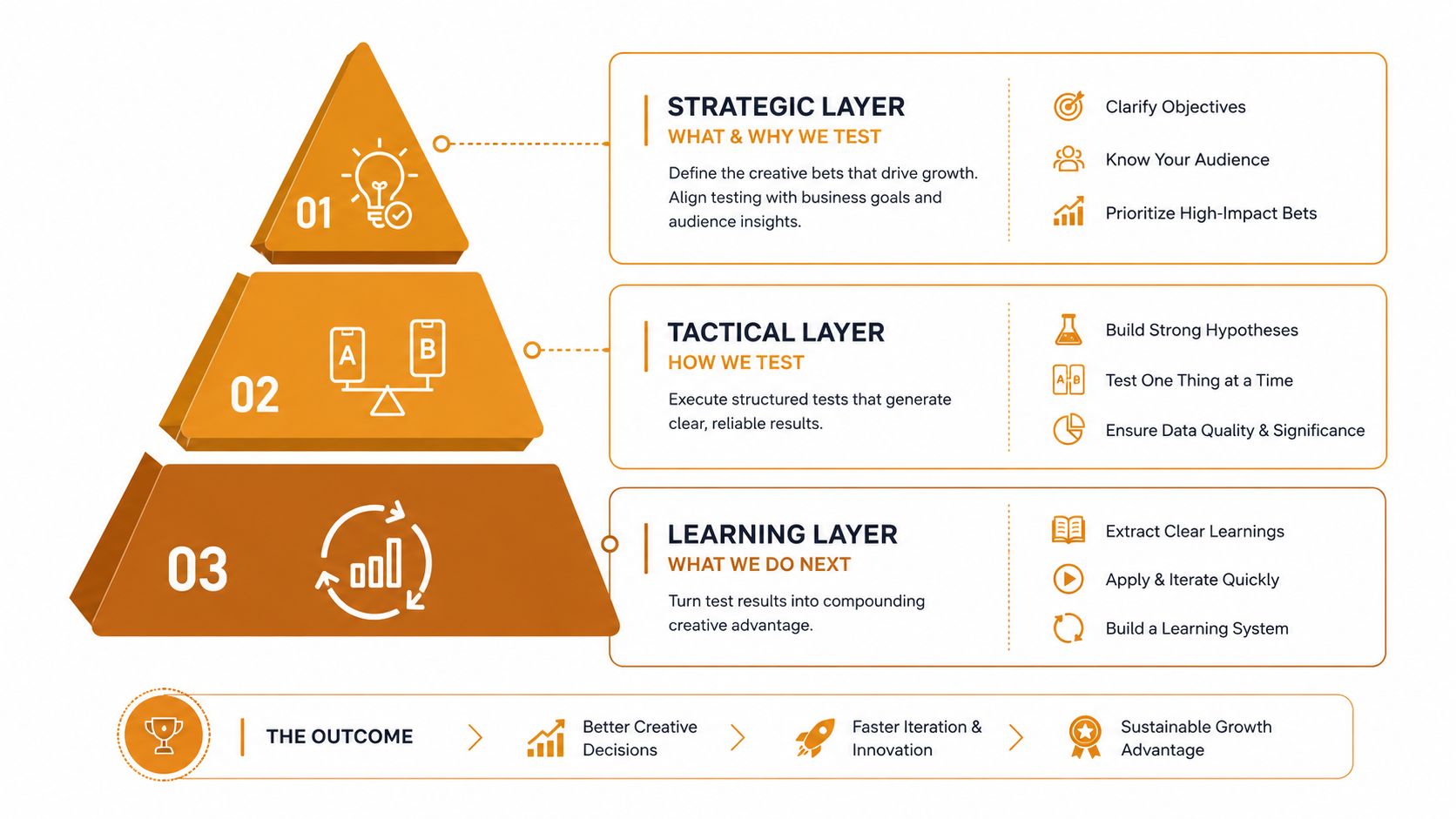
The shift is from one-off campaign tests to always-on experimentation budgets. That is the difference between running ads and running a system. Crank11’s engine is built around that separation.
[[C11-OPTIN]]
A one-page testing scorecard that turns raw results into promote, iterate, or retire decisions sits behind this section.
How to Design One Creative Test That You Can Trust
A trustworthy test starts with one falsifiable hypothesis and ends with one decision. Anything broader turns into creative theatre.
Start with one variable
Pick one thing to test, hook, format, or CTA. Not all three. If the hook changes, the format stays still. If the format changes, the CTA stays still.
That’s how you avoid learning nonsense. If two things move at once, you won’t know which lever drove the result, and your next batch will be built on sand.
Lock the floor before launch
Use 95% confidence and 80% power as the decision floor, the same common benchmark used in CRO testing as summarised here. In practice, don’t even look for a winner until the test has enough conversions to have a fair shot at stability.
No one likes being the person who killed a real winner early, then spent the next month pretending the account was “seasonal”.
Make the decision rule before spend starts
Write the action in advance. Promote, iterate, or retire. If the test is inconclusive, extend it or kill it. Don’t invent a fourth category because the result hurt someone’s feelings.
| Worked A/B Test | Arm A, UGC Hook | Arm B, Founder-Led Hook |
|---|---|---|
| Hypothesis | UGC hook beats founder-led hook on hook-rate while holding CPM flat | Founder-led hook underperforms if the opening line lacks proof |
| Budget | $1,500 | $1,500 |
| Conversions | 1,200 per arm | 1,200 per arm |
| Read window | 2 full business cycles | 2 full business cycles |
| Decision floor | 95% confidence, 80% power | 95% confidence, 80% power |
| Outcome rule | Promote if CPA improves by enough to clear the floor | Retire if CPA trails control |
The worked maths is blunt. If each arm gets $1,500 and reaches 1,200 conversions, then the result is not about vibes, it’s about whether the observed 12% CPA difference clears the statistical floor and survives a scale-up. Our own ad account audit checklist helps teams catch the dumb mistakes before they burn another test cycle.
How to Choose Between Build, Buy and a Partner
Monthly testing spend of $30,000 or more is where this choice stops being theoretical. At that level, the central question is whether you have the people and process to turn spend into decisions without wasting weeks on avoidable noise.
Judge the route, not the brand
Build works when an in-house team is already shipping at volume and owns the measurement stack. It also demands operator depth, because software will not fix weak test design or sloppy read rules. Buy suits brands that want platform access and faster setup, but do not have the analyst capacity to keep the system honest. A partner model fits when you need weekly winners without hiring a full creative-performance function.
Crank11 sits in the partner lane because the work is about more than asset generation. It covers scored production, testing, and clean handoff into media. If the bottleneck is measurement discipline and decision quality, that is where outside help earns its keep.
| Criterion | Build | Buy, SaaS | Partner, Crank11 |
|---|---|---|---|
| Speed to first decision | Slow at the start, faster later | Fast if the team knows the system | Fast when senior operators run it |
| Ownership of data | Highest | Mixed | High, with client-owned accounts |
| Senior-operator oversight | Internal only | Limited | Built in |
| Transparency of method | Depends on the team | Depends on the platform | Explicit scoring and logs |
| Reporting cadence | Whatever the team manages | Often fixed by software | Weekly, tied to decisions |
Use spend as the deciding threshold
Low spend makes a build route a waste of internal time. Healthy spend with weak interpretation skills makes software alone a poor fix. High spend raises the cost of bad winners, so partner support often pays for itself through cleaner decisions.
If you are still framing this as headcount, read the agency versus in-house cost math. The model should fit the volume, not the other way round.
The Maths Behind a 10 to 20 Percent Testing Budget
A testing budget should be ring-fenced before launch, not scavenged from leftovers. The cleanest model is a fixed slice of monthly spend, then a separate cap on any single test so one bad idea doesn’t eat the whole month.
Work the budget from the top down
Use this formula.
Monthly paid spend x testing percentage = monthly testing budget
For a January 2026 example, take $50,000 in total paid spend and a 15% testing budget. That gives $7,500 for the month. Split across roughly four weeks, that is $1,875 per week, which lines up with the practical range in the brief.
If you run 3 variants per week, each variant gets about $625 before you adjust for channel mix and conversion volume. A guardrail of 8% of monthly budget per test means no single test should exceed $4,000 in that month. That keeps exploration alive without letting a bad hypothesis wreck scale budgets.
Practical rule: if a test needs heroic spend to produce a clean read, the problem is often the hypothesis, not the media plan.
Calculate the read, not just the spend
For direct-response accounts, the practical constraint is conversion volume. A test with enough traffic but too few conversions is still junk data. That’s why budget should be tied to the conversions needed for the read, not just to media output.
Our creative-fatigue production maths note is the right companion if you’re trying to balance fresh production against avoidable waste.
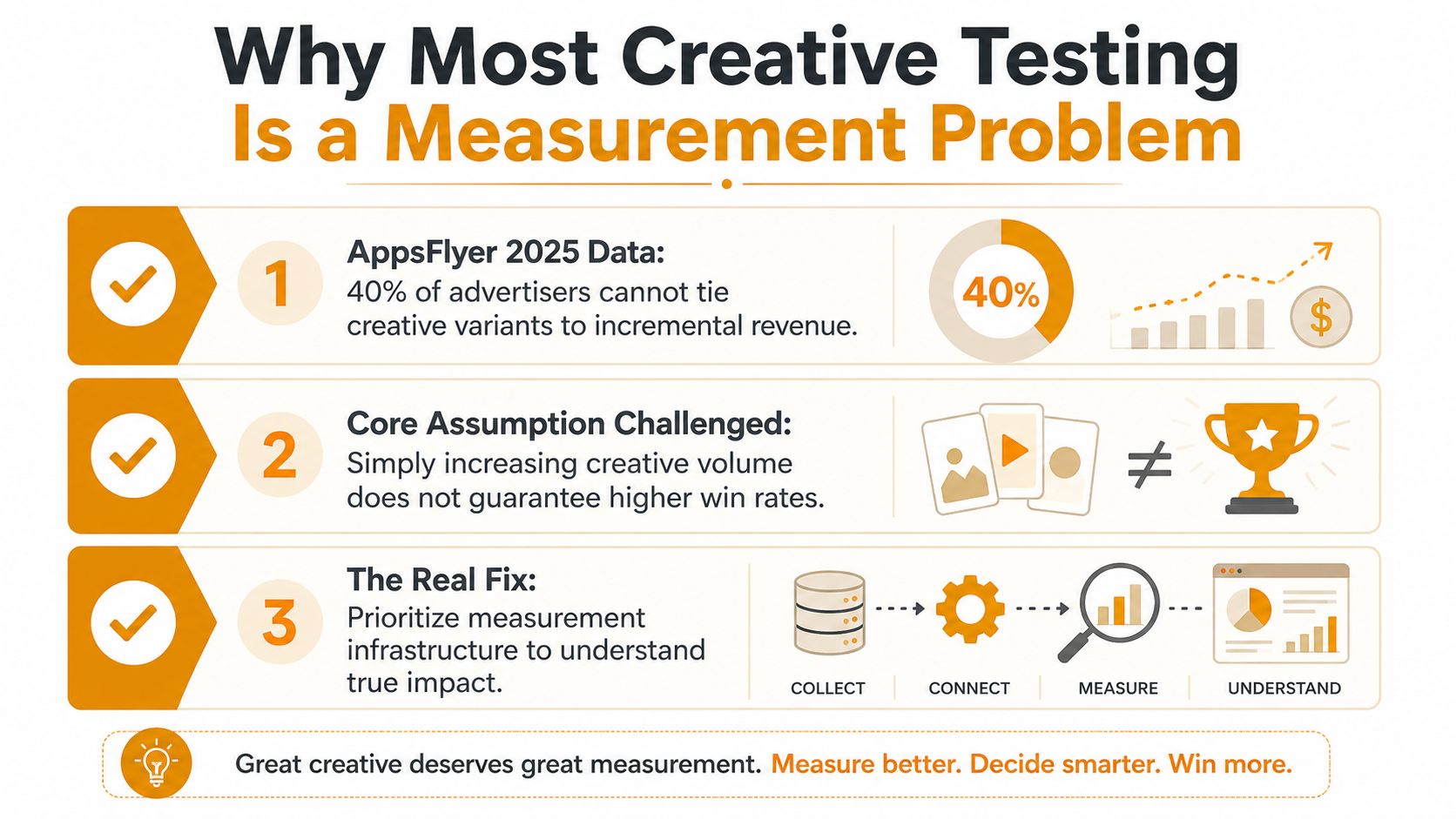
Why Most Creative Testing Is a Measurement Problem
More creative volume does not fix weak measurement. It just produces more things to misread.
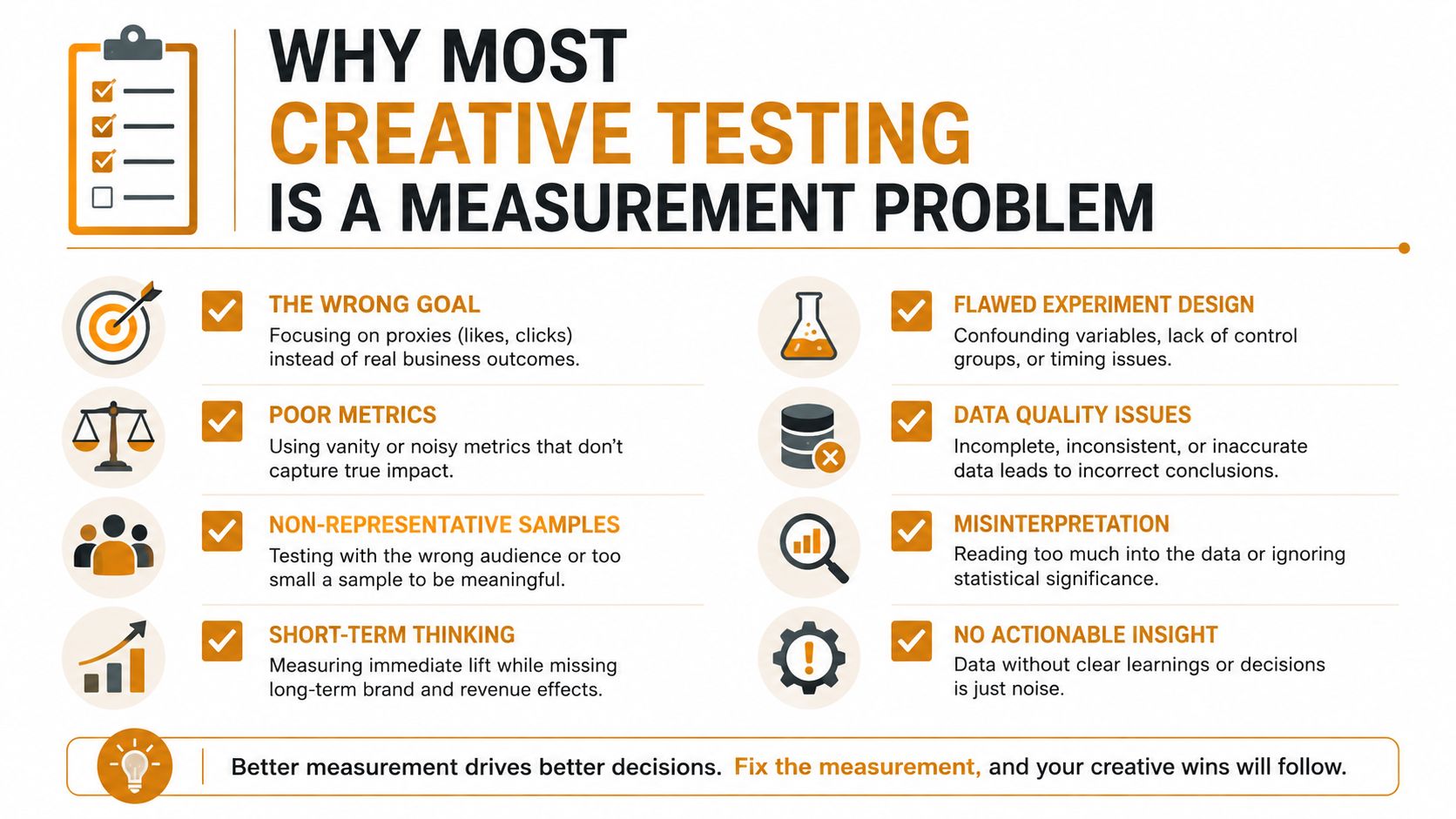
The bottleneck is usually not output, it is the read. If your attribution is shaky, your decision rules are vague, or your sample is too small, every extra variant increases noise instead of clarity. That is why teams can ship more ads and still learn less.
Incrementality beats vanity reads
Clean measurement starts with a holdout. In a Meta Conversion Lift setup, part of the target audience sees no ads during the test, so you can compare exposed and unexposed groups instead of chasing clicks that only look good on paper. The trade-off is slower learning, because the test has to stay open long enough for the signal to settle.
A common setup uses a 10% holdout, and the measurement window should run for at least 2 weeks, with 4 weeks preferred for cleaner results. That kind of design is slower than a basic performance read, but it tells you whether the creative changed business outcomes or just moved surface metrics.
Fix the weakest link first
If attribution is broken, more variants will not help. If the decision rules are bad, another dashboard only adds another place to argue. If sample size is thin, speed becomes self-deception.
Performance optimisation answers which ad deserves more budget. Measurement asks whether the lift held up under a clean read. Blend those jobs together, and you keep scaling false winners.
What a Senior-Operator Creative Testing Cycle Looks Like
A proper weekly cycle is boring in the best way. Monday starts with the losers. Tuesday turns those losses into new hook hypotheses, not generic inspiration, and the team ships four variants, usually two hook types and two offers.
Wednesday launch is controlled. Spend staggers at $150 per ad set, so the test has room to breathe before the numbers harden into a fake story. Thursday and Friday stay read-only, because fast emotional edits usually wreck the sample before it settles.
By Friday, the scoring sheet gets the final pass. The threshold is 95/80, and any variant under 1.0x the control CPA gets retired without drama. Winners do not get a heroic jump either. They graduate to scale with a 25% budget increase, not a reckless 200% shove that breaks the learning.
The discipline is in the kill rate, not the launch count. If your rotation cadence has gone soft, stale creative will eat budget while nobody admits the leak.
Senior rule: if you cannot explain why a test batch lost, you are not learning, you are just shipping.
The operating artefacts matter as much as the ads. Use a shared testing tracker, a scoring sheet, a retirement log, and a Monday debrief doc. That paper trail turns one week’s result into the next week’s brief, and it keeps the team from re-litigating old calls.
A decent team kills 60 to 70% of each batch without sentiment. That sounds harsh until you compare it with the cost of keeping dead creative alive.
[[C11-OPTIN]]
The full operating playbook shows the weekly tracker, scorecard and retirement log we use to keep tests honest.
Quick answers
How many new ads should I test each week?
For most accounts, 2 to 4 variants per week is the realistic floor. Bigger budgets can push more, but only if the measurement is clean enough to read them properly.
What confidence level should I use?
Use 95% confidence and 80% power as the practical floor. Anything lower and you will promote noise too often.
Should I keep weak ads for learning?
Sometimes, yes. If a loser teaches you something specific, keep it long enough to capture the lesson. If it is just wasting spend, retire it.
Is creative testing more about production or measurement?
Measurement. Production only matters once you can trust the read. Without that, volume just multiplies confusion.
What’s the simplest rule for a monthly testing budget?
Ring-fence 10% to 20% of channel spend and cap any one test so it cannot dominate the month. If one idea needs the whole budget, the idea is probably wrong.
When should I use a holdout test?
Use it when you need incrementality, not just platform performance. It is slower, but it tells you whether the creative changed real business outcomes.