
Conversion rate optimization services are the systems, tests and page changes that turn more of your paid clicks into revenue or qualified leads, without buying more traffic. If your account already spends hard, CRO matters because the gap between a weak site and a healthy one is often bigger than the gain from adding budget.
The obvious answer is still incomplete. Most founders treat CRO like button-colour theatre. It isn’t. It’s paid-traffic economics plus testing maths, and those two things decide whether the work pays back or wastes months.
Introduction to Conversion Rate Optimization Services
A small lift in conversion rate can change paid-traffic economics faster than a budget increase. If the same clicks produce more purchases, booked calls, or qualified leads, CAC falls without asking the ad platforms for more spend.
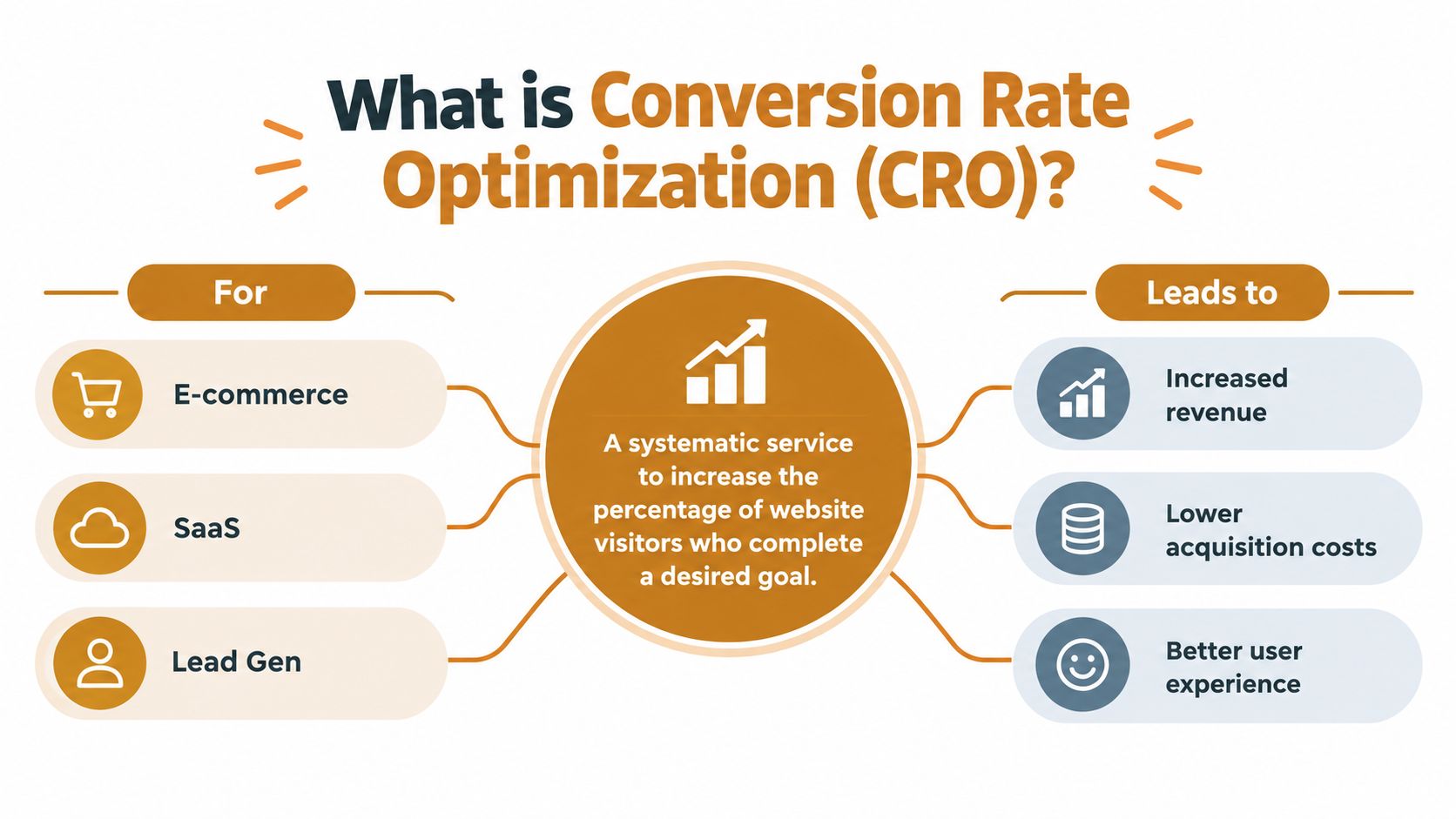
That is the core job of conversion rate optimization services. They improve the percentage of visitors who take a defined action, usually on the pages your paid traffic hits first or the steps closest to revenue.
For founders already buying traffic, CRO works like fixing the plumbing before turning up the water pressure. More traffic helps only if the page, form, checkout, or message can convert that traffic efficiently. If not, extra spend just pushes more people through the same weak path.
Who CRO is really for
CRO becomes useful when three conditions are true. You already have meaningful traffic. Your offer is stable enough to test. Your funnel gets enough conversion volume to separate signal from noise.
That third point gets missed a lot.
A business with a few conversions a month cannot test ambitious changes at a useful pace. A business with steady paid traffic and regular conversions can. In practice, that means CRO services are usually a better fit for accounts that already spend consistently and want to get more from that spend, not for sites still guessing at product-market fit.
What these services do, and what they don’t
Good conversion rate optimization services start with economics, not decoration. The question is not “what can we change on the page?” The question is “where is money being lost, and do we have enough volume to test a fix properly?”
From there, the work usually includes funnel analysis, friction diagnosis, test planning, variant design, experiment setup, QA, measurement, and shipping winners into the live experience. The strong providers also define decision thresholds before a test starts, so results do not get called early because one good day made the graph look exciting.
CRO also has limits. It can improve a page that gets the wrong message across, asks for too much too soon, or creates unnecessary friction. It cannot rescue low-intent traffic at scale if the offer, audience, or acquisition strategy is off.
A practical rule helps here. Fix the leak closest to revenue that has enough traffic to test. A prettier blog CTA rarely matters more than a paid landing page, lead form, cart, or checkout step that gets hit every day.
If you want to see what that operating model looks like in practice, Crank11’s CRO and experimentation guide walks through the workflow serious paid teams should expect.
Why Conversion Rates Vary So Much and What That Means for CRO
A small shift in conversion rate can change paid traffic economics fast. If 10,000 paid visits convert at 2%, that is 200 conversions. Raise that to 3% and the same traffic produces 300. You did not buy more clicks. You got 50% more output from traffic you already paid for.
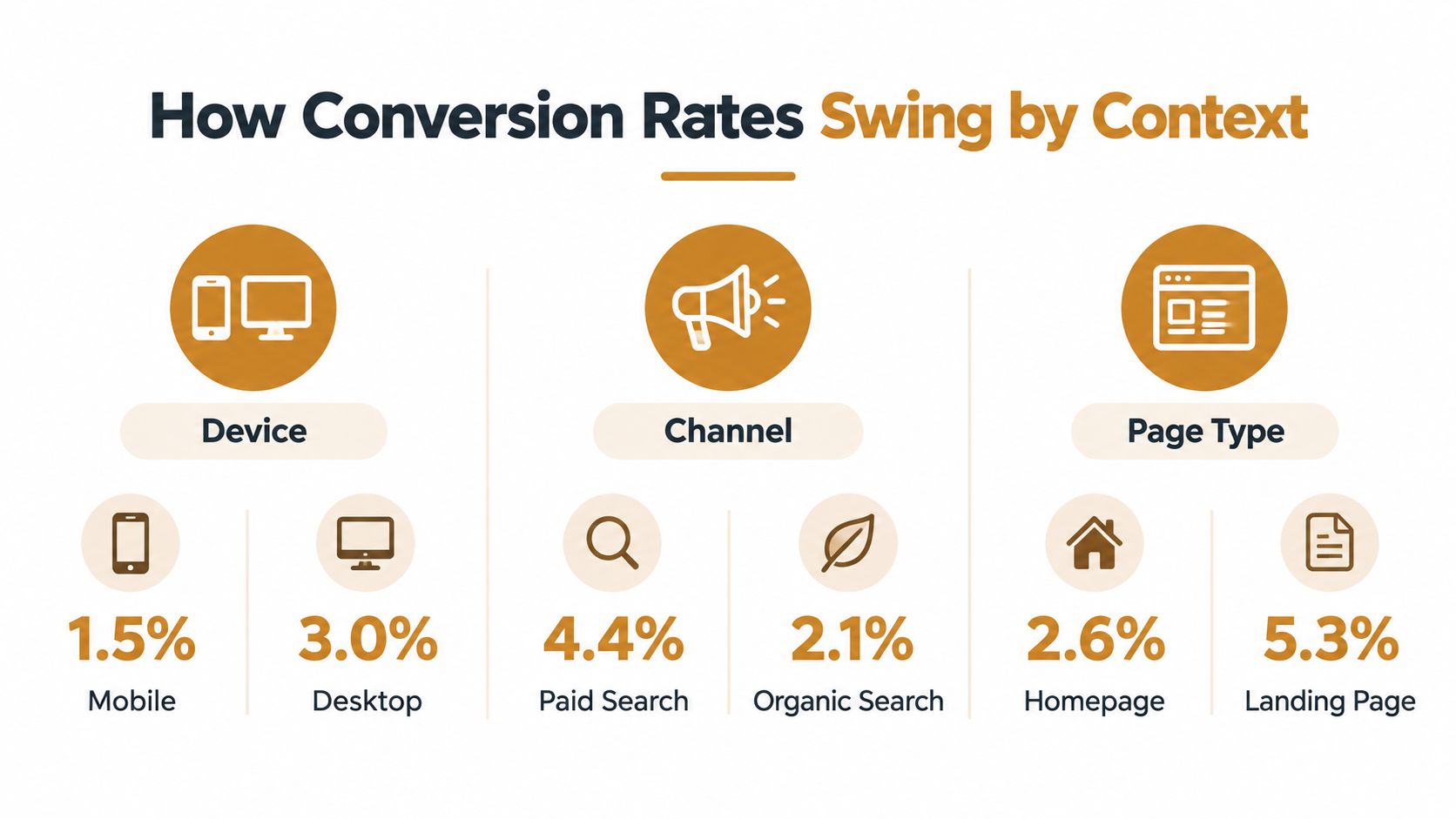
That is why broad conversion rate averages often mislead founders. A single sitewide number mixes cold and warm traffic, mobile and desktop sessions, landing pages and checkout pages, and users with very different intent. It works like averaging the close rate of a sales team across demos, renewals, and inbound hand-raisers, then using that blended number to judge every rep. The average exists, but it does not help you decide what to fix.
Device changes the maths
Mobile visitors usually convert differently from desktop visitors because the job is harder. Smaller screens hide context. Forms feel longer. Payment steps create more friction. Load speed matters more because attention is thinner.
If most paid clicks land on mobile, your real benchmark starts there. A page that looks acceptable on desktop can still waste spend on phones if the message order is wrong, the CTA sits too low, or the form asks for too much before trust is built. In practical terms, a CRO team should read mobile performance as a profit issue, not a design preference.
Page type sets the baseline
A paid landing page, a category page, and a checkout step do different jobs. They should not share one performance target.
Paid landing pages often convert higher than blended site averages because they match one message to one audience with one next step. Browse pages usually convert lower because they support comparison, exploration, and distraction. Checkout steps convert on a different curve again because users there already showed intent. If a provider reports one headline conversion rate for all of it, they are smoothing over the useful detail.
This matters for prioritisation. A paid landing page sitting below target can justify immediate work because every media dollar touches it. A blog CTA with thin traffic usually cannot.
Channel quality changes what CRO can realistically fix
Conversion rate is partly a page problem and partly a traffic problem. Good pages cannot fully rescue low-intent clicks. Bad pages can absolutely waste high-intent clicks.
Use a simple diagnostic. If click-through rate and cost per click look healthy, but the landing page converts poorly, page friction is a likely constraint. If the page engagement is weak from the first second, the traffic mix or promise in the ad may be wrong. CRO works best when the offer and audience already have some fit and the page is failing to carry that intent through the funnel.
Sample size decides what you can test
Many CRO retainers go off track. Teams queue up headline tests, button tests, long-form tests, pricing tests, and form tests as if all accounts can support the same cadence. They cannot.
Testing works like weighing coins on a scale. If the scale is crude, tiny differences disappear into noise. Low-traffic accounts need larger changes, cleaner hypotheses, and more patience. High-traffic accounts can test finer adjustments because they reach decision thresholds faster.
A useful rule is simple. The lower your volume, the more obvious the test should be. Structural changes beat cosmetic ones. Offer framing beats button colour. Form length beats icon swaps.
What the variance means for buying CRO services
Wide conversion-rate variance does not mean anything goes. It means your provider should segment the funnel, estimate where paid spend is leaking, and choose test ideas that match available volume.
Use that lens when judging the work:
- Large mobile drop-off usually means start with message hierarchy, form friction, speed, and checkout usability on phones.
- Strong ad efficiency with weak page conversion usually means CRO can beat buying more traffic.
- Weak engagement from the click onward usually means acquisition quality needs work before formal testing.
- Low session volume usually means fewer tests, bigger changes, and stricter prioritisation.
- Blended reporting only usually means you still cannot see where budget is being lost.
Some accounts should begin with instrumentation fixes and page-level friction removal, then move into A/B testing once the funnel is measurable. That is not a lesser version of CRO. It is the adult version.
What Conversion Rate Optimization Services Actually Include
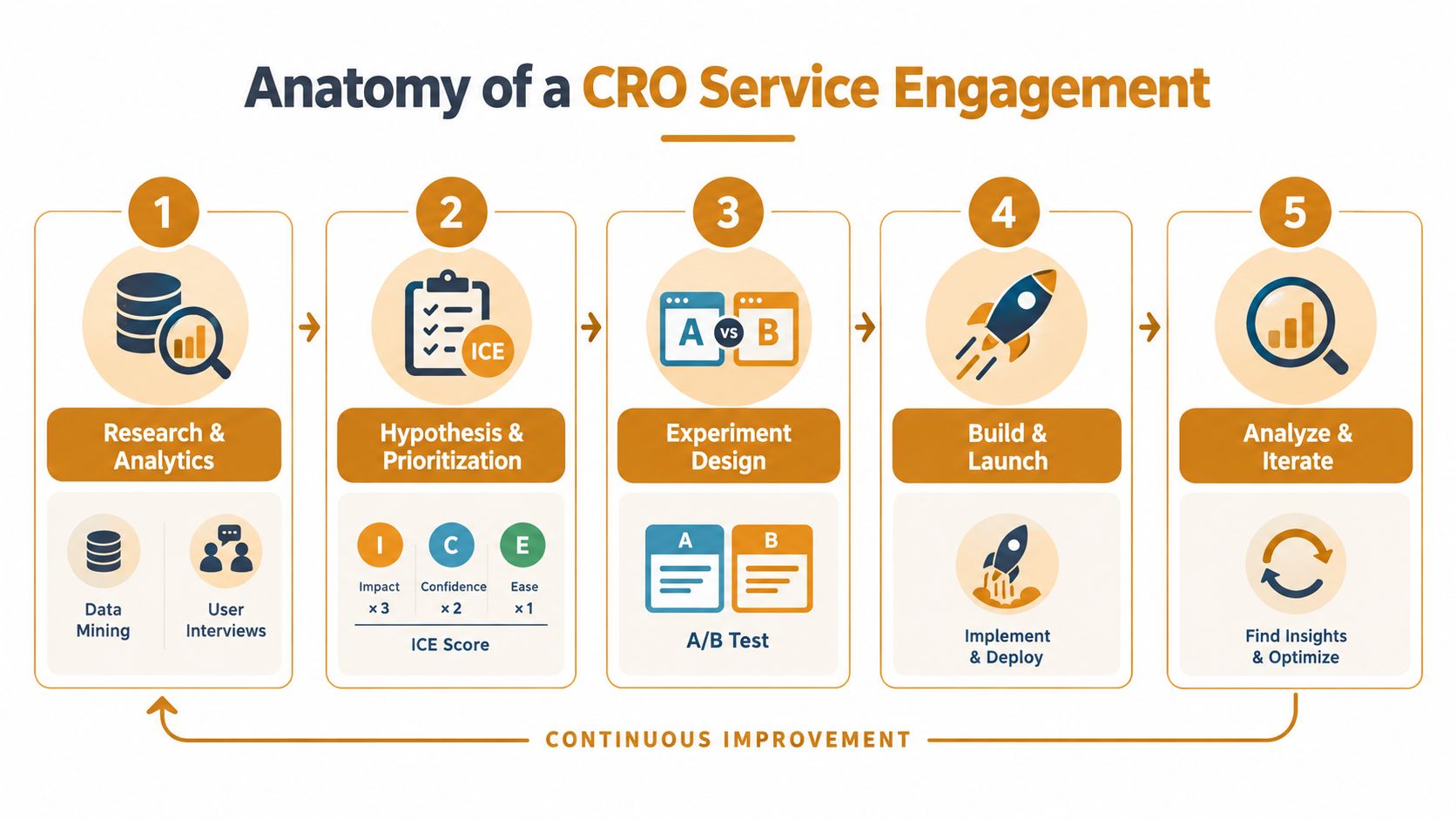
Good CRO services work like a production system, not a bag of tips. The goal is simple: turn paid clicks into more revenue or more qualified leads without guessing. That only happens when research, build work, testing, and decision rules connect tightly enough that each step improves the next one.
Research starts with economics, not opinions
Founders buying paid traffic do not need more generic best practices. They need to know where a click is losing value.
A serious CRO team begins by mapping spend against funnel leakage. Which landing pages absorb the largest share of budget. Which device types convert far worse after the click. Which steps break attribution. Which actions predict sales or qualified pipeline, instead of just looking busy in a dashboard.
Sometimes the first profitable finding is not a test at all. It is a tracking repair, a broken thank-you page event, or a mobile form that drops intent halfway through. If measurement is wrong, every test result that follows gets weaker.
Prioritisation decides whether CRO pays back
Once the leaks are visible, the next job is selection. You cannot test everything. You should not try.
Good prioritisation works like triage in an emergency room. The cases losing the most money go first. On a paid account, that often means starting where traffic volume is high enough to reach a decision and where friction sits close to the conversion event. A checkout step with heavy abandonment usually matters more than a light homepage tweak. A lead form with unnecessary fields usually matters more than a colour change.
This is also where providers reveal how they think. A weak one gives you a long idea list. A strong one explains why only a few ideas deserve immediate attention, what evidence supports them, and what level of lift would justify the effort.
Experiment design turns ideas into measurable bets
This is the point where “we should improve the page” becomes a real hypothesis.
A useful hypothesis names four things clearly: the audience, the change, the behaviour you expect to improve, and the threshold for calling the result a win. For example, a provider might test a stronger product-intent headline for paid search visitors, remove two fields from a demo form, or add a lower-commitment step before the main conversion ask.
The maths matters here. Testing works like using a ruler. If your ruler only has big markings, you cannot measure tiny differences with confidence. Lower-traffic accounts usually need bigger changes and fewer simultaneous tests. Higher-volume accounts can test narrower ideas because they reach decision thresholds faster. That is why competent CRO services define minimum sample requirements, expected effect size, and stop rules before launch, not after seeing a promising early result.
Build and launch work is part of the service
A recommendation is not a result. Someone has to design the variant, write the copy, make the dev changes, verify tracking, check QA on real devices, and publish without breaking the control.
Many CRO engagements stall. The strategy may be sensible, but the build queue moves too slowly for paid-traffic economics. If a provider cannot get tests live at a steady pace, the account keeps buying clicks while obvious friction stays in place.
If you are still trying to determine whether the main problem is landing-page friction, weak measurement, or paid-traffic mismatch, Crank11’s free ad account audit can help identify that before you commit to months of testing.
Analysis should end with a decision
Every experiment needs a clear conclusion. Ship the winner. Reject the idea. Keep the learning and redesign the next test. Or hold the result as inconclusive because the sample was too small.
That last outcome is more common than many founders expect. An honest provider will say, in plain language, “we did not get enough signal yet,” instead of stretching weak data into a success story. Ask how they define a valid read, how long they let a test run, and what they do when a result is directionally positive but below the agreed confidence threshold.
The service is not just experimentation. It is a repeated decision process for where paid clicks become profit, where they do not, and what to change next.
How Conversion Rate Optimization Services Are Delivered
How a CRO service is delivered changes the economics of the engagement. Two providers can spot the same friction point, but the one with a tighter operating rhythm gets more tests live, reaches decisions sooner, and wastes less paid traffic while waiting.
Three delivery models show up most often. Each fits a different combination of traffic volume, internal resources, and tolerance for test lead time.
CRO engagement models compared
| Engagement Model | Typical Cadence | Best For | Watch Out For |
|---|---|---|---|
| Audit project | One diagnostic sprint, then recommendations | Brands with unclear funnel problems or broken tracking | Good analysis, no implementation path |
| Monthly testing retainer | Ongoing research, prioritisation, build and readout cycle | Paid accounts with enough traffic to support repeated experiments | Tests that take too long to reach a valid read |
| Hybrid with paid and creative | CRO tied to ad messaging, page builds and traffic analysis | Teams where ads, landing pages and post-click flow need to change together | Confused ownership if final decisions are split across teams |
What actually separates the models
The format matters less than the rate of learning.
An audit is useful when the account needs diagnosis first. It helps you find where money is leaking. But an audit does not create lift on its own, in the same way a media audit does not lower CAC until someone changes bids, targeting, or creative.
A retainer starts to make sense when you have enough traffic to test ideas in sequence and enough operational support to ship changes without long delays. That is the point where conversion rate optimization services stop looking like a collection of suggestions and start acting like a system for improving the yield of paid clicks.
The hybrid model works best when ad message, landing page promise, and follow-up path are tightly linked. If your ad sells speed and the page opens with generic trust copy, CRO and paid media cannot be managed in separate silos for long.
Cadence depends on ownership and decision rules
Founders often ask who will “do CRO.” The better question is who owns each step between idea and decision.
If ownership is fuzzy, cadence slips. Pages wait on design. Tracking waits on dev. Results sit in slides instead of changing the funnel.
Ask for a plain-language answer to these questions:
- Who writes test hypotheses, and what evidence they must use
- Who builds the variants, including copy, design, and development changes
- Who verifies analytics and event tracking before launch
- Who reviews results, and what minimum sample or confidence threshold they require
- Who records the learning, so future tests build on prior results instead of repeating them
Paid-traffic maths matters. A provider with a strong process should tell you how many tests they can realistically launch per month, how they handle low-volume pages, and when they switch from A/B testing to lower-risk changes such as message alignment, form simplification, or UX fixes that do not need a formal split test to justify action.
Crank11 runs delivery as part of an integrated paid and funnel operating model. If you want to see that workflow in practical terms, Crank11’s CRO delivery engine shows how research, page changes, launch cadence, and decision thresholds fit together.
How Much Conversion Rate Optimization Services Cost and How to Judge ROI
A small lift in conversion rate can outperform a large increase in ad spend. If you already buy paid traffic, that is the frame to use.
CRO cost only makes sense inside paid-traffic economics. You are paying to make the traffic you already bought produce more margin. If that margin ceiling is low, the service will struggle to pay back. If tracking is unreliable, traffic quality is weak, or the mobile experience is broken, fix those first.
Founders often compare a CRO retainer with media spend. The better comparison is with the profit created by a lift on existing sessions. Buying 20 percent more traffic usually costs 20 percent more money. Raising conversion rate improves output from traffic you already paid for, which is why CRO can beat more acquisition spend once CPCs rise.
Use a payback model before you look at price
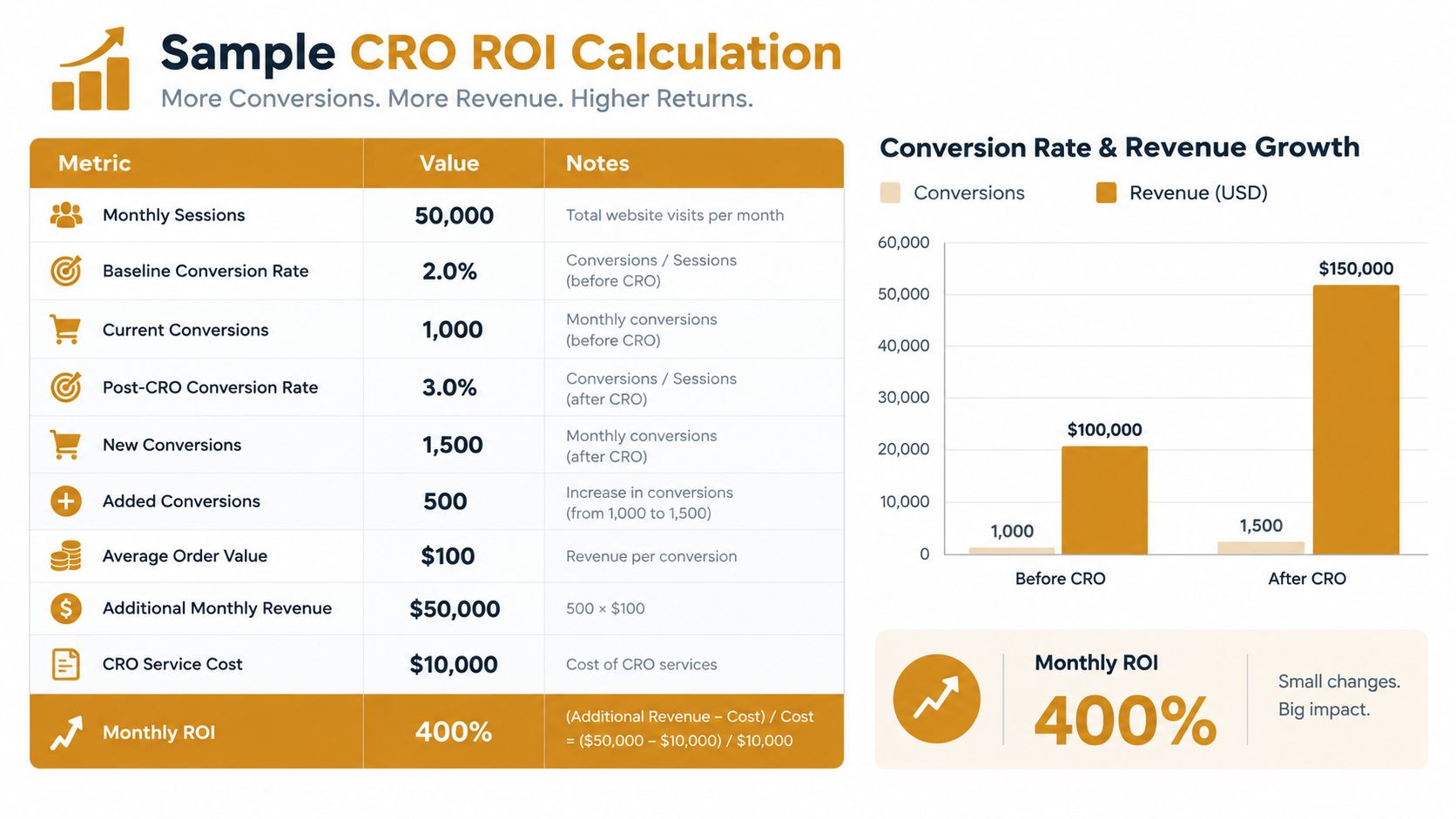
Start with five inputs for one month:
- Monthly sessions
- Baseline conversion rate
- Expected conversion rate after improvements
- Average order value or lead value
- Service cost
Here is the basic logic.
A paid landing page with 50,000 monthly sessions, a 2.0% conversion rate, and $100 average order value produces 1,000 conversions and $100,000 monthly revenue.
If CRO raises that page to 3.0%, the same traffic produces 1,500 conversions and $150,000 monthly revenue.
That means 500 extra conversions and $50,000 more monthly revenue against a $10,000 service cost. On paper, that is a strong return.
The maths looks simple because it is. The hard part is choosing a lift assumption you can defend.
A good operator will not promise blanket uplifts across every page. They should tie expected gains to funnel stage, traffic quality, and the type of change being tested. A checkout tweak, a lead form rewrite, and a new landing page angle do not carry the same upside or the same risk.
Sample size decides what is realistic
Testing works like weighing coins on a scale. If the difference is tiny, you need more coins before the scale can separate signal from noise.
That matters because low-converting pages need much more traffic to reach a confident decision than high-converting pages. The smaller the baseline conversion rate, and the smaller the lift you want to detect, the longer the test takes. This is why some paid pages are good candidates for frequent A/B tests, while others are better served by clear UX fixes, message alignment, or offer changes applied without a formal split.
Use a simple rule.
If a page cannot reach a decision in a reasonable time with the traffic you have, do not pretend you have a testing programme. You have a prioritisation problem.
That also changes what you are buying. On high-volume funnels, you can justify a heavier testing cadence because you can reach decisions. On low-volume funnels, value comes more from research, page improvement, and careful rollout of larger changes.
Judge ROI on speed, thresholds, and profit impact
Price by itself tells you very little. Two providers with the same retainer can produce very different economics.
Use this decision frame before you sign:
-
Can this funnel support valid tests?
If traffic is too thin to reach decisions, the service should shift toward fewer, bigger changes instead of forcing constant split tests. -
What lift changes profit?
A conversion gain only matters if it improves contribution after ad costs, discounts, sales effort, or fulfilment. -
How fast do ideas become live pages?
Delays shrink ROI. A useful test launched six weeks late misses paid traffic you already bought. -
What threshold is used to call a winner?
You want a clear standard for sample, confidence, and minimum effect size. Otherwise results turn into opinions with charts. -
How quickly is learning reused?
Good CRO lowers waste over time. Each finished test should improve the next page, offer, or audience decision.
If you want a practical benchmark for scope and budget, conversion rate optimization pricing and service levels should help you estimate whether the expected lift on your paid traffic can cover the work.
How to Choose the Right Conversion Rate Optimization Services Provider
A weak provider can burn through months of paid traffic before you learn anything useful. A strong one helps you turn that same traffic into faster decisions, cleaner economics, and a better funnel.
That is the frame to use when you choose. You are not buying ideas. You are buying a decision system.
A good CRO provider should explain your funnel the way a good media buyer explains auctions. Where is the waste. Which step has enough volume to test. What size lift matters financially. How much evidence is enough before shipping a change to all users. If they cannot answer those questions clearly, they are asking you to fund activity instead of learning.
A five-point provider checklist
-
Ask how they decide what is testable
Sample size comes first. If your landing page gets limited conversion volume, the provider should say so and adjust the plan. Small funnels usually need fewer, larger bets. High-volume funnels can support a faster testing rhythm. This sounds basic, but it is the difference between useful CRO and a queue of underpowered tests. -
Ask how they call a winner
Look for clear rules. Baseline conversion rate, minimum sample, decision threshold, and what happens when a result is inconclusive. Without those rules, every report becomes a debate about whether a small bump on a chart counts. -
Ask who owns implementation speed
Paid traffic keeps running while tickets sit in backlog. If every change waits on your internal dev team, learning slows down and the value of the service drops. The provider does not need to build everything themselves, but they should show exactly how ideas become live pages. -
Ask what they audit before they test
Good operators start by checking tracking, traffic quality, page-message match, mobile friction, and conversion path breaks. That is like checking scales before weighing ingredients. If measurement is off, the rest of the work looks precise while producing bad decisions. -
Ask what you keep after the engagement
You should retain the research notes, test log, variant copy, designs, and page assets. CRO creates operational memory. If that memory leaves with the provider, you end up paying twice for the same lessons.
Red flags that usually predict wasted spend
Some warning signs show up early.
-
They promise lifts before reviewing your numbers
Serious operators know the answer depends on traffic quality, baseline rate, and funnel constraints. -
They talk about ideas without talking about maths
A test plan without volume and sample discussion is just a wish list. -
They use the same roadmap for every business model
Lead gen, subscription, and ecommerce funnels break in different places. The work should reflect that. -
They separate strategy from shipping
Advice has limited value if no one can get changes live while paid traffic is still flowing.
One more point matters. Ask them to walk through a recent decision that did not produce a winner. Good providers do not hide inconclusive tests. They explain what they learned, what threshold was missed, and how that changed the next test or page revision. That is usually where you find out whether they run a real optimisation program or just produce polished weekly updates.
If you are comparing options side by side, use a CRO provider comparison framework that makes ownership, cadence, and decision standards easy to inspect.
Getting Started With Conversion Rate Optimization Services
A small lift in conversion rate can change paid traffic economics faster than a small lift in traffic volume. If you already buy clicks at scale, the first question is not “should we test?” It is “where can testing change contribution margin soon enough to matter?”
Start with the pages where paid spend and revenue are closest together. That is usually a landing page, lead form, checkout step, or booked-call page with enough traffic to produce a decision in a reasonable time. CRO works like fixing leaks in a paid funnel. Buying more traffic before fixing the leak often means paying to send more visitors into the same weak step.
A practical starting point is to sort paid landing pages by spend, then look at three things side by side: conversion rate, mobile performance, and tracking reliability. If one page takes a large share of spend, converts poorly on mobile, and still gets enough sessions each week, that page usually belongs at the front of the CRO queue.
Use this starting map
-
Tracking is unreliable
Fix attribution, form events, and revenue mapping first. Testing on bad measurement is like using a crooked ruler. You can still measure, but the answer will keep misleading you. -
Mobile carries most paid sessions
Review thumb friction, form length, page speed behavior, and checkout or lead-flow steps on an actual phone. Desktop reviews miss problems that block real buyers. -
One or two landing pages carry most spend
Focus there before touching the wider site. Concentrated traffic gives cleaner reads and faster decisions. -
Traffic is spread thin across many pages
Consolidate campaigns and test fewer pages. Sample size sets the pace of CRO. If volume is fragmented, the programme slows down no matter how many ideas you have.
That last point trips up a lot of teams. A page may have obvious problems and still be a poor testing candidate if it gets too little traffic. In that case, use page improvements that are strong enough to ship from research and heuristic review, then save formal testing for pages with enough volume to call a result without waiting months.
Set decision thresholds before the work starts. Agree on what counts as enough traffic, what lift would be commercially meaningful, and when a test stays inconclusive. Founders who buy paid traffic already do this with bids and targets. CRO needs the same discipline. Otherwise, the service turns into a stream of opinions dressed up as experimentation.
If paid acquisition is already working and customer intent is sound, conversion rate optimization services often produce a better return than increasing budget alone. Better conversion improves the value of clicks you already know how to buy. If traffic quality is weak, fix targeting and offer-message fit first.
For a simple first step, pull your top three paid landing pages and review them by device, source, and next-step completion. The goal is not to find every issue. The goal is to find the highest-value page where enough volume exists to learn quickly and act with confidence.
Quick answers
Do conversion rate optimization services only matter for ecommerce
No. They matter anywhere paid traffic hits a page with a measurable next step. Ecommerce, lead gen and hybrid funnels all qualify.
Should we test the whole site or just landing pages first
Start with the pages that carry paid spend and sit closest to revenue. Broad site programmes come later.
What if our conversion rate is already decent
That doesn’t settle it. Compare by device, page type and traffic source. Blended averages hide profitable gaps.
How long before a CRO programme shows anything useful
That depends on traffic volume, baseline rate and the lift required to matter. Sample size decides pace more than enthusiasm does.
Can CRO fix rising CAC by itself
Sometimes. Often it helps, but only if traffic quality and tracking are sound. CRO can’t rescue bad intent or broken attribution.
What should we ask for in the first month
A clear diagnosis, a prioritised test backlog, implementation ownership, and explicit decision thresholds for calling wins and losses.
Tomorrow morning, pull the top paid landing pages by spend and compare mobile conversion, drop-off and tracking health before you touch budget. If you want the operating playbook behind that process, see Crank 11.
We build paid acquisition systems that connect ads, creative, landing pages and CRO, so founders spending real money can fix the whole path instead of arguing over one step. If you want a clearer read on whether conversion rate optimization services should come before more media spend, Crank 11 shows how we run that analysis in practice.