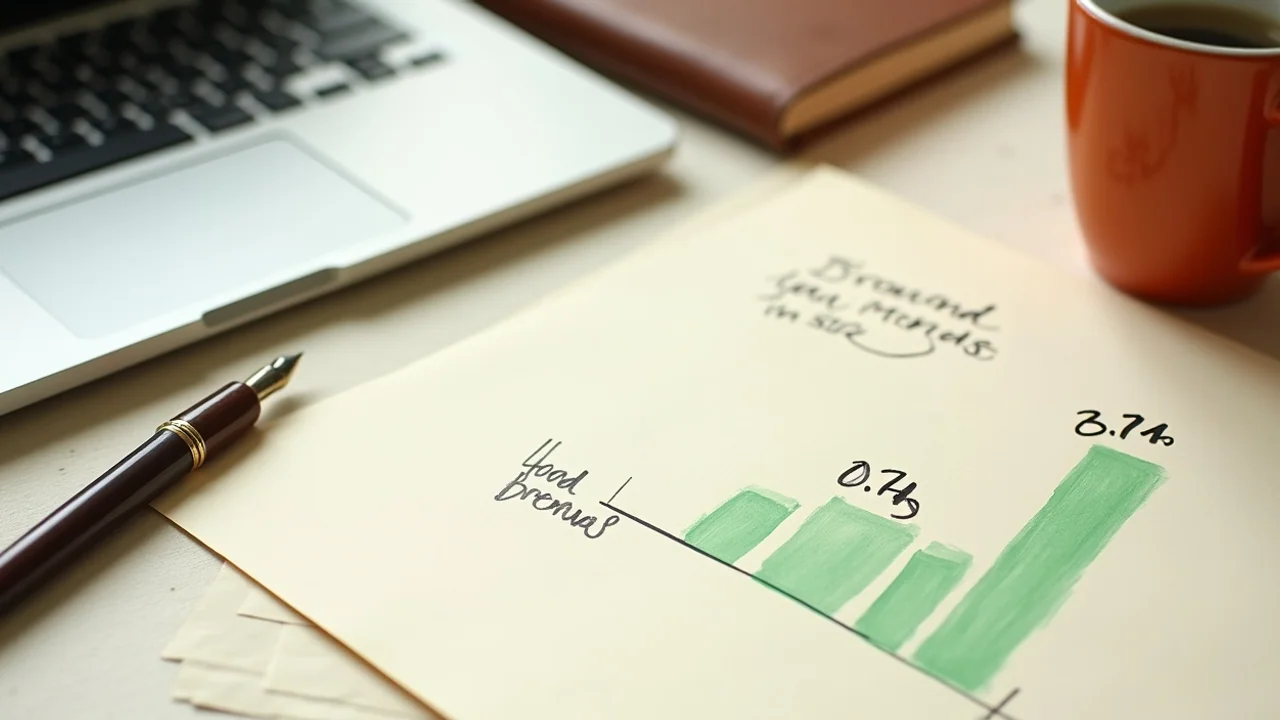
Brand mentions correlate 3x more with AI citations than backlinks. That’s the single most important SEO finding of the last 18 months, and most operators haven’t updated their strategy yet. The data: Ahrefs’ December 2025 study of 1.2M URLs across ChatGPT, Perplexity, Gemini, and Claude. Mentions correlation: 0.74. Backlinks correlation: 0.27. The shift is decisive. The implication: your 2026 SEO budget should look completely different from your 2023 budget.
I’m at $9,500 MRR / $114K ARR / 22.8% to my $500K target on 500k.io. Separately I co-founded The Kreators AI with Jack — $45M of client revenue ($10M Meta on my side). Both businesses depend on being found. Both shifted budget from backlinks to brand mentions in late 2024. I’ve watched the citation rates respond.
The Ahrefs data, in one paragraph
Ahrefs’ study analyzed 1.2M URLs that received AI citations across the 4 major engines in November 2025. They cross-referenced citation rate with three signals: backlinks (count + DR), branded queries (Google search volume for the brand name), and unlinked brand mentions (web text naming the brand without a link).
Result: branded queries + unlinked mentions correlated 0.74 with citation rate. Backlinks alone correlated 0.27. Combined model: mentions explained ~50% more variance than backlinks.
The mechanism is intuitive once you see it. AI engines build entity graphs from training data. The graph weights an entity higher when it appears in many high-quality contexts. A 200-word Wikipedia paragraph mentioning your brand 3 times feeds the entity graph. A backlink from a DR-30 site… feeds the entity graph less, because the linked text often doesn’t mention you in context.
What this means for content strategy
Three operational shifts.
Shift 1 — Reallocate 30-50% of “SEO budget” to brand mentions
Founders typically spend their non-content SEO time on:
- Backlink outreach (40-60%)
- Technical SEO (10-20%)
- Internal linking (10-15%)
- Other (15-30%)
Reallocate 30-50% of the backlink outreach time to mention plays. This is the highest-leverage shift you can make for 2026 AI visibility.
Shift 2 — Restructure outreach pitches
Old pitch: “Hey, would you link to my article?”
New pitch: “Hey, when you write about [topic], here’s a 2-paragraph perspective from me you can quote, with or without a link.”
Linked mentions are still better than unlinked. But unlinked mentions on high-authority sites beat linked mentions on DR-20 sites. The pitch shifts from “link to me” to “name me.”
Shift 3 — Build mention-rich infrastructure
You need entity infrastructure that AI engines can reference:
- Wikidata entry (60 min setup, free)
- Crunchbase entry (30 min, free)
- LinkedIn company page with full info
- Public-facing company about page with sameAs schema
- Author bio across 3+ named publications
This is the entity foundation. Without it, mentions on social or news sites have nowhere to “land” in the engine’s graph.
The 7 highest-leverage 2026 mention plays
1. Wikidata (60 minutes, free, foundational)
Wikidata is Wikipedia’s structured-data sibling. Anyone can submit an entry for a notable entity (person, company, project). Submissions are reviewed and most reasonable ones get accepted within 7-14 days.
Why it matters: AI engines (especially ChatGPT and Claude) cross-reference Wikidata heavily for entity disambiguation. A Wikidata entry signals “this entity exists, here’s its canonical description, here are its sameAs links.”
Setup: visit wikidata.org, create account, submit entry with name + description + occupation + employed-by + sameAs links to your social profiles. Done.
2. Wikipedia (long-game, free, transformative)
Wikipedia is the single highest-trust signal for AI engines. A Wikipedia entry mentioning your brand or company is worth 30-50 mid-tier backlinks of equivalent trust.
The catch: hard to earn. Wikipedia requires verifiable third-party citations, neutral tone, and notability. You can’t write your own page; someone else has to write about you in a Wikipedia-acceptable way first.
Strategy: you don’t get a Wikipedia entry directly. You get cited in 3-5 existing Wikipedia entries (e.g., “AI tools for solopreneurs” page, “Productized service” page). Each cite passes AI-engine trust to your domain.
3. Crunchbase (30 minutes, free, mid-tier)
Crunchbase is the structured database for companies, funding, and founders. AI engines reference it for company facts.
Setup: claim your company profile, fill out funding rounds (even bootstrap counts), founders, key people. 30 minutes total.
The leverage: any subsequent news article that lists your company often pulls from Crunchbase, which compounds the mention web.
4. Reddit presence (ongoing, free, compounding)
Reddit is the highest-weighted source on Perplexity (46.7% of citations come from Reddit per Perplexity’s own data). For ChatGPT, Reddit is mid-tier but rising.
Strategy: 8-week rotation across 6-8 subreddits relevant to your niche. One thoughtful comment per sub per week. Article shares only when the article is genuinely the best answer to a question being asked. No spam.
The compounding: Reddit accounts with 1,000+ karma in topical subs become high-trust mention venues. Mentions of your brand in those threads carry significant weight.
5. Podcast guesting (ongoing, time-cost only, high-value)
A 60-minute podcast appearance = 60 minutes of indexed transcript with your name, your company, your URL, and your context all mentioned in a high-authority show.
Strategy: 1 podcast per month for solo founders. Pitch shows where the audience matches your ICP. Show notes typically include a backlink AND name-mentions in transcript = both signals fire.
6. Named PR / publication contributor
Bylined article in a real publication > 10 backlinks from blogs.
Strategy: pitch one column per quarter to outlets that match your audience. For AI/founder content: Indie Hackers, Latent Space, Newsletter Operator, Lenny’s Newsletter (rare, high-value), industry trade pubs.
The signal: Person schema + named publication + link to your domain = three signals firing in one piece.
7. Twitter/X authority
Lower weight than the above six but still meaningful, especially for ChatGPT. A Twitter thread that goes mid-viral (5K+ views) creates dozens of unlinked mentions in replies, quote-tweets, and screenshots.
The strategy isn’t going viral; it’s posting opinions consistently for 18+ months in a niche so your name becomes the “mention” people drop in unrelated threads.
What backlinks still do
Backlinks aren’t dead — they’re foundational. The minimum bar:
- DR>20 to be considered by AI engines at all
- 50+ referring domains as a credibility floor
- Diversity of link sources (not all from the same network)
Below that floor, no amount of brand mentions saves you. Above the floor, marginal backlinks have far less impact than marginal mentions.
Where backlinks still matter:
- Google traditional rankings (slower to shift than AI engines)
- Linked mentions (link + mention = both signals)
- E-E-A-T verification (sameAs schema needs links to work)
- Topical authority signals
You still need backlinks. You just need fewer of them, and you stop chasing them after the foundation is built.
What I’m doing on 500k.io
Current state of my mention infrastructure (May 2026):
| Asset | Status |
|---|---|
| Wikidata entry | In progress |
| Crunchbase | Pending |
| LinkedIn company page (Kreators AI + 500k.io) | ✓ |
| About page with sameAs schema | ✓ |
| Reddit presence (6 subs) | Active, 8 weeks in |
| Podcast guesting | 1/month target, started May |
| Named PR | 0/quarter, planning Q3 |
| Twitter/X authority | Building (180K followers on @theKreators_ai brand) |
Honest progress: I’m 4 months into the mention shift. Citation rates haven’t moved much yet because mention-effects compound on a 6-12 month lag. By Q4 2026 I expect to see the trajectory bend.
The agency case is more advanced. The Kreators AI has been building mention infrastructure for 3 years. That’s why we have an advantage on AI citations for performance marketing queries. 500k.io is the new entrant; the data validates the strategy but the timeline is real.
What about Google’s algorithm?
Google is slower to shift than ChatGPT/Perplexity. As of May 2026, Google still weights backlinks heavily and weights brand mentions less than the AI engines do.
Two implications:
- Don’t abandon backlinks. Google traffic is still real revenue.
- Get ahead of Google’s eventual shift. When Google catches up (probably 2026-2027), you’ll already have the mention infrastructure. Competitors who chased backlinks-only will scramble.
The optimal strategy for 2026 is dual-track: maintain your backlink foundation, then over-invest in mentions for AI engine citation share.
“The 2018-2023 SEO playbook was ‘build backlinks, rank for keywords, get traffic.’ The 2026 playbook is ‘build entity, get cited by AI engines, get attribution traffic that converts 3-5x higher.’ Different game. Most operators are still playing the old one.”
Internal links
- How AI engines actually choose citations — the broader citation logic.
- GEO 2026: how to get cited by ChatGPT and Perplexity — implementation.
- AEO vs GEO vs SEO 2026 — the framework comparison.
- Schema markup for AI search 2026 — the entity foundation.
- How to rank in Perplexity (DR zero reality) — the practical Perplexity play.
- AI SEO playbook 2026 — the holistic strategy.
External sources
- Ahrefs December 2025 — brand mentions and AI visibility — primary source for the 0.74 vs 0.27 correlation.
- Profound — citation tracking dashboards — paid measurement.
- Otterly — AI citation monitoring — alternative tracking.
- Wikidata submission portal — the 60-minute foundation.
- Crunchbase claim portal — the 30-minute foundation.
What to do this week
- Submit your Wikidata entry. 60 minutes.
- Claim your Crunchbase profile. 30 minutes.
- Add sameAs schema linking your homepage to LinkedIn, X, Wikidata, Crunchbase. 15 minutes.
- Pick one Reddit sub. Comment thoughtfully on 3 posts. 30 minutes.
- Pitch one podcast in your niche. 20 minutes.
Total: ~2.5 hours. Single biggest 2.5-hour SEO investment you can make in 2026.
The backlink chase loses to the mention build. The math is unambiguous now.
FAQ
Are backlinks dead in 2026?
No. Backlinks remain a foundational trust signal — without DR>20, you're invisible to most AI engines. But they've moved from 'primary lever' to 'baseline requirement.' The marginal backlink matters far less than the marginal brand mention.
What's the actual correlation data?
Ahrefs December 2025: brand mentions correlate 0.74 with AI citation rate; backlinks correlate 0.27. Brand mentions are roughly 3x more predictive. The study covered 1.2M URLs across ChatGPT, Perplexity, Gemini, and Claude.
What counts as a brand mention?
Any web text that names your brand or company without necessarily linking to you. Wikipedia paragraph mentioning your name. Reddit thread referencing your tool. Podcast transcript saying your handle. News article quoting you. They all count.
How do I track brand mentions?
Otterly.ai, Profound, Brandwatch, or Google Alerts as a free starter. The paid tools track AI citations specifically; the free ones track web mentions but you'll need to interpret AI-citation impact yourself.
What's the highest-leverage brand mention play?
Wikipedia. Hardest to earn but worth 30-50 backlinks of equivalent trust signal. Wikidata is the easier sibling — 60-minute setup, ~30% of the trust signal of full Wikipedia.
Will Google still rank backlink-heavy sites well?
Probably yes for the next 12-24 months. Google's algorithm is slower to shift than ChatGPT or Perplexity. The lag is the opportunity: invest in mentions now while Google still rewards backlinks, and you'll be ahead when Google catches up.