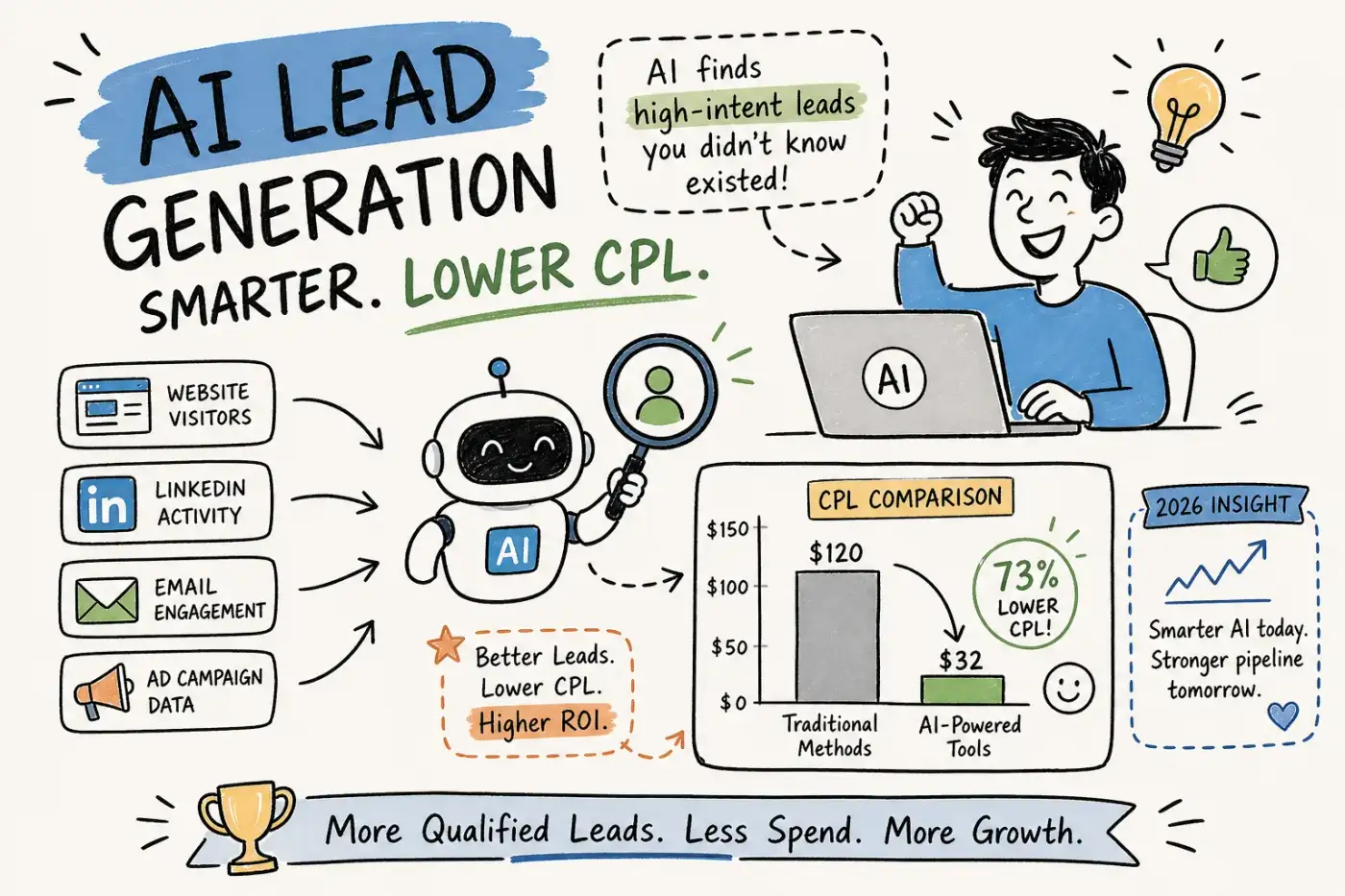
Many marketers running paid lead generation in 2026 are still budgeting like it’s 2022. They’re paying around $115 per HVAC lead and $150–$442 per MVA lead — benchmark ranges that vary by geography and lead type — and accepting those numbers as fixed costs. Meanwhile, operators who’ve layered AI lead gen tools into the same campaigns are pulling equivalent leads at a fraction of those rates. Documented campaigns show HVAC CPLs as low as $38 and legal CPL reductions of roughly 20%. The gap isn’t theory. It’s showing up in actual campaign data, and if you’re trying to figure out what is the best AI tool for generating leads online, the 2026 experiment log answers that question by use case.
This breakdown comes from the experiment log here at the 500k.io Journal — a bootstrapped founder journal documenting real lead gen campaigns across US verticals including home services and legal, with full tool costs and honest CPL reporting. What follows isn’t a software directory. It’s a matched recommendation by use case, a feature evaluation framework, real CPL benchmarks, and a pricing reality check so you know exactly which tool to test first. One disclaimer before the numbers: CPL benchmarks shift by market, season, and offer — treat every figure below as a reference point to beat, not a guarantee.
Why AI tools are collapsing cost-per-lead right now
The mechanism isn’t complicated. High CPLs have two root causes: bad data that wastes outreach budget on unqualified contacts, and slow speed-to-lead that kills conversion after the click. AI-powered lead gen tools attack both simultaneously, which is why the impact shows up fast. A 2025 Salesforce State of Sales report puts the improvement at 50% more sales-ready leads and roughly 60% lower acquisition cost when AI-driven qualification replaces manual methods.
Traditional prospecting software hits hard limits at scale. Static filter logic, single-source databases, and manual sequence management create a ceiling that human SDRs can’t push through without adding headcount. AI tools break that ceiling with NLP-based prospect discovery, waterfall enrichment across 30–100+ data sources, and predictive intent scoring that surfaces buying signals human reps routinely miss. The speed-to-lead math is equally important: the A-Team Soft Solutions case documented a response time drop from 6–8 hours down to under 2 minutes, which pushed pipeline conversion from 8% to 16.5% without changing the lead source.
Same lead source, double the conversion — speed-to-lead and data quality are the two levers, and AI tools pull both.
The 4 features that actually determine lead quality
Prospecting depth: from filter grids to natural language search
The shift from manual filter selection to NLP-powered prospecting is the single biggest efficiency gain in the current tool generation. Instead of stacking industry, headcount, and geography filters, you describe your target audience in plain language and the platform generates a matched list. Tools like Salesforge and Crono.one collapse hours of list-building into minutes using this approach. The better platforms layer lookalike modeling on top, using machine learning propensity scoring to surface buying signals that manual research would never catch.
Enrichment logic: waterfall vs. single-source pulls
Waterfall enrichment means the system queries multiple data providers in sequence until each contact field is successfully filled. Where a single-source tool might verify 40–60% of emails in a given list, waterfall systems push that to 85–95% with bounce rates under 2%. Cleanlist reports 98% email accuracy using this method. That benchmark matters directly for CPL: every dead contact in your outreach list is wasted spend, and wasted spend inflates your effective cost per qualified lead before your ad budget even gets involved.
Intent scoring and outreach automation
Rule-based lead scoring flags records based on static criteria. Predictive decay scoring uses behavioral signals — pricing page visits, content downloads, webinar attendance — to rank leads by conversion likelihood and flag stale records before you burn budget on them. The top tools then connect that scoring directly to multichannel outreach automation, orchestrating sequences across email, LinkedIn, and phone without manual handoffs, the same motion I mapped in the AI cold outbound workflow. Salesforge’s Agent Frank and platforms like Ava take this further with AI SDRs that automate the full outbound motion end-to-end.
Four features decide lead quality: NLP prospecting, waterfall enrichment, predictive scoring, and orchestrated multichannel follow-up. Everything else is UI.
Best AI lead gen tools matched to your actual use case
B2B outbound: Apollo, Clay, and ZoomInfo
Apollo is the fastest path from zero to a working outbound list. With 300M+ contacts, native Salesforce and HubSpot sync, and a free plan that includes 50 AI credits, it’s the default starting point for most lean operators. Paid tiers start at $49 per seat per month on annual billing. Clay targets operators who want custom enrichment workflows: 100+ data sources, an AI agent called Claygent for web-scraped personalization, and API-level flexibility for non-standard use cases. Clay’s pricing starts at roughly $300 per month, and it rewards more technical setups with significantly deeper enrichment logic. ZoomInfo anchors enterprise intent data and reports an 84% lift in MQLs from account prioritization, but the price point puts it out of range for most solopreneurs and small teams.
B2C and inbound: where qualification speed wins
For B2C and inbound lead flows, the prospecting problem is already solved by your ad campaign. The bottleneck is qualification speed. Leads contacted within minutes of submission convert at dramatically higher rates than those reached hours later — cases like Arahi AI document response windows under 60 seconds driving measurable conversion lifts — and no human intake team can staff that window consistently. Lindy, at $20–$50 per month, handles automated qualification conversations across channels with CRM-connected follow-up. ConversionIQ reports a 22% pipeline conversion rate within 30 days for inbound traffic, which makes it a strong benchmark for B2C operators evaluating conversational AI tools.
Where Claude and ChatGPT fit in the stack
Claude and ChatGPT aren’t standalone lead sourcing platforms. They’re CPL reducers within the workflow. Claude-generated ad copy tested in documented campaigns produced 23% higher CTR and 31% higher conversion rates compared to control copy, translating to an 18% lower cost per acquisition. ChatGPT’s lower token cost makes it the better choice for high-volume content generation: email sequences, ad variation testing, qualification scripts. The stack logic is straightforward: a specialized tool sources and enriches the lead, Claude or ChatGPT handles the language layer, and an automation tool manages follow-up timing.
Match the tool to the bottleneck: Apollo for sourcing, Lindy for qualification speed, Clay for enrichment depth — and the LLM is the language layer, never the lead source.
What is the best AI tool for generating leads online, by vertical
What the 500k.io experiments actually show
The AI Marketing category of this journal tracks live campaign data across US-based verticals including bathroom remodeling and MVA/legal. Every entry includes tool costs, CPL changes, and honest assessments of what broke. It’s a practitioner-level counterpart to vendor-produced case studies — written by a single operator actively running the campaigns, with the vertical-by-vertical playbook detailed in lead gen with AI by vertical. The numbers below come from that experiment log alongside industry aggregate benchmarks.
Home services CPL benchmarks with and without AI tooling
For HVAC and bathroom remodeling, AI-optimized lead gen operates across three distinct levers. Ad copy generation using Claude or ChatGPT for creative testing at scale pushes CTR and conversion up, which lowers the cost per click needed to produce a lead. Lead enrichment filters out non-homeowners before outreach, cutting wasted spend on contacts who can’t convert. Follow-up automation then hits the speed-to-lead window that human reps miss.
Standard paid advertising CPLs for HVAC run around $115 on Google. AI-qualified lead workflows have pushed that to $38 in documented campaigns — a 70% reduction. Bathroom remodeling falls in the $45–$110 range for standard campaigns; high-end projects above $15,000 in project value push CPL to $150–$250.
Legal and MVA: where CPL math is highest stakes
MVA and personal injury leads on Google Ads run $150–$442 per lead, with metro markets like New York and Los Angeles at the top of that range. General legal runs $132–$741. Those numbers make tool ROI easy to justify: even a 20% CPL reduction on a $325 median MVA lead saves $65 per contact, which covers most tool subscriptions in a single week of campaign volume. AI intent scoring flags in-market prospects more accurately than broad-match keywords, and outreach automation handles the follow-up volume that legal intake teams can’t staff manually without adding full-time headcount.
The higher your baseline CPL, the faster AI tooling pays for itself: a 20% cut on a $325 MVA lead covers a month of tool spend in days.
Pricing reality: what you’ll actually pay per lead
Free plans vs. paid tiers
The free plans across the top tools are built for validation, not production. Apollo’s free plan includes 50 AI credits, 2 active sequences, and no time limit. LeadIQ’s free tier gives you 500 credits and 1 user seat, with a 14-day paid trial available. Lindy’s free plan covers 10 hours per month with no expiration. Clay’s free plan provides 500 credits permanently. These limits are enough to confirm the workflow works against your specific ICP. The first paid tier is where actual testing happens, and that’s where you get the data to justify scaling.
How to calculate tool ROI before you commit
The math is simple. Take your current CPL, your close rate, and your average deal value. Model what happens if the AI tool improves lead quality by 25% — the figure cited in aggregate AI-powered lead scoring benchmarks. On a $200 home services lead with a 10% close rate and a $3,000 average job, a 25% quality improvement means fewer wasted contacts per close. On a $325 MVA lead, the ROI calculation is even cleaner. Based on the 500k.io experiment log and comparable documented SMB implementations, most operators see positive ROI within 45–60 days and a predictable pipeline within 90 days — though results vary by vertical and tool fit.
Free tiers validate, first paid tiers test, and the ROI model is three numbers: current CPL, close rate, average deal value.
How to pick your first AI lead gen tool and start testing
Picking your starting tool: three questions
Three questions determine your starting tool. Is your audience B2B or B2C? Is your bottleneck lead sourcing or lead conversion speed? What CRM are you already running? The answers map cleanly. B2B sourcing with HubSpot or Salesforce: start with Apollo. B2C inbound qualification: add a conversational AI layer like Lindy. Custom enrichment needs with some workflow-building tolerance: Clay. For most lean operators under $500 per month in total tool spend, Apollo combined with Claude for copy is a strong default starting stack — covering prospecting, enrichment, and language in one coherent system.
Where to track what’s actually working
This journal publishes ongoing experiment data from live campaigns across these exact verticals, with CPL changes, tool stack updates, and honest failure reports documented as they happen — the practitioner-level counterpart to vendor case studies, written while running the campaigns rather than summarizing them after the fact. The immediate next step is straightforward: pick one tool from the matched recommendations above, run it against your existing lead source for 30 days, and measure CPL before and after. That’s the only benchmark that matters for your specific workflow.
Three questions, one tool, one 30-day test window — then let your own CPL data decide what scales.
The bottom line on AI lead generation tools in 2026
The best AI lead gen tool is the one matched to your specific bottleneck, not the one with the most features. For most operators, Apollo handles sourcing, Claude or ChatGPT handles copy and personalization, and a lightweight automation layer handles follow-up timing. In most tested use cases — HVAC, bathroom remodeling, legal, and B2C inbound — AI-assisted workflows consistently cut cost, improve lead quality, and compress speed-to-lead when the tool is matched correctly to the problem. Figuring out what is the best AI tool for generating leads online starts with identifying that bottleneck first.
Follow the live experiment log in the AI Marketing cluster for ongoing CPL data, tool stack updates, and what’s actually working in home services, legal, and adjacent verticals.
FAQ
What is the best AI tool for generating leads online in 2026?
The one matched to your bottleneck, not the one with the most features. B2B sourcing with HubSpot or Salesforce: Apollo ($49/seat/month, free plan with 50 AI credits). B2C inbound qualification: a conversational layer like Lindy ($20–$50/month). Custom enrichment with technical tolerance: Clay (~$300/month). For most lean operators under $500/month total, Apollo + Claude for copy is the default starting stack.
How much can AI tools actually lower cost per lead?
Documented campaigns show HVAC CPLs dropping from ~$115 to $38 (a 70% reduction) and legal CPL reductions of roughly 20%. A 2025 Salesforce report puts the aggregate at 50% more sales-ready leads and ~60% lower acquisition cost when AI qualification replaces manual methods. Results vary by vertical and tool fit.
What is waterfall enrichment and why does it matter for CPL?
The system queries multiple data providers in sequence until each contact field fills. Single-source tools verify 40–60% of emails; waterfall systems push that to 85–95% with bounce rates under 2%. Every dead contact is wasted spend that inflates your effective cost per qualified lead.
Where do Claude and ChatGPT fit in a lead gen stack?
As CPL reducers, not lead sources. Claude-generated ad copy in documented campaigns produced 23% higher CTR and 31% higher conversion vs control, an 18% lower CPA. ChatGPT's lower token cost suits high-volume generation: email sequences, ad variations, qualification scripts. A specialized tool sources the lead; the LLM handles the language layer.
Why does speed-to-lead matter more than lead source?
One documented case dropped response time from 6–8 hours to under 2 minutes and pushed pipeline conversion from 8% to 16.5% — same lead source, double the conversion. Leads contacted within minutes convert at dramatically higher rates, and no human intake team staffs that window consistently.
How do I calculate AI tool ROI before committing?
Take current CPL, close rate, and average deal value; model a 25% lead-quality improvement (the aggregate AI scoring benchmark). On a $325 median MVA lead, a 20% CPL cut saves $65 per contact — covering most tool subscriptions in a week of campaign volume. Most operators see positive ROI in 45–60 days.