
The average media buyer salary in the United States is $66,414 per year as of mid-2026, or about $5,534 per month before bonuses or profit share. That baseline is practically useless for a founder scaling past $3M in revenue because it prices access to an ads manager, not profitable acquisition strategy, creative direction, tracking diagnosis, or the capacity to scale spend without damaging efficiency.
A media buyer is a performance operator who allocates paid traffic budgets, tests creative and audiences, reads commercial signals, and changes campaigns against profit targets. The salary figure matters, but the economics of the role matter more.
What is the average media buyer salary in 2026
The cleanest United States benchmark is $66,414 a year, according to ZipRecruitter’s July 2026 salary estimate. The same source converts that figure to roughly $31.93 per hour, $1,277 per week, or $5,534 per month, before bonuses or profit share.
Other aggregators land in a similar range, though they measure different samples. Indeed reports $72,597 annually from 454 salary postings updated in October 2025, while the AAF Career Center lists an average of $68,924, equivalent to $33.14 per hour. For England, Indeed reports £36,588 per year based on 67 salaries updated in August 2026.
Those figures answer the employment question. They do not settle the hiring decision.
A generalist buyer may handle campaign builds, pacing, reporting, and routine optimisation. A senior operator managing substantial budgets must also connect creative production with performance data, distinguish tracking faults from demand problems, assess incrementality, and allocate spend against contribution margin. The title stays similar. The commercial exposure does not.
Practical rule: Salary buys capacity. It does not automatically buy judgement.
Why the benchmark breaks at scale
The AAF distribution places the bottom 10% near $45,800 and the top 10% near $85,000. That spread reflects experience and market structure, but one title still covers materially different jobs.
Adjusting existing campaigns is one role. Shaping the testing roadmap, directing creative angles, repairing measurement, and owning allocation across acquisition channels is another. The second role carries greater commercial risk, so compensation should reflect decision quality and scope rather than platform access alone.
Founders should use the average media buyer salary as a reference point, not as the full hiring budget. For a brand spending $30,000 or more per month on paid traffic, the comparison is an employee’s total operating cost against an agency retainer or a broader paid acquisition function.
Map the work before opening a requisition. If the role includes media buying, creative strategy, landing-page analysis, tracking repair, and executive reporting, one salary figure will understate the requirement. Compare that operating model with Crank11’s transparent pricing options, then choose between an employee, a fractional specialist, or a wider delivery structure.
How do channel and seniority change media buyer pay
Seniority and channel complexity affect pay more than the title alone. A junior buyer executing defined tasks and a senior operator responsible for acquisition decisions may both be called media buyers, while their commercial value and compensation differ substantially.
The market shows a wide range. Entry-level buyers generally sit in the $45,000 to $60,000 band, mid-level buyers near $70,000 to $90,000, and senior buyers can exceed $100,000 in high-spend or performance-linked environments. Treat these figures as directional bands, not a promise attached to a channel or job title.
Compensation by operating responsibility
| Seniority level | Primary channel focus | Estimated base salary band |
|---|---|---|
| Junior | Assisted campaign execution across one channel | $45,000 to $60,000 |
| Mid-level | Independent management across a core channel and supporting tests | Near $70,000 to $90,000 |
| Senior | High-spend, multi-channel or performance-linked acquisition | Above $100,000 |
Channel specialisation changes the work. A search-focused buyer may spend much of the week improving query quality, bidding signals, and landing-page alignment. A paid social specialist may turn creative results into production briefs, identify fatigue, and connect asset quality with auction performance. A short-form video specialist works to a different testing cadence and must judge whether creative variation, audience response, or offer strength explains the result.
The channel does not set the compensation by itself. Pay for the business problem the person can solve. Someone who can export polished platform reports is not a senior buyer unless they can diagnose performance, choose the next test, and protect contribution margin while spending meaningful budget.
For brands spending $30,000 or more per month on paid traffic, this distinction changes the hiring decision. A junior buyer may provide execution capacity at a lower salary, while a senior buyer may justify a premium by improving allocation, measurement, creative feedback, and testing quality. Compare that cost with an agency retainer, but define the work on both sides first. Paying for channel access without decision-making ability creates an expensive gap.
What to test before paying the premium
Ask candidates to explain a failed account diagnosis without hiding behind platform terminology. Strong answers separate measurement, offer, creative, audience, and budget-allocation issues. They also explain what evidence would confirm or reject each hypothesis.
Use our guide to auditing your own ad account to create a consistent review exercise. Give each candidate the same account context, then assess their order of operations, hypothesis quality, and ability to protect commercial metrics during testing.
The premium belongs to people who make fewer expensive decisions, not to people who claim familiarity with more buttons.
How much does an in-house media buyer actually cost
Base salary is only the starting point. Hiring cost includes employer contributions, benefits, software, equipment, recruitment, management time, and the period before a new employee produces useful work.
The salary benchmark was established earlier. Use it as the base input, then add the costs from your own finance records. One published benchmark places the average at $68,924, while another estimate places it at $66,414. Those figures describe salary, not the full cost of employing the person.
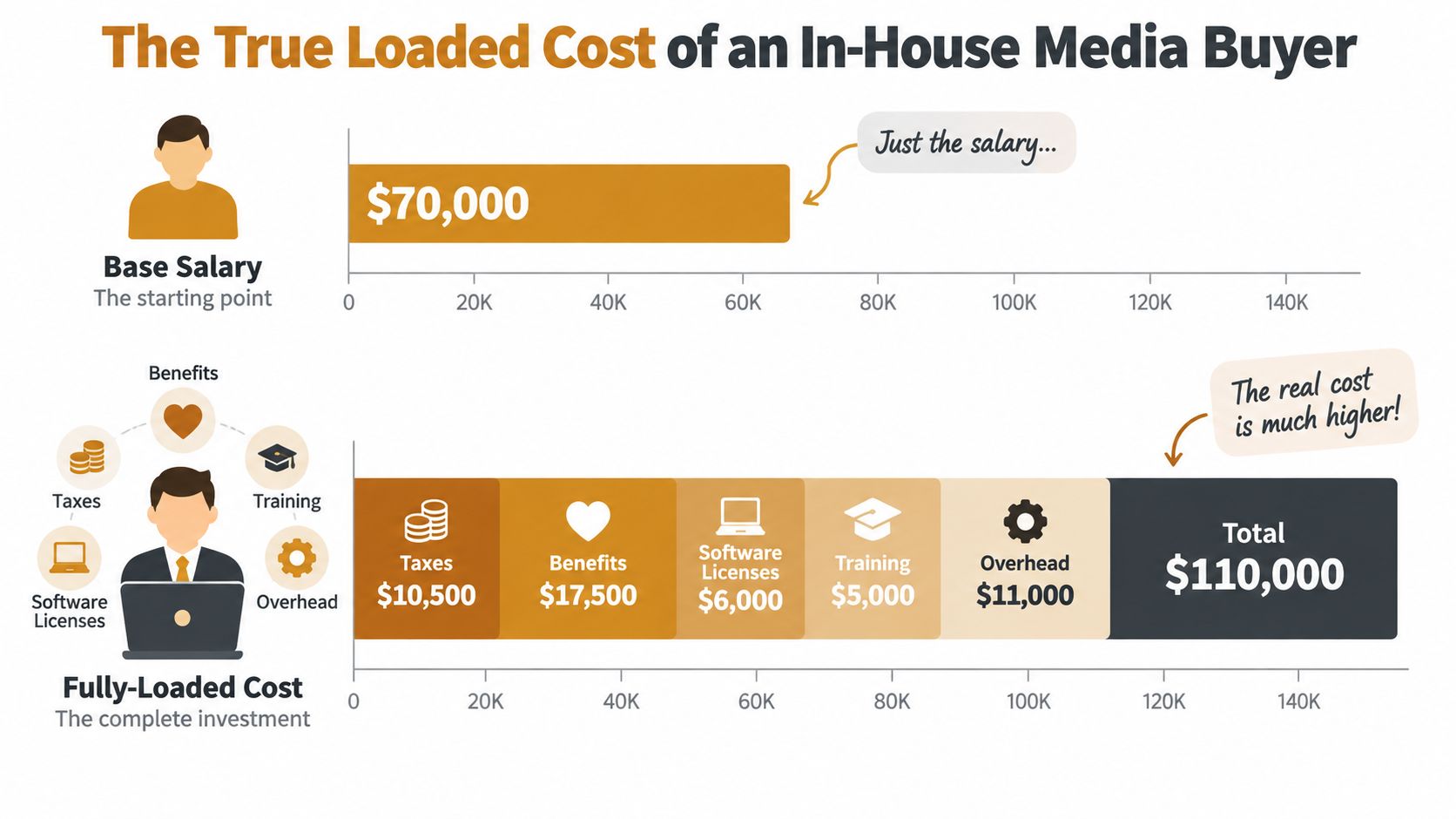
The loaded-cost calculation
Use this formula:
Fully loaded annual cost = base salary + employer costs + benefits + software and equipment + recruitment cost + management allocation.
For a worked example, use the United States average of $68,924 per year as the salary input. If employer costs equal $X, benefits equal $Y, software and equipment equal $Z, recruitment equals $R, and management allocation equals $M, then:
$68,924 + X + Y + Z + R + M = total annual cost.
Divide the result by 12 to find the monthly employment cost. This method keeps every assumption visible and avoids importing an unsupported overhead percentage. It also makes the comparison fair when a founder is weighing an employee against an agency retainer.
For a brand spending $50,000 per month, calculate the employment cost as a share of media spend:
Monthly loaded employment cost ÷ $50,000 monthly ad spend = employment cost as a share of media spend.
That ratio shows the cost of the hire before creative production, conversion-rate optimisation, analytics support, or leadership time. It does not show whether the buyer will improve contribution margin. Salary is an operating input, not proof of commercial performance.
Compare the function, not the invoice
An agency retainer can include campaign management, creative input, asset production, tracking, analysis, landing-page work, reporting, and senior review. An employee may appear cheaper while the founder or internal team supplies those missing capabilities without recording the time as a cost.
Define the scope on both sides. List who owns campaign changes, creative strategy, asset production, tracking, experimentation, reporting, and leadership. Then use agency versus in-house cost maths to compare the same workload against your actual requirements.
A low-salary hire without creative or analytical support can become an expensive coordinator.
For brands spending over $30,000 per month on paid traffic, the decision comes down to utilisation and capability. In-house hiring fits a steady workload that can keep the right operator fully engaged. An agency fits a situation where the business needs several specialist functions before separate hires make financial sense.
The right comparison is fully loaded cost against delivered scope, decision quality, and the amount of management the business must provide.
How to structure performance bonuses for paid media teams
Bonuses should reward incremental profit, not attractive platform metrics. Raw ROAS can encourage a buyer to cut spend, avoid new tests and protect a ratio that says little about total contribution.
Start with a baseline agreed before the bonus period. Name the inputs:
- Baseline contribution profit, the profit level the business expects without the bonus.
- Measured incremental contribution profit, calculated after variable costs and validated against the agreed measurement method.
- Bonus rate, the share paid on profit above baseline.
- Cap and review period, approved before campaigns run.
The formula is:
Performance bonus = (incremental contribution profit above baseline) × bonus rate.
Example: if measured incremental contribution profit is £A, baseline contribution profit is £B, and the agreed bonus rate is C%, then:
(£A minus £B) × C% = bonus for the period.
Use your actual figures. The verified data contains no universal bonus rate, so setting one here would be fiction disguised as precision.
Why revenue and ROAS create bad behaviour
Revenue rewards spending, even when margin deteriorates. ROAS rewards efficiency, even when the buyer could profitably spend more. MER can help at company level, but it still needs a contribution-margin context and a clear view of non-paid demand.
A sound package combines a stable salary with a measured profit component. Senior growth leaders may also receive equity with documented vesting terms, but the commercial logic should remain explicit. Ownership shouldn’t replace basic accountability.
Contractors need a different structure. Pay for a defined scope, response standard and decision ownership, then add a performance component only where the buyer can influence the result and the measurement window is fair.
Creative supply belongs in the model. If the account is starved of new assets, blaming the buyer for fatigue is lazy. Our creative production maths helps separate buying skill from the production constraint that limits it.
What to look for when hiring a senior media buyer
Don’t hire for certificates. Hire for diagnosis. Automated bidding has reduced the value of repetitive manual adjustments, while creative quality, measurement integrity, budget allocation and cross-channel judgement have become harder to fake.
A senior candidate should pass a practical assessment before discussing a premium package. Give them a controlled account snapshot and ask for a prioritised action plan. Don’t reward the longest list of changes.
The senior buyer checklist
-
Finds measurement faults first. They check event quality, attribution gaps and reporting consistency before declaring a campaign winner or loser.
-
Builds a creative feedback loop. They can turn hook, angle and offer-level signals into a production brief, rather than asking for more ads without direction.
-
Allocates budget commercially. They explain why money should move, what evidence would change their mind and how they balance efficiency with scale.
-
Understands incrementality. They know platform-reported conversions aren’t the same as additional demand, and they can design a test that acknowledges that limitation.
-
Works across channels. They don’t need to be a master of every platform, but they must understand how channel interactions affect blended acquisition economics.
-
Uses automation without surrendering judgement. Tool proficiency matters only if the operator can set guardrails, inspect outputs and reverse poor decisions.
The interview question that exposes weakness
Ask: “Your reported ROAS improves while contribution margin falls. What do you inspect first, and what decision do you make?”
A weak buyer reaches for another bid adjustment. A strong buyer asks about margin, attribution, product mix, discounting, conversion quality and spend distribution before proposing a change.
Use a live-account exercise, not a polished portfolio. Our paid social agency evaluation guide applies the same principle to external partners. The operator should show how they think under incomplete information.
Crank11 uses senior operators to connect creative, paid media, funnels and CRO, with no junior staffing on accounts. That model isn’t automatically right for every brand, but the standard is useful: pay for decision quality and clear ownership, not activity theatre.
Quick answers on media buyer compensation and hiring
What is the average media buyer salary in the United States?
The clearest mid-2026 benchmark is $66,414 annually, or about $5,534 monthly, according to ZipRecruitter’s July 2026 estimate. Other estimates place average pay between the mid-$60,000s and low-$70,000s. Treat that range as a hiring input, not a complete cost model.
Does a senior media buyer earn more than the average?
Yes. AAF places the top 10% near $85,000, with senior buyers reaching above $100,000 in high-spend or performance-linked roles. The premium pays for broader ownership, harder decisions and commercial accountability.
Should a founder hire a junior buyer for a $100,000 monthly budget?
A junior buyer should not be the sole owner. They can execute inside a supervised system, but a large budget needs senior review, reliable measurement and clear escalation. Otherwise, the apparent salary saving can become an expensive learning curve.
Is a technical buyer worth more than a creative strategist?
Neither title guarantees value. Technical buyers protect tracking and campaign structure. Creative strategists improve testing and message development. Hire around the constraint currently limiting growth, then assign one person clear ownership of that problem.
When should a brand move from an agency to in-house?
Move in-house when workload is steady, scope is defined and the surrounding functions are covered. For brands spending over $30k a month on paid traffic, compare the loaded employee cost with the agency retainer and the cost of replacing missing creative, analytics or conversion-rate skills. Stay external when you need several specialists but not enough continuous work to keep each one occupied.
What should founders do tomorrow morning?
Map the full role, calculate loaded monthly cost and compare it with the complete function, not salary alone. An agency retainer may cost more on paper, while an employee may require additional specialists and management. Crank11 combines paid media, creative, funnels and CRO for brands investing heavily in acquisition. Review Crank11 as one external operating model before choosing.